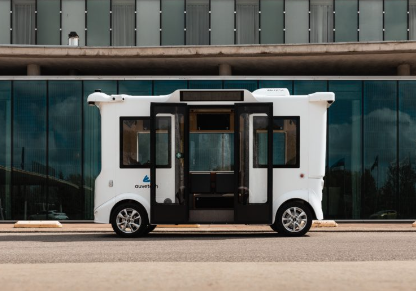
An autonomous shuttle bus designed and built entirely in the European Union is finding its biggest markets in Japan, the Middle East, and the United States – not in Europe. Why is this the case, asks Euronews.
The MiCa, which seats eight passengers and operates up to 20 hours daily in self-driving mode at speeds reaching 25 km/h, represents a paradox: European innovation thriving everywhere except on its home continent.
The shuttle bus is heavily equipped with up-to-date technology, including sensors, LiDARs, cameras and, lately, improved software that enables artificial intelligence (AI)-based dynamic reaction to objects, overtaking vehicle detection or side detection.
“When the vehicle understands what’s around it, then it’s able to see where the road is, see where the possible objects are moving, where the crosswalk is, where the intersection is”, explained Kristjan Vilipõld, product manager at AuVe Tech OÜ, the Estonian company behind the shuttle development.

“Based on that and the next stop the bus is going to, the system is able to plan a path for its route,” he added.
In a European premiere last month, developers were allowed to conduct tests in Tallinn International Airport.
The vehicle could help transport maintenance staff around aircraft hangars 24/7 in cost-effective and environmentally efficient ways, managers claim. During the tests, autonomous prototypes have driven 2.150 km and transported 215 passengers around the airport’s runways.
The company was founded in 2018 in cooperation with Tallinn University of Technology.
Its self-driving vehicles have so far operated in 17 countries, including several in Europe as well as in Japan, the United States, Israel, Saudi Arabia and the United Arab Emirates.
Yet, by far the most advanced projects are currently not to be found in European markets, but in the Middle East and in Asia, especially in Japan.
Managers blame first a lack of government funding in autonomous vehicles and an overall lack of strategy in the sector in the EU.
“In Japan, for example, they provide a very clear goal where the autonomous vehicles have to operate: let´s say 50-60 locations by the year 2027. China has significant investments. In Europe, we have been a little more conservative”, said Johannes Mossov, member of the management board at Auve Tech.”
Click HERE for the full article.
(Picture: Courtesy AuVe Tech)