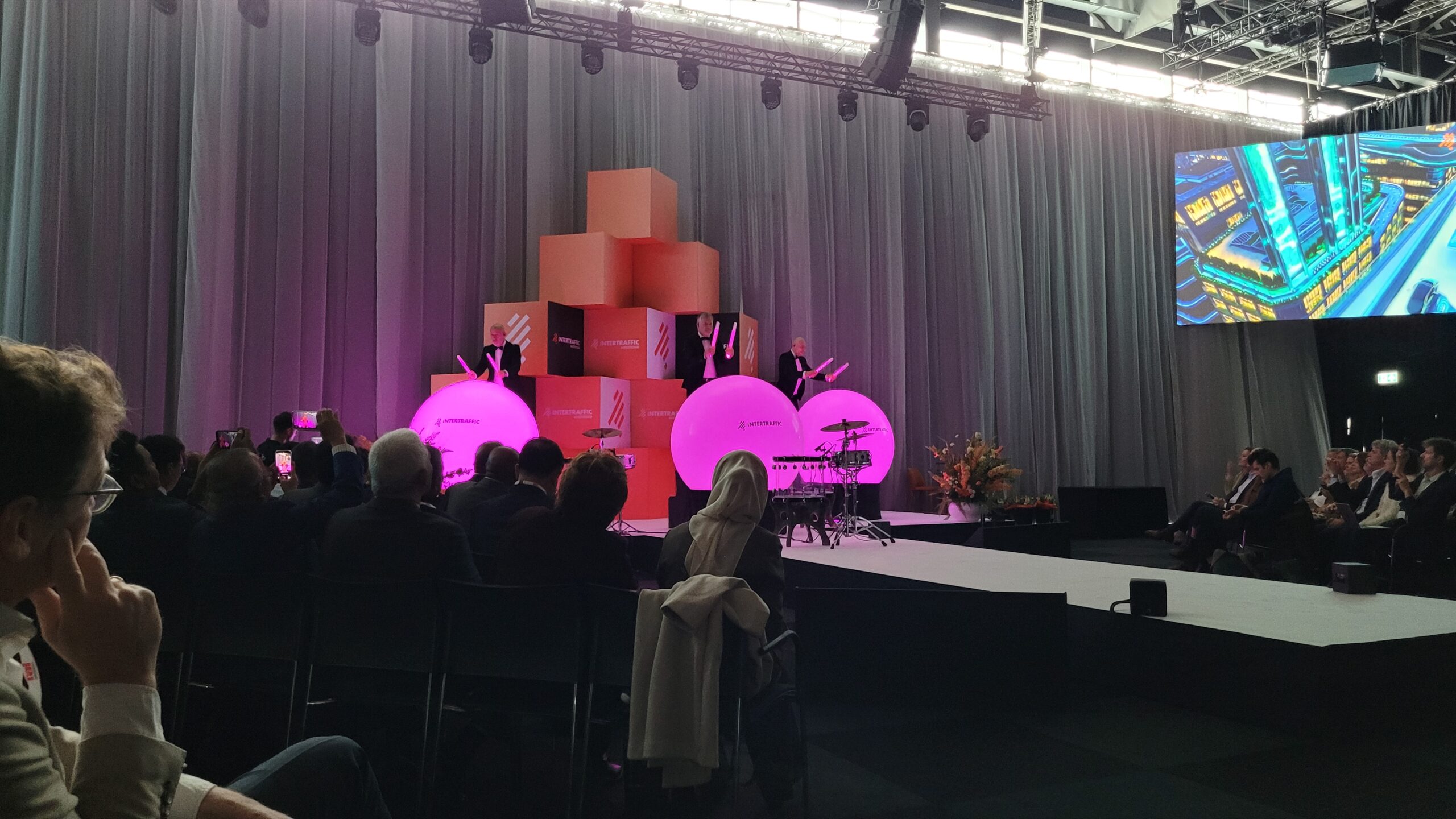
Intertraffic Amsterdam 2026 kicked off (literally) in style with a performance by an ear-splitting drum trio and the audience bouncing three giant (and surprisingly heavy) balloons around Summit Theatre 1. The theatrics and light-hearted sensory overload aside, the main event, as with every iteration of Intertraffic Amsterdam, was the announcement of the winners of the four Intertraffic Awards.
Presented by the chair of the judging panel, CROW’s Peiter Litjens, the winners were three groundbreaking innovations in the Green Globe, Inspiration and User Experience categories. The new ITSUP Startup Award and a Special Jury Mention completed the event’s recognitions.
• The Green Globe Award – recognising environmental sustainability – was claimed by MB Air by HR Groep Streetcare, the world’s first CE-certified compressed-air bicycle parking-lift system.
• The Inspiration Award went to Deltabloc TAM Technology by Deltabloc International, a revolutionary fibre optic sensing platform capable of monitoring traffic across 50km of road in real time.
• The User Experience Award was awarded to TLEX Interchange by Monotch, a cloud-native engine for seamlessly setting up real-time, low-latency mobility data exchange.
• Luxene claimed the ITSUP Startup Award for its innovative laser-driven, fibre-optic road-marking system.
• A Special Jury Mention was given to NavTac Temporary Tactile Guidance Films by Brite-Line.

Said Litjens:
“This year’s selection process was made particularly compelling both by the rich mix of solution types as well as the passion that lay behind all of the nominations that made it to the final 15 – all of whom had presented their solutions to the panel across an entire day at the RAI exhibition centre, ahead of Intertraffic Amsterdam.
“It was great to see the combination of innovation, heartfelt presentations, and the inspiring nature of the people who are behind them,” says Litjens. “There are people behind each of these innovations who are inventing and making them. And they’re not only making them to make profit or to sell something. They are making these solutions because they believe in better, safer traffic, or a better world, or a sustainable surrounding. That’s what I like most.”

Litjens also highlighted the breadth of the shortlist. “We saw a lot of technical applications – software, hardware inventions – all very technical. But I also liked the mix between high tech and also some low tech, very simple inventions that really make an impact – and can contribute to inclusivity in society.”
On the technology side it was notable that two of the four award recipients – Deltabloc TAM and Luxene – employ fibre optic technology, albeit in entirely different applications. Deltabloc uses distributed fibre optic sensing cables embedded alongside or within road surfaces to detect vehicle vibrations and translate them into rich traffic data, while Luxene embeds laser-driven, side-emitting glass fibres directly into road markings to provide continuous visual guidance in rain, snow and darkness. The jury observed that the two technologies could, in theory, be complementary on future road infrastructure projects.
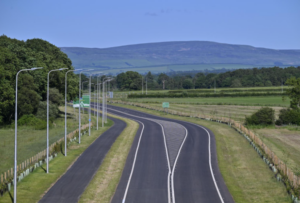
Of particular interest to Highways News’ UK readers was Deltabloc’s triumph. Deltabloc TAM brings distributed fibre optic sensing – technology previously used in pipeline and earthquake monitoring – to the field of traffic management. A single interrogator unit connected to up to 50km of sensing cable, placed alongside or beneath the road surface, detects the vibrations created by passing vehicles and translates them via AI and machine learning into comprehensive traffic data: speed, counting, braking behaviour, overtaking events, traffic jam formation and more.
The system requires no gantries, no cameras, no local power supply and no complex cabling infrastructure beyond the fibre itself. The jury found the technology completely new and groundbreaking, a key factor in earning it the award. Close attention will now be paid to real-world testing, some of which has already been conducted in Germany, Belgium, Slovenia, Latvia and the UK.
(Pictures: Kevin Borras/Highways News)