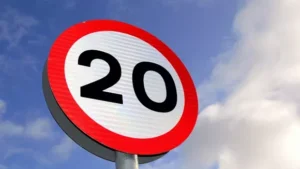

Speed limits on country lanes in rural towns and villages in England “should be no more” than 20mph, according to new government guidance. The 20mph limit has been recommended for walking and cycling routes that form part of the Active Travel Network, with new guidance also suggesting that councils in rural areas should narrow roads, use more bollards and remove the centre line separating traffic lanes, reports The Times.
It added that councils in rural areas should consider narrowing roads, using more bollards, and removing the centre line separating the two lanes of traffic as measures to lower speeds. Currently, most country lanes are derestricted, meaning they are subject to the national speed limit of 60mph. However, many drivers choose to travel at lower speeds due to the nature of the roads.
The measures are outlined in a new Rural Design Guide by Active Travel England, a Department for Transport agency responsible for promoting walking and cycling.

Although councils are not legally compelled to follow its guidance, the 253-page document is intended to promote “best practice” to help them design better infrastructure in their area.
In 2023, Wales became the first UK nation to introduce a default 20mph speed limit on restricted roads. A report last year showed casualties had dropped by more than 10 per cent but initial polling suggested it was unpopular.
In England, many of London’s roads have a 20mph speed limit, but in rural areas the rollout has been more limited. Parts of Surrey and Oxfordshire have reduced the speed limit on some country lanes from 60mph to 20mph.
The document said almost 10 million people, about 17 per cent of England’s population, live in an area defined as rural. In 2024, almost two thirds of all road deaths in Great Britain occurred on rural roads, despite carrying less traffic than urban areas.
The new guidelines said that where people “walking, wheeling and cycling share space on country lanes with motor traffic, traffic speed should be no more than around 20mph”
It added that by doing this local authorities can reduce traffic because the reduced speed will make the road “less attractive” for drivers.
It also said that traffic speed “should be no more than 20mph” in rural settlements and villages, with the limit also recommended for routes that form part of the “active travel network” — routes designed around walking and cycling.
The guidance noted that local authorities are “best placed” to decide where such limits will work but said a “whole-settlement 20mph limit” may prove cheaper and cause less confusion for motorists. It also advised interventions by councils that can reduce speeds of motorists including removing “centre lines” on carriageways, narrowing roads by creating a footway, putting a textured strip in the middle of the road or using islands or bollards.
Kazimieras Urbonas, car expert and Supplier Excellence Manager at Ovoko told Highways News:
“As MPs examine the role of 20mph limits in the Government’s Road Safety Strategy, it is important that the discussion considers the full evidence rather than relying on a single headline figure. The fall in overall collisions is encouraging, but the increase in collisions recorded as serious deserves closer examination. These records do not explain what caused either change, so they should not be treated as evidence for or against a particular speed limit. Whatever limit applies, drivers still need to respond to the conditions around them rather than treating the posted speed as a target.
“Slowing down early near junctions and crossings, leaving a greater following distance and giving cyclists at least 1.5 metres when overtaking at speeds of up to 30mph can create more time for everyone to react. Vehicle condition also matters, as a valid MOT does not guarantee that a car will remain safe between tests. Regular checks of tyres, brakes, lights, mirrors and the windscreen remain important.”
Chris Boardman, the former Olympic cyclist and now the national Active Travel Commissioner, said:
“20mph is a tool to be used. If you have people mixing in areas where you want to see more people walking and cycling that’s not gonna happen if you have them mixing in a confined space with high speeds then that becomes a local choice.”
In an interview with The Times, he added:
“If you don’t want to give up those few seconds in a car then you’re gonna have to keep running your kids to school because they haven’t got another choice. Or you can go and campaign really hard to get your local paths made so they don’t have to mix but pick one. Drop the speeds or you’ve got to have another route or you accept the status quo.”
(Picture: Welsh Government)