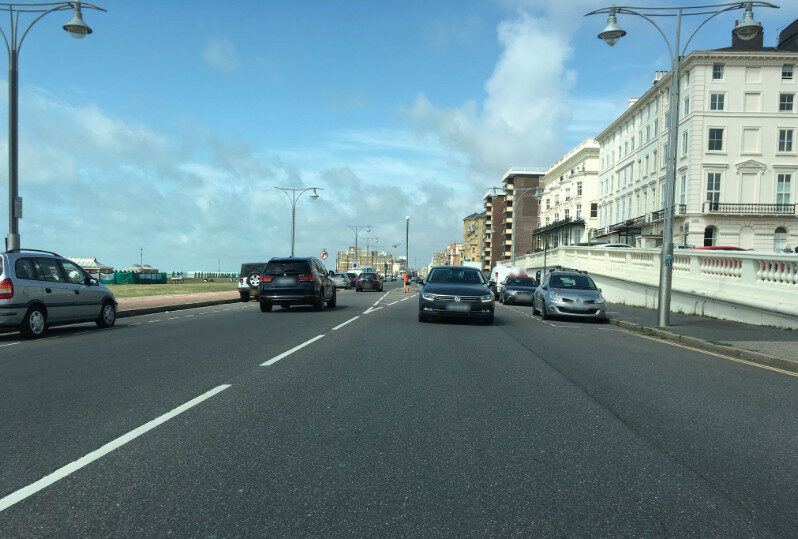
Brighton & Hove Council has created a clear, evidence-led pathway to deliver a high-impact active travel scheme that meets the needs of residents, businesses, and visitors alike, using VivaCityʼs AI solutions.
Brighton & Hove is known for its active travel culture, but along parts of the A259, there was no dedicated cycling infrastructure. Cyclists often shared narrow pavements or mixed with heavy traffic, especially near the Shoreham Port access routes. The council faced a complex challenge: deliver safe and direct cycling connections, improve pedestrian access, and ensure that traffic flow on this key coastal route remained smooth.
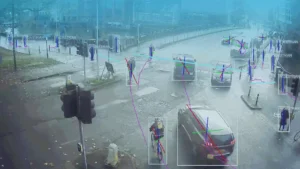
To achieve this balance, decisions needed to be firmly rooted in evidence. The project team needed highly accurate, real-world data on how people and vehicles were already using the corridor across different times, seasons, and junctions, to inform design choices and build confidence among councillors, stakeholders, and the public. Brighton & Hove City Council worked with VivaCity to deploy five AI-powered sensors along key points of the corridor, capturing anonymised multimodal data on pedestrians, cyclists, and vehicles. These sensors provided continuous monitoring, helping the council:
• Understand baseline conditions – Classified counts (volumes) and turning counts data across four major junctions, three of which lie on the Shoreham Port access route.
• Identify pressure points and conflict zones – Where pedestrians and cyclists competed for space or where safety risks were highest.
• Test design impacts – By analysing turning counts and traffic flow distributions, the council could model and justify changes, such as lane reallocations or turn restrictions, without compromising capacity.
The data revealed clear patterns that guided design decisions:
• Low pedestrian use, high informal cycling: On a section where the pavement will be widened into a shared-use path, sensors confirmed very low footfall but up to 100 cyclists a day already using the space informally due to perceived on-road danger.
• Demand follows safe design: Where protected infrastructure already exists (such as near Hove Lagoon), counts reached 1,000 – 1,500 cyclists per day, compared with only a few hundred using the adjacent unprotected road.
• Targeted junction redesigns: Turning counts showed that a proposed left-turn ban at the busy Hove Street junction would affect only a few hundred vehicles daily but protect a higher number of cyclists already making this direct crossing, and many more cyclists who currently follow an indirect route around this junction. The evidence helped build support among councillors and partners, including developers at the nearby King Alfred Leisure Centre.
• Efficient lane reallocation: Classified counts data confirmed that 80% of vehicles used the outer lane, validating the decision to remove a redundant inside lane to create space for cycling without affecting capacity.
Armed with solid evidence, the council entered consultation confidently. The result was overwhelmingly positive with over 60% of respondents supporting the upgraded cycle route. For an active travel scheme of this scale, that level of support is remarkable. The ability to visualise and share data during engagement sessions helped address common concerns (“no one uses cycle lanesˮ, “it will cause congestionˮ) with transparent, location-specific evidence.
Jasmin Barnicoat, Senior Project Manager for the scheme, explained:
“Having VivaCityʼs high quality, multimodal data to back up our design decisions has been invaluable. We could show exactly how the space is used, quantify low-use lanes or turning movements, and demonstrate that our proposals minimise impact on traffic while improving safety for cyclists and pedestrians. Which in turn supports active travel and our long-term vision for the area. The data let us show residents that weʼre designing based on how people actually move through the space. It gave credibility to our decisions and helped turn what could have been a contentious project into one thatʼs widely supported.ˮ
Mark Nicholson, CEO at VivaCity, commented:
“Weʼre thrilled to be working with Brighton & Hove City Council on a project that so clearly demonstrates how data can build confidence in change. By capturing accurate baseline data and continuing monitoring through to delivery, the council is ensuring that every design decision is backed by evidence and is reflecting the public best interest and desire. This approach not only helps secure funding and political support, but also ensures public money is spent wisely to benefit the local community and economy. VivaCity is very proud to have its data at the heart of providing this evidence that will support safer, more sustainable journeys for Hoveʼs infamous seafront.ˮ
onstruction is expected to start in 2026, phased to account for summer tourism and local demand. Post-implementation monitoring will continue for at least three years to measure success, with VivaCity sensors remaining in place to track modal shifts, safety improvements, and network performance. By integrating continuous data from the outset, Brighton & Hove City Council has built a blueprint for how evidence-driven design can help local authorities deliver ambitious, people-focused transport schemes that stand up to public scrutiny and political challenge.
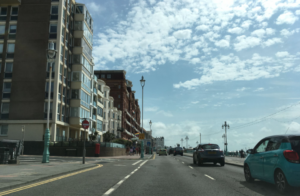
(Picture: Mapillary)