
Significant progress is being made in delivering Greater Manchester’s investment-led, non-charging Clean Air Plan, with bus fleet electrification, clean taxi upgrades and local traffic measures being delivered at pace.
An update to the Air Quality Administration Committee next week sets out that the city region is delivering all the measures agreed with government to meet legal limits for nitrogen dioxide (NO₂), in line with legal requirements and without the need for a charging Clean Air Zone.
The committee will also be asked to agree that the ANPR cameras installed for the Clean Air Zone are transferred to Greater Manchester Police to help tackle serious crime and keep communities safe, after nearly 90% backed the plans during public consultation.
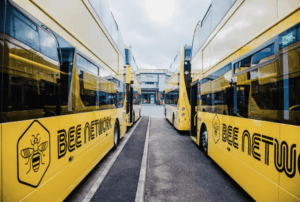
Greater Manchester’s move to a fully electric bus fleet by the end of the decade is supported by £51.1m of government-approved Clean Air funding that is delivering:
• 78 additional zero emission buses: With 20 already on the roads and running from the newly electrified Bolton depot, and 58 more electric buses coming to key routes throughout the spring. This includes the 8 and 10 service from April and V1 and V2 from May.
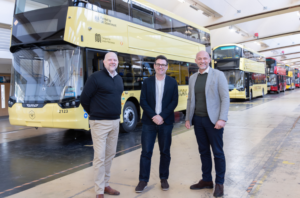
• Depot electrification: Completed at Bolton depot, providing 24 new dual chargers and capacity for up to 98 electric buses. New chargers have also been installed on Piccadilly approach so that more electric buses can run on the free bus city centre service. These upgrades are in addition to electrification of other depots across Greater Manchester, including fully electric depots at Ashton and Middleton.
Cllr Eamonn O’Brien, Leader of Bury Council and Clean Air lead for Greater Manchester, said:
“We are determined to meet our legal obligations and improve public health for all our residents. Since taking back control of local buses through the transformational Bee Network, we’ve been able to run cleaner and zero-emission buses on routes where they are most needed to improve air quality.
“This is about improving air quality in the right way. Our investment-led approach means we are on track to deliver cleaner air without a charging zone and without placing financial pressure on residents or businesses.
“Through the rollout of new zero-emission buses, alongside grants for black cab drivers to upgrade their vehicles, we’re showing exactly what an investment-led plan can achieve: cleaner air, modern public transport and a fairer approach for local people.”
Alongside delivery of the investment-led plan – which is fully funded by central government – proposals to transfer Clean Air-funded Automatic Number Plate Recognition (ANPR) cameras to Greater Manchester Police to help tackle crime received high levels of support from the public.
Almost nine out of 10 (89.7%) responses supported the plans during a recent six-week consultation. Camera data has already been used to help develop the Clean Air Plan and will continue to be used to monitor the efficiency of the plan in tackling harmful nitrogen dioxide on local roads.
(Picture: TfGM)