INRIX has announced a major expansion of its Traffic family of products, delivering innovative AI-driven capabilities to help transportation agencies and logistics organizations move from reactive traffic management to proactive, safety-focused and efficient operations.
In 2019, INRIX launched AI Traffic – the world’s first traffic platform to leverage deep learning models and AI to improve the quality and analysis globally. Now, INRIX is launching a new generation of automation and intelligence to help agencies and enterprises move faster from analyzing data to making decisions.
These capabilities enable customers to shift from reactive real-time operations to more proactive, safety-focused planning – responding faster to incidents, surfacing risks earlier, and operating with greater confidence in the accuracy and consistency of the data. Together, these investments define the newest INRIX generation of Traffic products, setting a stronger foundation for scalable, trustworthy traffic operations.
“Transportation professionals are being asked to do more with fewer resources, while also delivering safer and more reliable roads,” said Bryan Mistele, CEO of INRIX. “We continue to invest heavily in AI across our Traffic product family to improve everyday workflows, helping cities, businesses and government agencies move faster from data to decisions, history to predictions, and insight to action.”
AI-Generated Radio Traffic Reports
INRIX is extending the same AI-first innovation behind INRIX Compass into the media world with INRIX AI Traffic Reporter: a fully automated product that transforms validated incident intelligence and connected-vehicle signals into broadcast-ready traffic bulletins, using advanced generative AI. Designed for radio networks, the system produces consistent, natural-sounding, human‑like updates at scale, day or night, so partners can move faster from raw events to ready-to-air reporting without the bottlenecks of manual scripting.
Average Daily Traffic Goes Global
INRIX expanded its global traffic intelligence portfolio with the launch of Volume Profiles globally. Built on an innovative multi‑source, normalization‑based AI model and validated against ground-truth data, Volume Profiles provides directional, time‑of‑day, and day‑of‑week vehicle volumes in 15‑minute increments, enabling agencies and businesses to replace costly manual counts with consistent, continuously updated insights. The product delivers monthly, quarterly, and annual profiles that support transportation planning, safety analysis, site selection, and performance monitoring – while removing reliance on any single data provider and improving stability across markets. INRIX has already released Volume Profiles in Canada and the UK, with expanded coverage to Germany, Spain, France, Italy, and Sweden in 2026.
Expanded Insights with Observed Speeds
INRIX Speed Distribution Profiles marked a major step forward in how transportation agencies understand and manage speeding risk. Unlike traditional speed datasets that rely on averages or isolated field studies, Speed Distribution Profiles provide a full statistical view of observed vehicle speeds – by roadway, direction, time of day, and day of week – using connected vehicle data collected across the road network. This percentile‑based approach allows agencies to move beyond snapshots and identify systemic speeding behavior, pinpoint high‑risk corridors, and evaluate the effectiveness of policy, enforcement, and roadway design changes using real‑world evidence.
Strengthening Map Agnostic Incident Support
INRIX is expanding the use of OpenLR‑based location-referencing to deliver more consistent, map‑agnostic traffic and incident intelligence globally. New innovations will enable INRIX to deliver incident intelligence across all roads – regardless of proprietary map segments or Traffic Message Channel (TMC) coverage. By improving how incidents are dynamically referenced on off‑TMC roads and slip roads, INRIX can accurately tie events to entry, exit, and connector roadways rather than generalized to nearby mainlines. These improvements reinforce a completely map‑agnostic, future‑proof approach to traffic intelligence, delivering consistent, high‑fidelity incident data across diverse road geometries and customer map ecosystems.
Modernizing Traffic Signals with AI Analytics
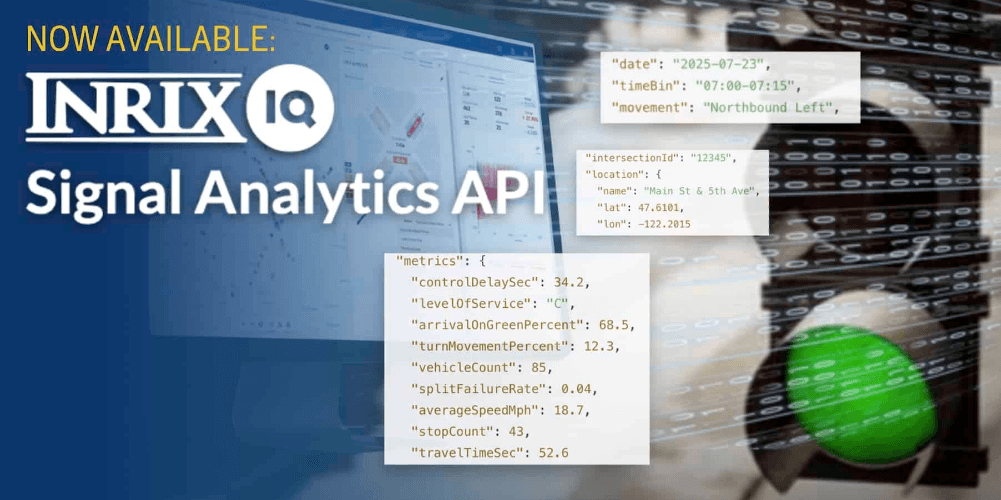
New innovations also include significant enhancements to INRIX Signal Analytics, helping agencies move beyond periodic retiming studies toward continuous data. Enhancements focused on making it easier for traffic engineers to monitor performance at scale, identify issues faster, and evaluate the real-world impact of signal timing changes – without relying on costly field equipment or manual data collection.
(Picture: INRIX)