The Transport Committee has launched a new inquiry into how transport services and investment can be planned to best meet the needs of the public.
The ‘Joined-up Journeys’ inquiry will investigate how the Government can achieve, and measure the benefits of, better integration between transport services throughout the country.
The inquiry will look at how people can make better and more informed journey choices by positively choosing between, and combining, different forms of transport depending on their needs.
Joining up transport could involve ways of making journeys more seamless by having combined tickets, coordinated timetables, travel hubs, and tools like parking apps that aren’t restricted to one area. Better information for travellers through real-time journey planning services like Google Maps and Citymapper is also part of the picture.
The cross-party Committee will examine how methodologies for appraising the value for money of transport investment could be better at capturing the potential benefits of integrated transport networks, including the Government’s aims such as economic growth or reducing carbon emissions.
The Government plans to publish an ‘Integrated National Transport Strategy’ that will put the emphasis on user experience of transport. The Committee will look at what a strategy like this needs to cover to be successful.
MPs will also look at how making services more joined up could be beneficial to particular groups, such as those with accessibility needs, older or younger people, and those for whom affordability is a barrier to using transport. The Government has said that its future plans for making transport accessible will be covered by the new Strategy.
Transport Committee Chair Ruth Cadbury MP said:
“In this inquiry we’re going to zoom out and look at the big picture. How can the Government do a better job of joining up the different transport options in every community so that they work to their fullest potential for the travelling public? If I want to get from A to B, what are the options, and are those options as efficient as they could be? Will a reliable bus service take me to the railway station before the train arrives? Can I park my bike, or hire a bike to get to the station instead? If I have access needs and want to take my car, where will I park without being left with a long walk on the other side? Is it really cheaper to drive, or to use public transport? Is time, or the ability to work en-route more important?
“The Committee’s joined-up journeys inquiry will look both at how transport integration can be achieved through better planning, more information for travellers, and by improving the services we already have. From planting those seeds, we want to see how other strategic aims such as modal shift, improvements to local economies and better quality of life, can be measured and replicated.”
The Transport Committee welcomes written evidence submissions from those with expert knowledge of the transport manufacturing sectors. Submissions can be made via the Committee’s website until 11.59pm on 16 October.
- What are the key features that make a transport system feel joined up to the user? How would ‘integrated’ transport look different to current services and networks?
- What stops effective integration happening now, and how can these barriers be overcome?
- What kinds of interventions and policy decisions are needed to provide joined-up transport, including in areas beyond transport such as planning?
- How should transport integration and its benefits be measured and evaluated—including the impact on economic growth, decarbonisation and the Government’s other ‘missions’?
- How should the cost of interventions needed to deliver transport integration be assessed and appraised? Will proposed changes to methodology in the Treasury’s ‘Green Book’, including the introduction of ‘place-based business cases’, change this?
- Will integration in itself deliver other benefits such as wider transport options in more places, and behaviour changes such as mode shift? What other impacts could it have?
- What is needed to ensure that integration is inclusive and meets the diverse needs of transport users? Will integration necessarily lead to better outcomes for accessibility?
- Will the meaning of integration vary across different kinds of areas and for different kinds of journeys? (such as rural and suburban areas, and inter-city journeys)
- What lessons can be drawn from attempts to integrate transport elsewhere in the UK and around the world? What examples should the Government seek to emulate?
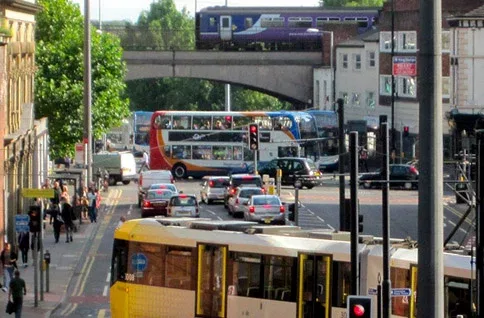
(Pic: TfGM)