
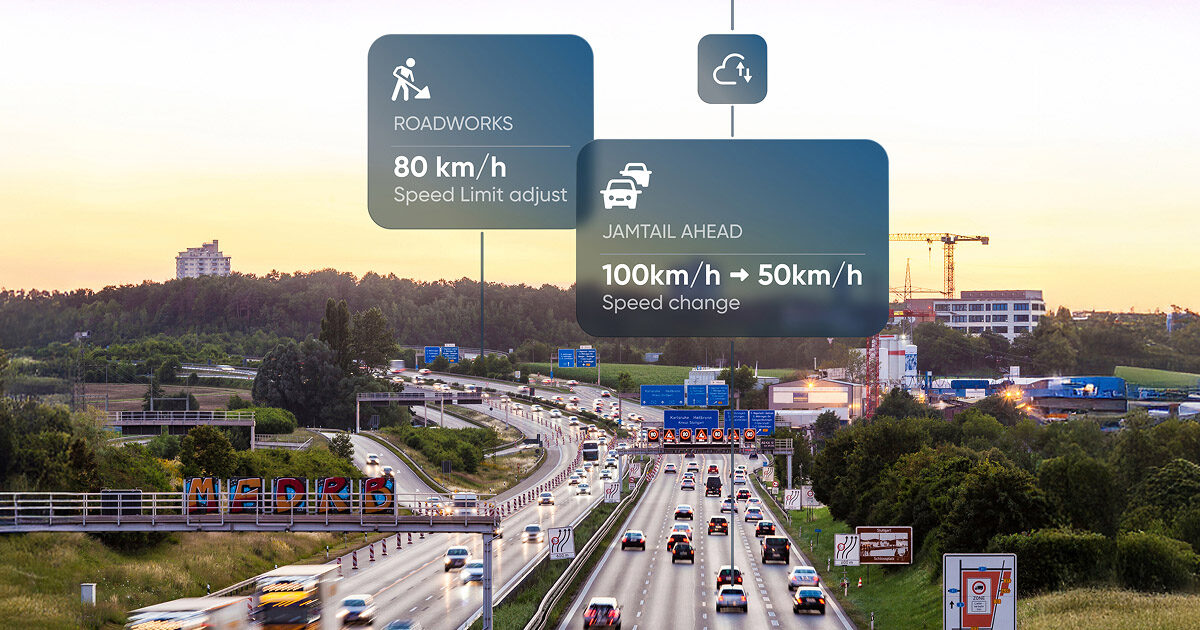
Ahead of next week’s Consumer Electronics Show in Las Vegas, TomTom has showcased its TomTom Orbis Lane Model Maps, demonstrating the automation and scalability of the Orbis AI map data factory, proving its readiness to serve as a single, high-fidelity source for both automated driving (AD) and navigation systems.
Orbis Lane Model Maps delivers lane-level intelligence, such as lane geometry, connectivity, and markings, at true urban scale. By leveraging an AI-powered map-factory approach, TomTom can produce lane-accurate maps with exceptional efficiency for all roads throughout a wide territory or region. As a result, TomTom Orbis Lane Model Maps can already be available with lane-level geometry across Germany. TomTom is rapidly scaling to many countries to cover the demands of our customers, ensuring they have access to the same level of lane-level detail across the whole regions where they have their operations.
This combination of breadth and freshness is essential for advanced driver-assistance systems (ADAS) and automated driving, enabling vehicles to make safer, more precise decisions on the road. Unlike traditional HD maps, which can be expensive to expand city-wide and slow to refresh, Orbis Lane Model Maps has the same HD richness while being engineered to scale across the whole road network, including the urban road network at a fraction of the cost while remaining continuously up to date as road conditions change.
Car manufacturers’ AD stacks can utilise Orbis Maps content to optimise real-time scene understanding in complex environments and to provide context about what lies ahead, including road layout, speed adjustments, thus working in conjunction with the sensors every step of the way.

The company has also announced the launch of its ADAS SDK, a modular, lightweight, and standalone toolkit designed to deliver high-quality ADAS map data for predictive driver assistance systems. Built for the era of software-defined vehicles, the SDK addresses the growing need for scalable, cost-effective solutions that enable car manufacturers and Tier-1 suppliers to deploy advanced driver assistance features across vehicle platforms and geographies.
As automotive OEMs accelerate toward L2+ driver assistance and higher levels of automation, they face mounting challenges in scaling these capabilities efficiently. Acting as a gateway to TomTom’s Orbis map data, the ADAS SDK provides an out-of-the-box solution that enables OEMs to integrate safety, comfort, and efficiency features directly into vehicle control systems, significantly reducing development time and development and integration costs.
TomTom ADAS SDK also directly addresses the compliance needs of manufacturers expanding into new markets. With Intelligent Speed Assistance (ISA) requirements or Euro NCAP protocols raising the bar for safety scoring, the ADAS SDK serves as a compliance-in-a-box offering. By eliminating the integration overhead typically associated with full navigation stacks, TomTom provides a streamlined path to faster vehicle certification and improved safety ratings.
Leveraging TomTom Orbis map data, the SDK generates a predictive path enriched with attributes such as speed limits, lane connectivity, curvature, gradient, and traffic signs. It also provides advanced horizon capabilities, enabling vehicles to compute a Most Probable Path and anticipate upcoming road conditions for adaptive lighting, hazard warnings, and more precise lane-keeping assistance. For electric vehicles, access to detailed road gradients and statistical speed profiles provided by the SDK enables predictive powertrain management. This allows vehicles to optimise energy consumption based on the upcoming route profile, contributing to improved efficiency and extended driving range.
(Pictures: TomTom)