Experts from roads, rail and ferries have come together to outline their plans to prepare for the impact of severe weather on the transport network.
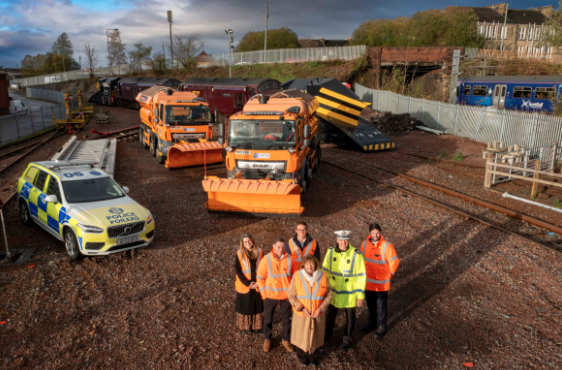
Representatives from Transport Scotland, Police Scotland and the Met Office were joined by ScotRail, Network Rail, CalMac and trunk road operating companies at Shettleston Rail Depot in Glasgow to remind the travelling public that difficult conditions can present a challenge at any time of year, and how their preparations must be ready to tackle more than just snow and ice over the winter period.
The Met Office’s named storm process has helped highlight the increasing impact of severe weather and climate change on the transport network – from gale force winds to flooding and landslides – which often leads to cancellations and delays for passengers and deliveries.
The transport network faces the threat of severe weather all-year-round. Over the last three years, flooding has restricted the trunk network for an average of 62 days each year, compared with the 2015-2017 average of 20 days.
This winter, there will be around 240 gritters undertaking patrols of the trunk road network, spreading salt and ploughing snow from around 40 depots across Scotland. The annual winter service runs until 15 May. The winter operations include:
- Dedicated snow plans for key routes like the M8, M74, M77, M80 and AWPR
- Improved mitigation, detection and management of ice on the Queensferry Crossing.
- Around 497,000 tonnes of salt currently in stock, which is more than was used for the entirety of last winter.
Cabinet Secretary for Transport Fiona Hyslop said:
“Severe weather has traditionally been associated with winter, snow, ice and gritters. However we just have to look back at the impact of Storm Amy and Storm Floris to realise that we can face challenging conditions at any time of year.
“We can see the real impact of climate change almost every day, be it on our television screens or through social media. Today gives us a chance to highlight all of the preparation that is put in place ahead of winter by our transport operators and resilience partners, as well as an opportunity to look at the hard work being carried out behind the scenes to cope with severe weather.
“It’s also important that travellers continue to plan ahead when the conditions take a turn for the worse. The Met Office’s named storm process and Traffic Scotland‘s gritter tracker have all helped raise awareness of the issue but the public also have a role to play – from drivers making sure their vehicles are winter ready to commuters on the rail and ferry networks checking with operators ahead of time to see how services are affected.
“Because of climate change we are seeing more frequent heavy rain and more weather extremes throughout the year. We heard from experts today across all transport modes about what they are doing to prepare, as it’s vital we all work together to face the challenge and keep Scotland moving.”
National Operations Manager for Resilience at Transport Scotland Martin Thomson said:
“Modern technology is once again at the forefront of managing severe weather.
“In addition to work on the Queensferry Crossing to mitigate ice, a new advanced weather forecasting system, new sensors to provide early warning of risk levels, and automatic barriers are now in play, if required.
“Effective communications with the public and stakeholders is also critical. We know from recent named storms that, alongside Police Scotland, Traffic Scotland is one of the most trusted sources and a voice of authority.”
(Picture: Transport Scotland)