
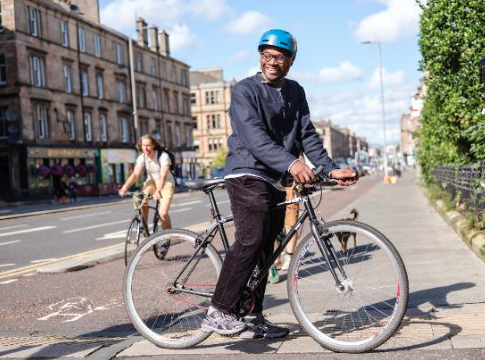
New findings from the Glasgow Walking and Cycling Index 2025 show a rise in confidence in using local streets, alongside public backing for safer neighbourhoods and improved cycling infrastructure.
Produced by Walk Wheel Cycle Trust (formerly Sustrans) in partnership with the council, the Index demonstrates increasing positivity around active travel when compared with the 2023 edition – highlighting how recent investment and street improvements are shaping people’s everyday experiences across the city.
The independent survey questioned 1,181 Glasgow residents aged 16 and over between March and June 2025.

Walking and wheeling continue to underpin everyday travel in Glasgow, with 93% of residents walking or wheeling and 57% doing so at least five days a week.
Confidence in the safety of local streets has increased since 2023, with 71% of residents now saying it is safe to walk or wheel in their local area. Confidence in cycling has also risen, with nearly half of residents now saying it’s safe to cycle locally, including gains among women, disabled people and parents.
Public support for safer streets and better active travel infrastructure is strong and consistent, reflecting clear untapped demand. Over a quarter of residents who do not currently cycle say they would like to, and nearly half of adults now have access to a cycle, suggesting that many more people could choose cycling if safer routes continue to be delivered.
This is reinforced by widespread backing for specific safety measures, with 71% of residents supporting safer school streets with improved crossing points and protected cycle paths, and 61% supporting 20mph speed limits on local roads.
There is also demand for improved cycling networks. Two‑thirds of residents say they would be encouraged to start cycling by more traffic‑free routes away from roads, while 61% support additional cycle paths along roads that are physically separated from traffic.
A further 68% want better integration between cycling and public transport, including secure cycle parking at train stations and bus stops, and more than half of residents, support building additional protected cycle paths even where this reduces space for other traffic.
Support extends beyond cycling, with residents backing many ways to make our streets and neighbourhoods safe, welcoming and comfortable for everyone to walk or wheel. 76% want better pavement accessibility like level surfaces and dropped kerbs at crossing points. And support for fewer cars parked on the pavement remains consistent with the previous Index.
Measures to make neighbourhoods safer for children also command broad support, with 60% backing traffic reduction targets.
Overall participation in cycling has remained broadly stable since 2023, with 15% of residents cycling at least once a week. The Index has however highlighted a shift in how cycling is used, with the 26 million trips made in 2025 increasingly focused on everyday journeys such as commuting, work and shopping – reinforcing cycling’s growing role as a practical and valued part of Glasgow’s transport system.
Cllr Angus Millar, City Convener for Transport, said:
“Glasgow is changing how we move. Over the past two years, the city has made major investments in walking, wheeling and cycling infrastructure, backed by community support and driven by a commitment to delivering safer, more accessible streets for everyone.
“The 2025 Index shows strong demand for safer streets and better active travel infrastructure, alongside growing confidence, with more people than ever now feeling safer walking, wheeling and cycling in their neighbourhoods. This reflects the impact of sustained investment in high‑quality infrastructure and the difference it is making to people’s daily lives.
Download the Glasgow Walking and Cycling Index 2025 here.
(Picture: Brian Sweeney/Walk Wheel Cycle Trust)