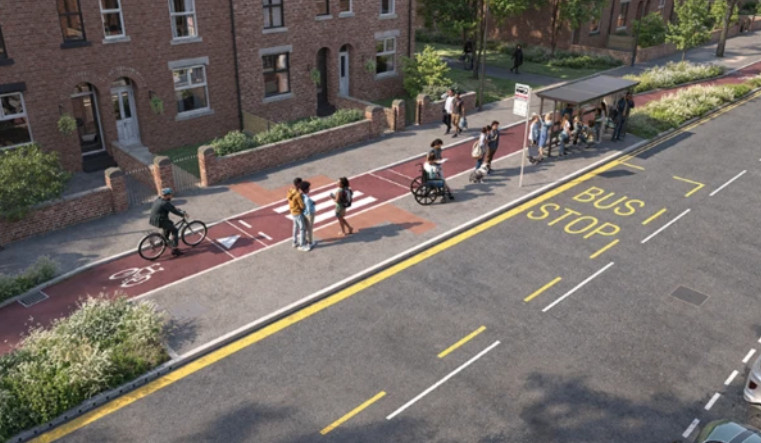
Updated government guidance on the rollout of floating bus stops is “shambolic” and should be withdrawn, campaigners have said. The design, which has a cycle lane between the stop and the kerb, is intended to allow bus passengers to get on and off safely while cyclists continue moving, according to the BBC.
Sarah Gayton, street access campaign co-ordinator at the National Federation of the Blind of the UK, said: “It does not address the concerns that blind and visually impaired people have and it’s totally insulting to think that we’ll accept this.”
The Department for Transport (DfT) said “making bus travel accessible and safe for everyone is a key priority for this government”.
The fresh DfT guidance, published earluer this week, follows November’s announcement of a pause in the installation of Shared Use Bus Border (SUBB) where passengers alight from or into a cycle track.
Another type of floating bus stop is a bus stop bypass, where the bike track runs behind the bus stop/shelter, which are the ones installed by Transport for London (TfL).
There are no SUBBs on TfL’s road network but many exist on roads managed by London boroughs.
TfL says there were five pedestrian casualties involving cyclists and one with an e-scooter in a three-year period at floating bus stops compared with 11,400 pedestrians injured by motor vehicles.
There were 164 floating bus stops in the capital in 2024, London Assembly figures show, external.
Gayton described the updated guidance, which advises that a bus boarding island would work at some sites, as “not fair on blind and visually impaired people. They only talked to the people they thought they would get an answer they wanted. If they did hear concerns, they haven’t listened to them properly.
“It does not make sense. They’re just rehashing different versions of schemes that have been out before. They think this will pacify us but it will just make it worse. It doesn’t do anything, really. It’s a really poor, shambolic document. It does not address any of our concerns.”
Nearly 40% of blind and partially sighted people avoid bus stop bypasses, according to the Royal National Institute of Blind People (RNIB).
Erik Matthies, the RNIB’s policy lead for travel and transport, said:
“There is no safe and accessible way for people like me with sight loss to cross the cycle lane to and from a bus stop, and this new guidance does not address that at all.”
A TfL spokesperson said:
“Keeping everyone travelling in the capital safe is our top priority and we’re determined to ensure that changes to London’s roads work for everyone. We welcome further statutory guidance to support the delivery of safe cycle infrastructure at bus stops in a way that balances the safety of all road users.
“We will be in touch with all boroughs to discuss the specifics of schemes and ensure that any implications for TfL-funded schemes, and TfL guidance, are understood.”
(Picture: DfT)