A series of signage and road marking improvements, including Vehicle Activated Signs from Clearview Intelligence, have seemingly fixed a collision problem at a low bridge on a key route in rural Scotland.
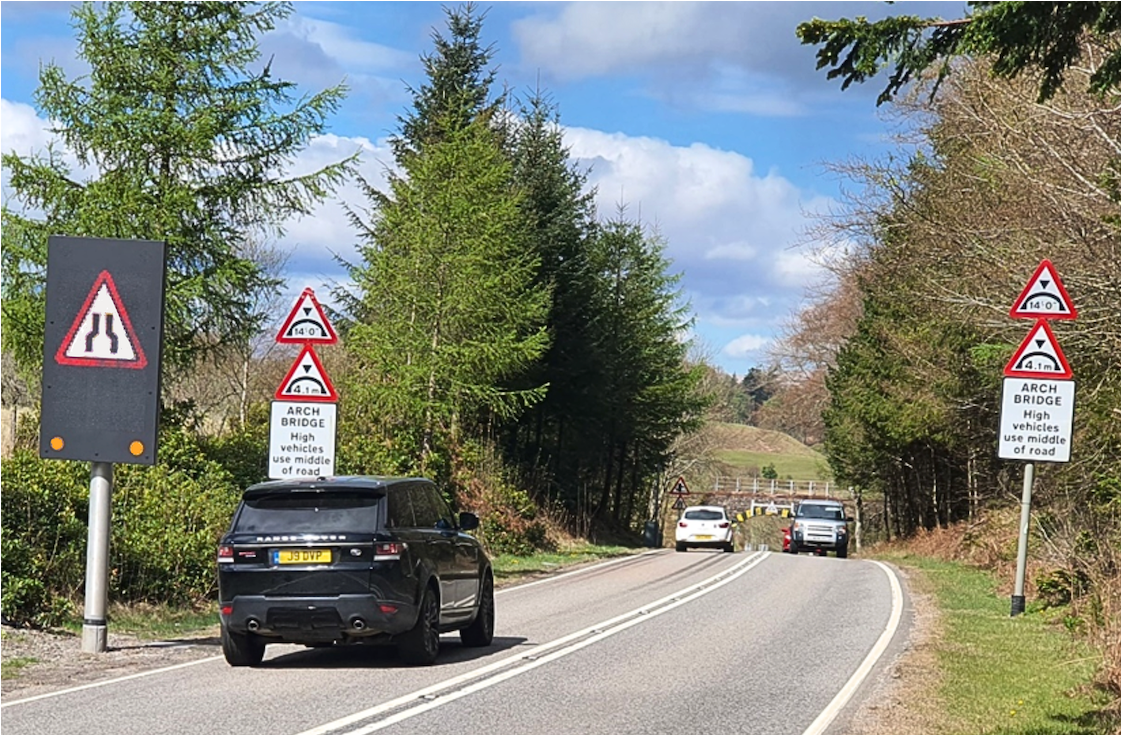
Stonefield Bridge on the A85 is seven miles from the key port of Oban, which links the Scottish Mainland with the Inner and Outer Hebrides. The bridge means the carriageway width is reduced to 4.3m, while the bridge is only 4.1m (14 feet) high.
Any bridge strike that leads to the closure of the road necessitates a 75-mile diversion, while there had been five personal injury collisions during the 2010s, including, tragically, a motorcyclist fatally injured in 2019. There had also been five bridge strikes in the period.
The Vehicle Activated Signs were identified as part of a solution after analysis showed significant evidence of late and heavy braking manoeuvres on approach to the bridge, with roadside damage, potentially caused by swerving vehicles to avoid oncoming traffic that had assumed priority. At the time, the road markings did not indicate any priority in either direction.
Transport Scotland commissioned BEAR Scotland to develop a range of road safety improvement measures to address the collision patterns, and this identified the need for improved driver behaviour. Therefore, a range of engineering measures, including vehicle activated signs, vehicle restraint barrier and road markings were chosen to alert drivers that oncoming vehicles are approaching and where they should be positioning themselves to negotiate the bridge safely.
The electronic signs were deemed to be more reactive than traditional fixed plate signs because of their dynamic ability to highlight opposing vehicles more prominently, therefore reducing collision risk.
Clearview installed three signs, two on the westbound approach and one on the eastbound. The first sign that westbound road users encounter warns of queueing vehicles ahead, which was necessary due to the road alignment limiting forward visibility. The second westbound sign and the eastbound sign were both designed to detect vehicles approaching and display varying LED warning signs with text depending on the class of vehicles approaching the bridge. These warnings consisted of warnings of a narrowing of the road for any vehicle, bridge height messages for larger vehicles and warnings of oncoming vehicles in the centre of the road.
Figures show that in the three-year post opening period since these changes, there were no recorded bridge strikes or injury collisions at the location, suggesting that these simple and inexpensive driver information solutions have been successful in changing driver behaviour and traffic management.
“This project at Stonefield Bridge is a great example of how smart, data-led interventions can deliver tangible safety improvements for road users,” commented Chris Keenan, Director of Business – Scotland at Clearview Intelligence. “By combining intelligent signage with real-time vehicle detection, we’ve been able to influence driver behaviour and remove a long-standing collision problem. It shows that effective technology doesn’t always have to be complex or costly to make a real difference.”
(Picture – Clearview)