
The UK will struggle to deliver the government’s £725bn 10-year infrastructure strategy without immediate and sustained action to boost industry capacity, productivity and collaboration, according to the Institution of Civil Engineers’ (ICE) State of the Nation 2026 report.
The report draws on insights from expert panels across transport, energy, water and a range of industry interviews.
Contributors agree that years of fragmented planning, existing skills shortages, and inconsistent investment have left the sector ill-equipped to meet the scale and urgency of the UK’s infrastructure needs.
The government’s 10-year infrastructure strategy and the accompanying project pipeline give the industry a clearer view of its upcoming workload than it’s had for many years. The ambition and commitment present a big opportunity, but delivering these projects will be challenging and will require supply chains to increase productivity, work smarter, and boost capacity.
Large-scale innovation across investment models, procurement approaches, digital tools and industrialised construction methods, like Modern Methods of Construction, will be vital to improving productivity and enabling the sector to deliver more with less.
The report highlights the potential of offsite and standardised construction to deliver major time, cost and labour savings, but warns that slow adoption and fragmented approaches are holding progress back.
Funding projects in innovative ways, new procurement approaches, and the application of technology like AI will also be crucial.
The report warns that the supply chain is already short of people, equipment, and materials. This challenge will intensify as major projects compete for limited resources. Without intervention, costs will rise and “A list” projects, like Sizewell C or HS2, could pull specialists away from essential but less high-profile work.
Some areas, including asset maintenance and specialist engineering roles, face critical skills shortages.
The report notes that attracting and training new talent takes a significant amount of time – typically five to seven years – for new professionals to become fully effective.
This makes a long-term workforce strategy essential. The ICE recommends government and industry collaborate to publish one aligned with the goals in the 10-year infrastructure strategy.
The government’s newly formed National Infrastructure and Service Transformation Authority (NISTA) has created an opportunity for the sector to work in a more coordinated way, but only if organisations move beyond traditional, transactional relationships.

Integrated delivery models – like enterprise working agreements – shared data, longer-term frameworks and clearer, earlier pipelines of work will be essential to give suppliers the confidence to invest in skills, technology, and capacity.
The ICE recommends including more information in the Infrastructure Pipeline so that decision makers have clarity about projects. This will help guide industry planning and investment.
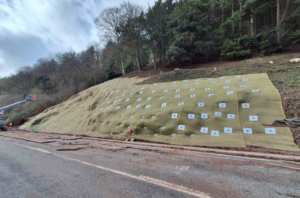
While new construction dominates political attention, the report reiterates the ICE’s previous warning that the UK faces an asset management emergency, particularly across local roads and ageing transport networks. Delayed maintenance is creating mounting safety risks and higher long-term costs.
The government has existing plans to implement road usage charges. The ICE recommends these plans are expanded and that money collected is reserved for highway maintenance.
ICE President David Porter said,
“The UK has set out an ambitious and much-needed infrastructure vision. But we cannot deliver it with the systems, behaviours and capacity we have today.
“We need a step change in how the sector works — with more collaboration, more innovation, and far greater investment in people and productivity.
“This is a moment of opportunity. If industry and government act now, we can deliver the infrastructure that communities rely on and that the UK needs to thrive.”
(Pictures: National Highways)