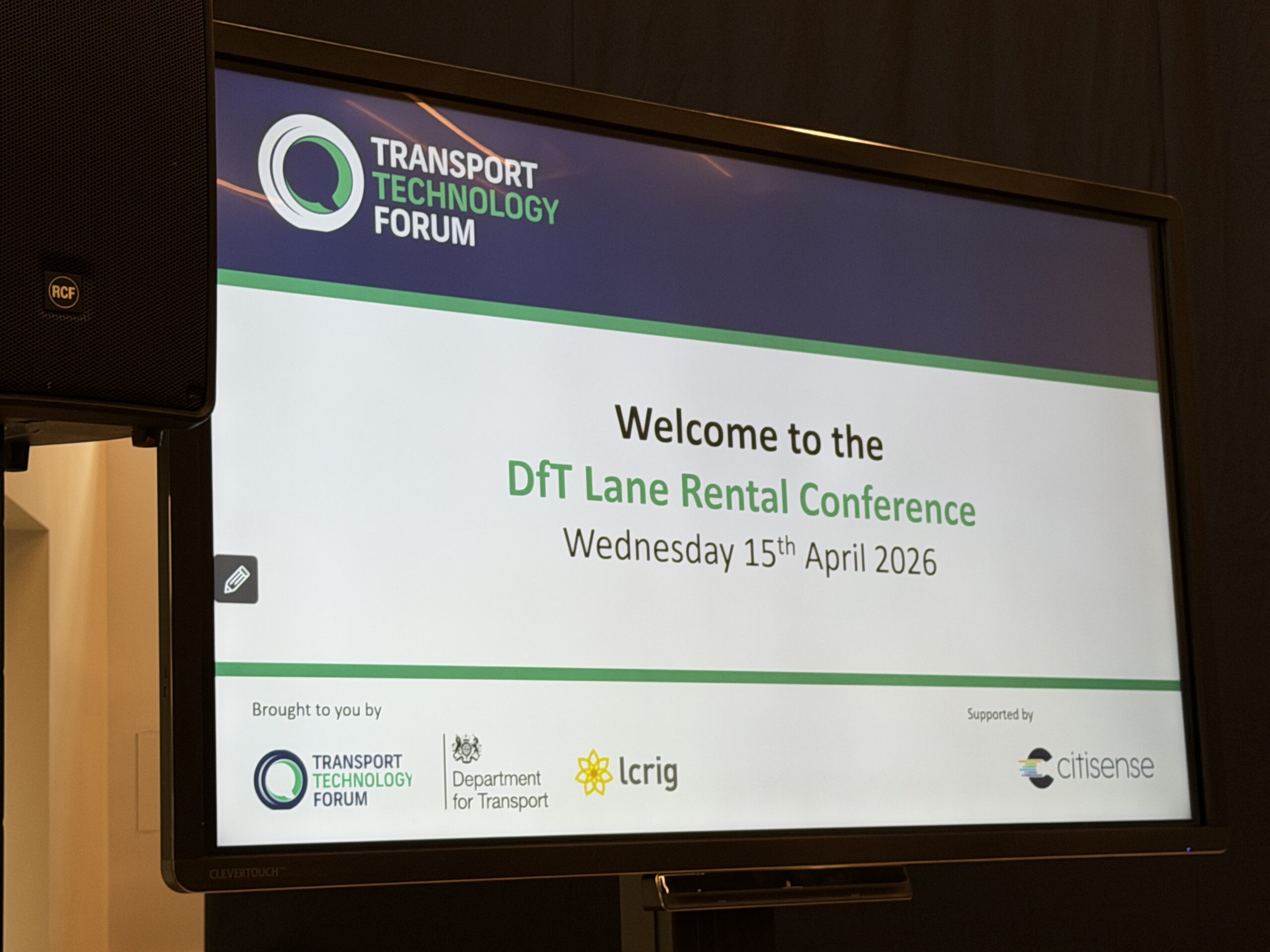
We’re live at the Department for Transport’s Lane Rental Conference 2026 in Tower Hamlets – it is a one-day event bringing together local authorities, utilities, and industry professionals to discuss how lane rental schemes, where companies are charged for occupying busy roads, can be used to reduce congestion from roadworks.
It focuses on sharing policy updates, practical experiences, and best practice, with sessions on tools like Street Manager and NUAR, case studies from existing schemes, and collaboration across the sector to improve how street works are planned and delivered.
This is Paul Hutton reporting from Tower Hamlets Town Hall.

09.30
Paul Chandler, Head of Traffic Management Digital Services, Traffic & Technology Division at the Department for Transport welcomes delegates, explaining this event is far bigger than ever imagined, with bookings closed at just over 200 people. He’s joined by Hugh Randall from Streetwork Solutions who’s compering the event.
9.40
Jack Darby, Head of Streetworks Policy at DfT now gives a policy update.
He explains the background to lane rental schemes, new policies, legislation and schemes approved over the past 12 months. He then looks towards the next 12 months.
He says this idea is not about bringing in money, but making streetworks more efficient and changing behaviours. The schemes should only apply to the busiest streets at the busiest times, and that it will generally affect 5-10% of an authority’s networks.
The guidance is here.
“I’d say Lane rental is becoming increasingly important today because of the scale and volume of street works,” he says, and explains the costs to the economy are estimated at £4 billion.
He outlines what revenue can be spent on, and the flexibility on how many roads can be affected, including around strategic roads and cross-authority co-operation. They have also removed certain requirements such as unnecessary policy statement templates.
He now outlines the next 12 months: seven new lane rental schemes will launch expanding coverage across England, with another 12 being reviewed. Approval powers will move from centrla government to Mayors in late 2026, with statutory guidance on how to assess schemes. He stresses all schemes must comply with national criteria, including coverage, quality and governance standards.
“Because this model may be new for many areas, we’re not simply handing over the powers and stepping away,” he says. “We’ll be running training workshops across the summer, and those sessions will cover how to interpret applications and how to apply the statute criteria.”
During Q and A, a representative of HAUC, The Highway Authorities and Utilities Committee, talks about the lane rental tracker and requests that everyone keeps the scheme details updated.
10.10
We now hear about the National Underground Asset Register. The speaker is Andrew Gilbert, Senior NUAR Adoption Consultant at Ordnance Survey to talk about NUAR and Lane Rental.
He says NUAR is the government digital service that is providing the application, and OS is the service provider. This is a map of underground cables and pipes across England, Wales and Northern Ireland. He says the whole point is to make underground space more efficient.
He says there are more than four million kilometres of buried pipes and cables in the UK, with 600 asset owners. There are 60,000 accidental strikes per year, costing £2.4 billion. Access to the asset owner data takes more than six days and data is supplied in different formats and styles.
He says this needs changing and with NUAR, you’ll get the right data within a minute.
He says NUAR in numbers so far means 350 asset owners’ data published, with more than 3.2 million kilometres (nearly 80%) published.
Asset owners in England, Wales and Northern Ireland (not Scotland yet) can access this at no cost. Authorised street work contractors can too, with proposals for additional user groups for safe digging, emergency services, asset owners for core business use and public sector bodies having access too. This is currently in consultation.
He adds that the data is secure, streamlined and supported and delivers safety improvements for workers.
Operationally, it’s being run at scale with no cap on the number of users. It can be used as aa tool to refer to plans but is not available for the public so data use is safe.
He lists a number of organisations using NUAR already, such as water companies, gas and electricity networks, telecoms suppliers and councils.
10.25
Next up we get a utility company’s view, with Richard Boissieux, Streetworks Manager of UK Power Networks.
He talks about how utilities companies can work with authorities and says the drivers are safety, customer service, network customer minutes lost, employee engagement, cost and average durations. He says as utilities he gets a finite amount of money from regulators, so asks what is the expectation of where his additional money will come from because this is an extra cost to utilities – it can only come from the regulator or customers? As utilities he knows lane rental is here, and wants to make it work, but wants consistent schemes in places, reasonably locations identified as traffic-sensitive, give clear and realistic opportunities to avoid lane rental when possible and to be listened to.
He says he believes there are a number of concerns around the information provided as to why roads have been selected for lane rental and discusses the guidance shared:
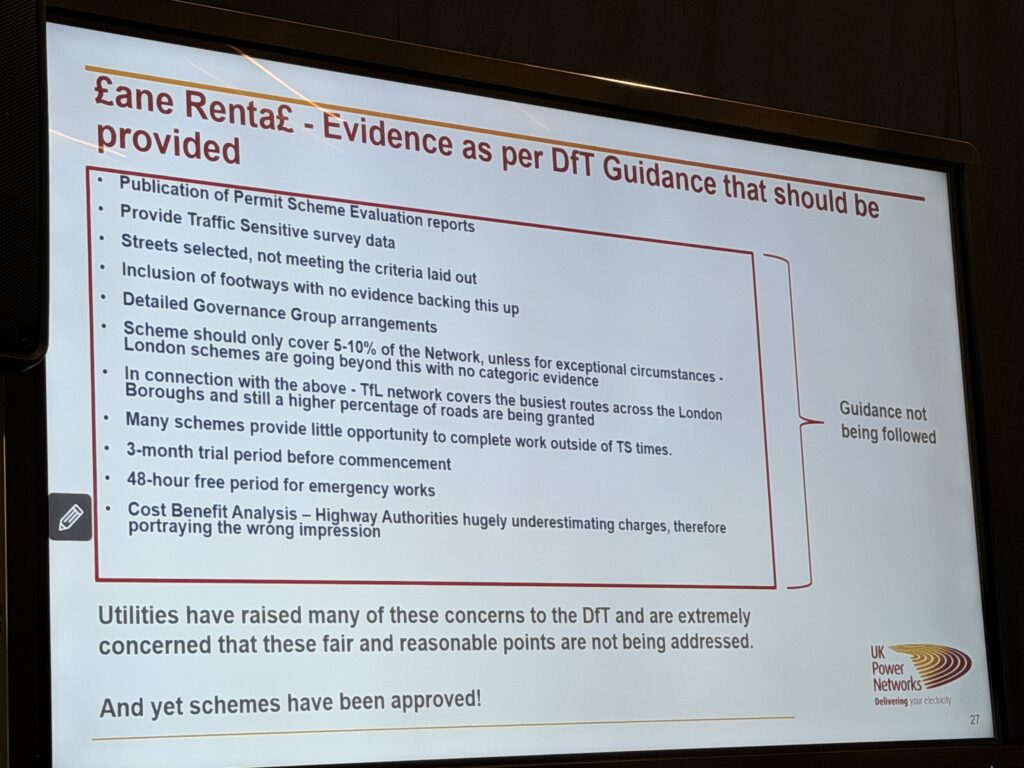
He also questions why the lane rental money can be used for a large number of schemes that should be funded through other means.
He then summarises areas to consider when they start work, focussing on safety, location of the asset, power outage access and available workforce, but says there shold be better co-ordination to highlight collaboration opportunities for highway authorities, placement of spoil, parking of vehicles, shrinking of sites wherever possible and innovative solutions.
He also says that they are required to respond to emergencies quickly and that contradicts how they deal with lane rental.
He points out a concern is the changes in costs when lane rental is implemented:
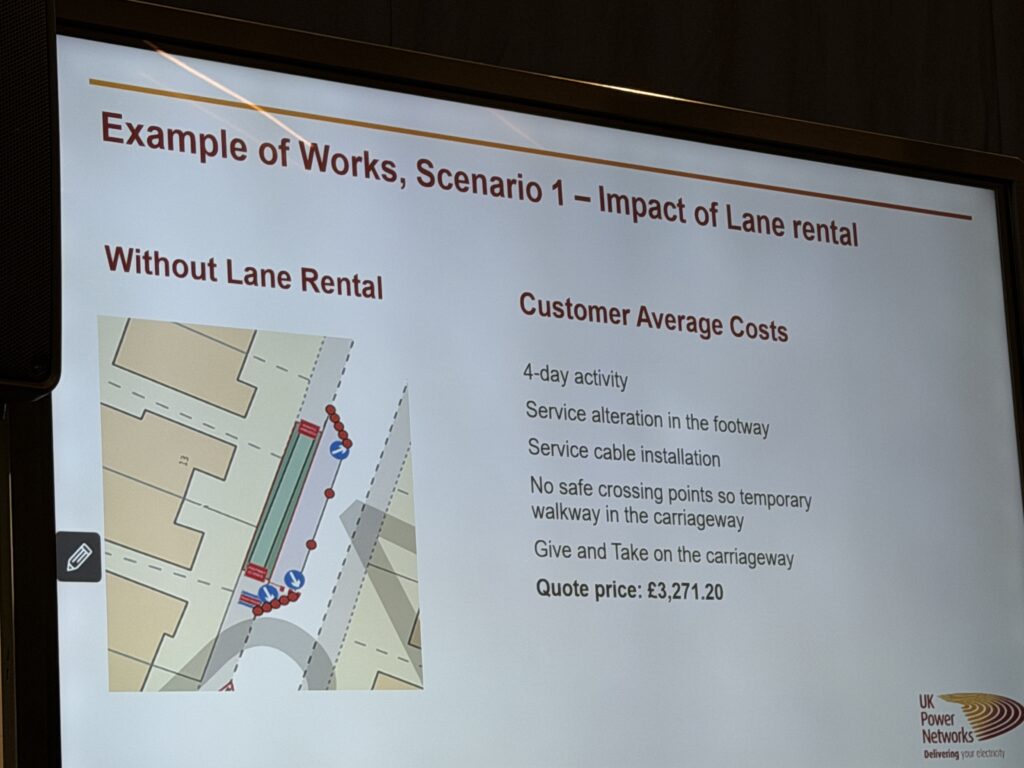
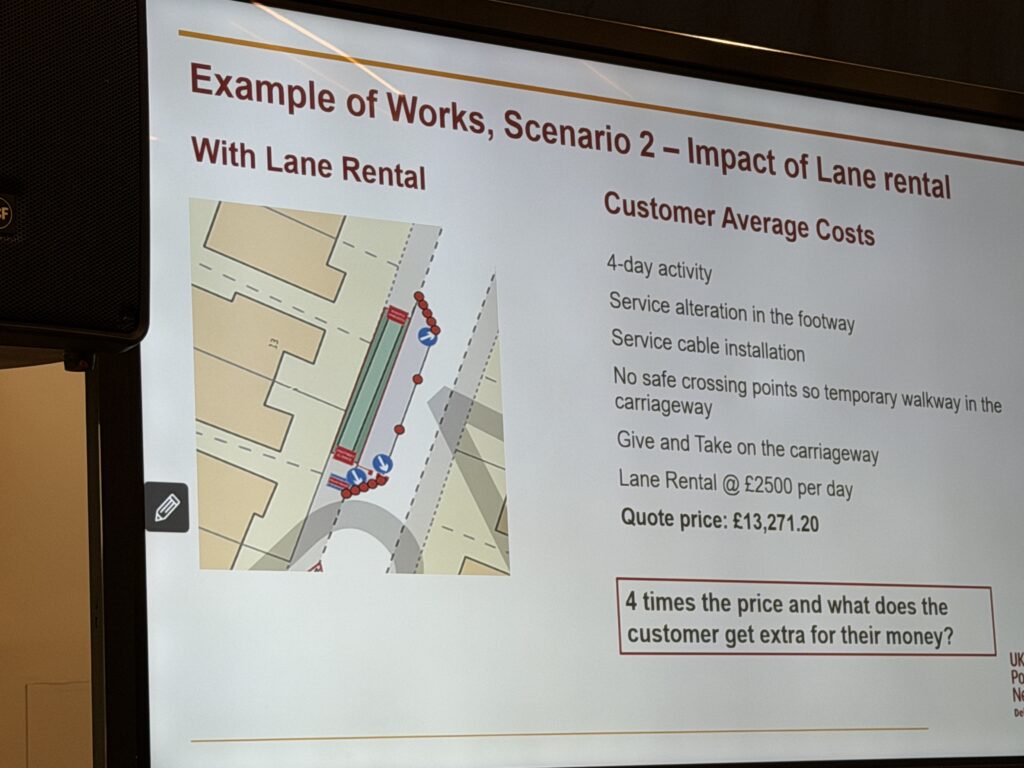
He therefore asks for a number of things, including stricter controls around allocations of traffic sensitive schemes, dealing with the clash between the safety code and lane rental objectives, lane rental timings, and not to be a way of generating money. He says this means there must be a way of dealing with the way surplus funds are used, because he says it can be seen as a money-making exercise.
10.50
We’re now talking about “Applications without the stress” with Nick Ruxton-Boyle, Technical Director of Citisense.
He says lane rental schemes can be stressful, but there is help out there.
He says he is a transport planner by background and is a big supporter of financial tools that can change behaviour. Not only lane rental schemes but also workplace parking levies and road user charging.
He says he offers support lane rental schemes around business cases, applications data collection, setting up of the schemes, scheme design and liaison – all important for schemes.
He now gives his views on the concept. He says people should learn from those who have done it already, to seek support, follow guidance and understand that there is no one-size-fits-all solution. He adds that you should have a clear view on council works, start permit scheme evaluation early, upskill your team and understand guidance is likely to change.
Generally he says you need good political and internal support, ensure revenue generation potential is robust, and be clear about risk and uncertainties, know your internal approval processes and ensure any external suppliers are set up ahead of go-live.
He now shares his “view from his team” which include a need fr clearer communication, worries over moving goalposts, the impact on utilities, lengthy processes, innovation fund potential and impact, plus staffing challenges and monitoring.
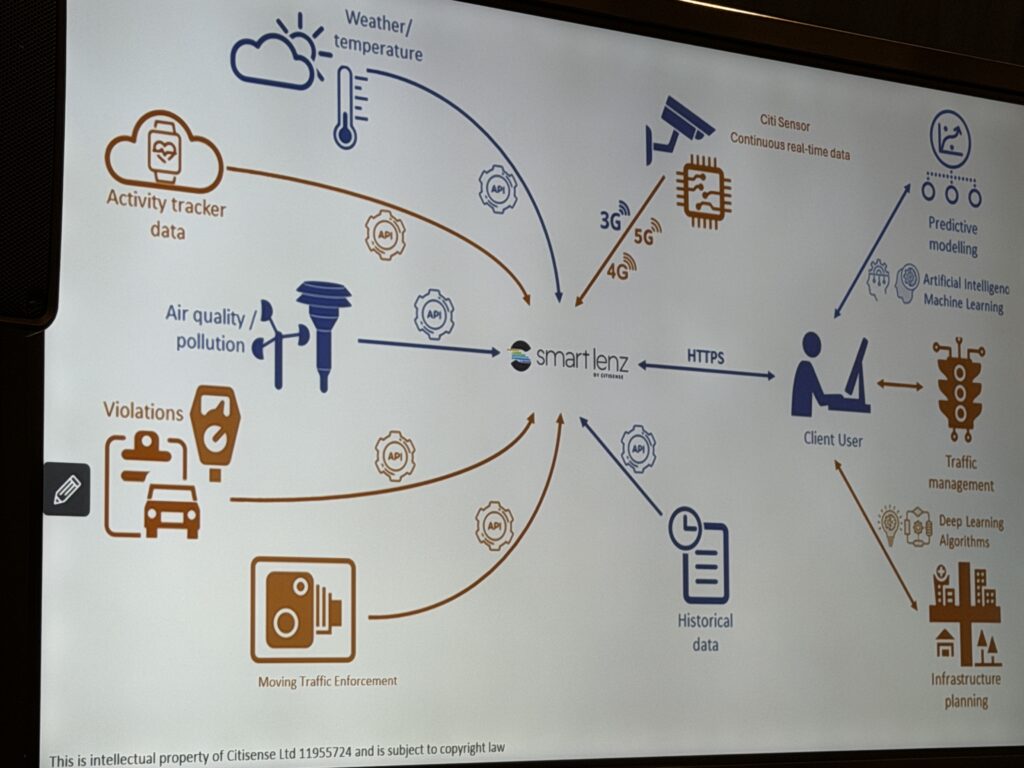
For the first time today, and nearly 90 minutes in, we first hear about AI. He says AI will have a place in solutions, especially around camera and sensor technology for scheme justification and evaluation. He says it will help with data storage and visualisation and live scheme monitoring. There are also technological improvements with software packages for day-to-day scheme operaton.
He then shares a graphic around a lane rental scheme:
Rounding up, he says he want s to see flexibility in submission dates, national and regional steering groups and best practice solutions. He says you should be patient, manage expectations and understand your local governance.
11.10 – Coffee time! Back soon.
11.50 – We’re back.
Karl Kulasingam is up next talking about 14 years of street works innovations. He’s Roadworks Performance Manager at TfL’s Lane Rental Scheme.
He says the journey actually started 16 years ago in 2010 when colleagues prepared the scheme application project and in 2012 the DfT gave the “pioneering” scheme approval. First Lane rental funding and guidance (LRGC) funding applications were approved in 2014, a “lite” funding approval process was approved in 2015, and 45 applications were determined the following year. A fast track and extraordinary measures process was created in 2017 and in 2018 77 more funding applications were determined. A new scheme, with an updated scheme application process was approved in 2021, and a London Borough strategic group was formed in 2023. The Mayor pledged to expand the scheme in 2024, then a DfT borough scheme approval process was approved and four borough schemes are go-live in 2026, with 135 more funding applications determined.
He also talks about the political backdrop of the London Borough Lane Rental Scheme which included the inclusion of transport in the government’s five strategic priorities, the Mayor of London’s election manifesto including a lane rental roll-out and the encouragement and support for more local authorities to set up schemes and the allowance that 50% or lane rental surplus income to boost roads maintenance budgets.
He talks about the four boroughs – Lambeth, Merton, Enfield and Camden – which gave a consistent scheme framework, lane rental network definition and operational guidance document. He says was important to set the groundwork for wider expansion.
“We’ve got consistent lane rental operational guidance with a set of consistent waivers. So if you’re doing collaboration out there, you get 100% discount,” he says.
He says 27 out of the 32 London boroughs (plus the City of London) have delivered, or are working on, schemes. “Lane rental really does work,” he says and shares a graphic explaining why he thinks this is the case:
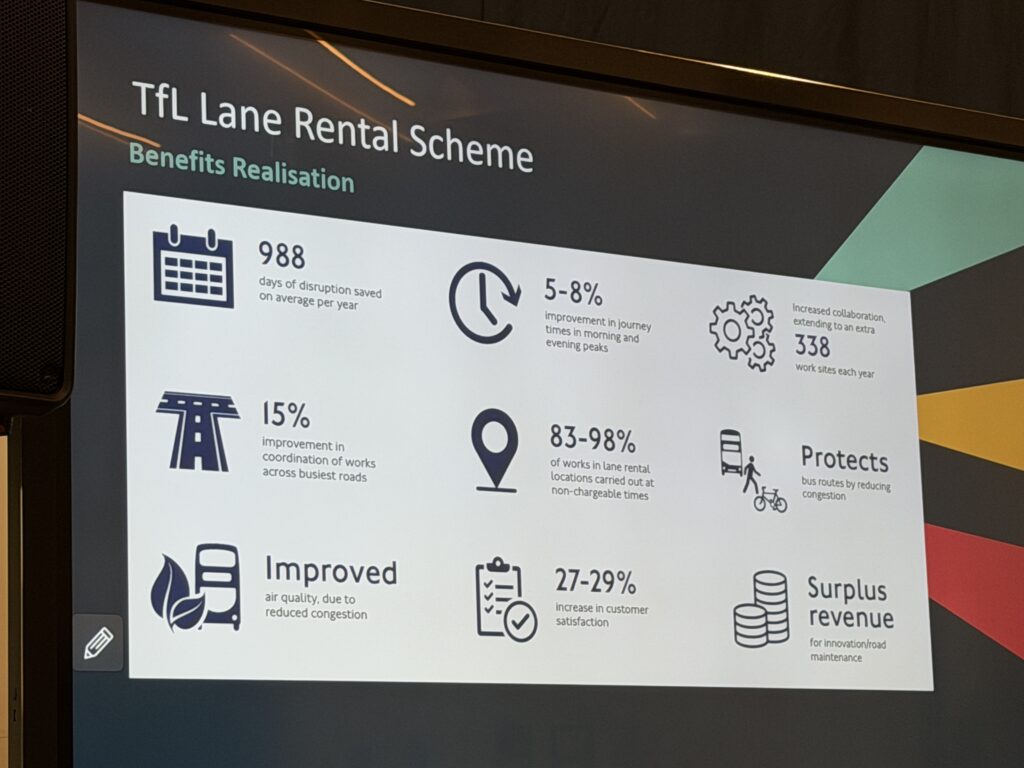
He talks about “funding and waivers in numbers”. He says 30 projects are being delivered, with the social cost of delays saved at £150 million and 130 waiver requests per year, with an average saving of £4.6 million.
He then touches on the use of surplus funds around preventative maintenance, capital, routine, major and reactive maintenance. He says you can use the money for innovation challenges, software, robotics, strategic initiatives, technology, environmental, enhanced information and data, materials, extraordinary measures, traffic management and future proving.
He then points to the innovation catalogue and recommends delegates look through this.
12.20
We’re now onto a panel session talking about “spending finances”. It’s chaired by Paul Chandler of the DfT, with Stephanie Master, Senior Policy Adviser at the DfT, Samantha Brothwell, Streetworks Policy Manager at National Grid and Sarah Widdows, Street Works Manager at Norfolk Council.
This panel focused on how to manage and govern funding generated through lane rental schemes, particularly as more schemes come online and the amount of available innovation funding grows.
A key early discussion point was the risk of duplication, such as the same project being funded by multiple schemes. Stephanie Master noted that, while not yet a major issue, this will become more important as schemes expand. The panel broadly agreed that existing industry forums, particularly those linked to HAUC, should play a central role in coordination. Samantha Brothwell and Sarah Widdows highlighted the need for stronger governance structures, suggesting a revitalised national lane rental forum supported by regional boards. They emphasised transparency, consistency, and accountability, alongside potential tools like shared databases to track bids and avoid duplication. There was also agreement that applicants themselves must be open about submitting bids to multiple authorities.
The conversation then turned to awareness and access to funding. While the funding is well known within the street works sector, the panel acknowledged a need to promote it more widely, although with care. There was some tension between broadening awareness and ensuring the funding remains targeted at those contributing to it. The group agreed that communication through existing networks, partnerships, and possibly wider initiatives could help, but the purpose and eligibility of the funding must remain clear.
On spending and innovation, the panel agreed there is no strict limit in principle, but practical constraints exist, particularly around legislation. Samantha stressed that innovation must align with the regulatory framework, and that DfT has a role in enabling this alignment so ideas can move from concept to real-world deployment. There was also strong support for simplifying the application process. Samantha argued that lengthy, complex applications risk undermining the benefits of the fund, especially given the operational pressures utilities face. A more standardised, streamlined process (which they thought could potentially developed through HAUC) was suggested, with the caveat that financial governance remains robust.
Finally, the discussion addressed governance at scale. With multiple schemes and boards emerging, there is concern about fragmentation and inefficiency. The panel agreed on the need for a more streamlined structure, likely involving regional assessment of bids combined with national oversight. DfT’s role in providing guidance, and potentially a clearer governance framework, was seen as essential.
Overall, the session highlighted that while lane rental funding presents a major opportunity for innovation, its success depends on coordinated governance, transparency, and processes that are both robust and practical.
12.40 – Lunchtime. Back at 13.30.
13.35
We’re back and now discussing user needs with Claire Hamlet, User Researcher at Kainos.
She explained how user feedback has shaped the development of new lane rental functionality and outlined a structured, user-centred approach beginning with identifying the core problem: as more highway authorities introduce lane rental schemes, Street Manager needs to evolve to better support both authorities and promoters.
She told the delegates how early engagement started in February 2025 with focus groups involving promoters and utilities to inform a successful funding bid. This was followed by a discovery phase in August 2025, where extensive interviews with authorities and users helped identify key pain points in managing lane rental schemes.
She said the team then translated these insights into design solutions, testing them through usability sessions and wider feedback via video demos and surveys. This iterative process ensured the product is grounded in real user needs, such as clarity on when and how lane rental applies to avoid charges where possible. Promoters need to understand costs up front, to allow for upfront budgeting, consistency across different schemes, transparency around waivers and discounts, and better tools for budgeting and oversight. Authorities also expressed the need to adjust charges post-works and access data to evaluate outcomes.
The project is now in development, with early versions expected soon, building on earlier work funded in 2019 that first introduced lane rental concepts into Street Manager.
Claire Hamlet returns now and talks about Lane Rental Waivers, a section to capture agreed waiters or invite the discussion, separate to the “permit journey” and when a highways authority assesses a lane rental, they can see these points. There is also a lane rental assessment and calculation.
Here are some videos shared about the concept that has been shared.
And new functionality will be shared by the autumn.
13.55
Hugh Randall, from Streetwork Solutions talks about “the maverick of streetworks”, although he starts by saying he’s no maverick. He says Streetwork Solutions oversees systems, processes, charges fees etc for national utility companies, and has worked with 65 permit authorities, and has been working on lane rentals since the earliest trials in 2002.
Hugh Randall draws on his extensive experience working with both utilities and local authorities to reflect on the realities and challenges of lane rental schemes. He explains that his organisation sits between these groups, handling large volumes of permit and fee data while also supporting authorities with training and scheme implementation. Having been involved in early lane rental trials, he offers a balanced but cautious perspective, noting that while the concept has merit, it introduces significant complexity and cost pressures, particularly as the number of schemes is set to expand rapidly across England.
A key theme in his speech was the contrast with Scotland’s more structured and disciplined system, where stricter planning requirements, consistent rules, and strong enforcement reduce the need for reactive measures like lane rental. Randall argues that better upfront planning, clearer processes, and higher standards could alleviate many of the issues lane rental aims to address. However, he acknowledged that lane rental could still play a useful role on the busiest, most critical roads if applied thoughtfully, helping authorities better manage network disruption and encourage efficient working.
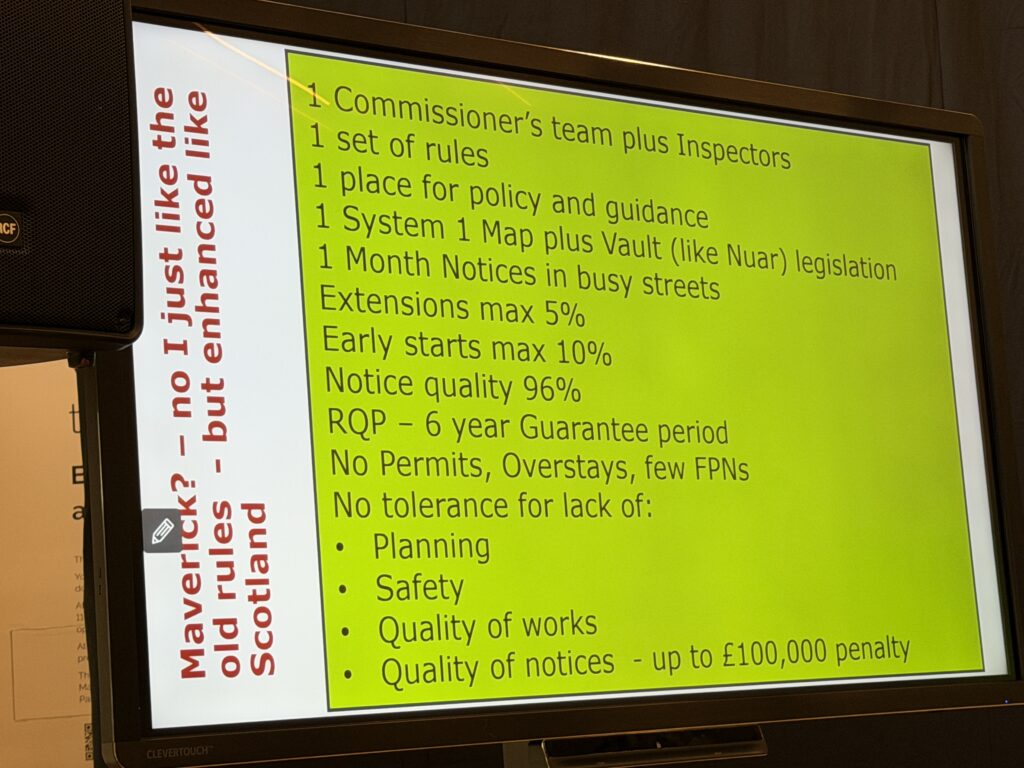
He also highlighted practical challenges in England’s approach, particularly the lack of consistency between schemes. Different rules, charge bands, and waiver processes across authorities make it difficult for utilities to plan and manage costs effectively. He stressed the importance of standardisation, especially through tools like Street Manager, and called for all authorities to input and maintain accurate data so users can better anticipate charges. He also pointed out usability issues, such as the lack of clear warnings in systems when costly decisions are being made, which could lead to significant unexpected charges.
Finally, Mr Randall emphasised the operational and financial implications for both authorities and promoters. Lane rental introduces large, sometimes unpredictable costs, he said, requiring much greater planning, coordination, and communication. Authorities will need more skilled staff and resources to manage schemes effectively, while utilities must engage earlier and more proactively to avoid high charges. He concluded by urging a more collaborative, customer-focused approach, where authorities and promoters work together to minimise disruption and improve outcomes, rather than treating lane rental as a punitive system.
14.10
Richard Groombridge, Strategic Product and Data Development Manager at Geoplace is next. Geoplace is the central source of information for all UK addresses and streets, managing the data that officially defines more than 42.8 million addresses and 1.3 million streets in the UK.
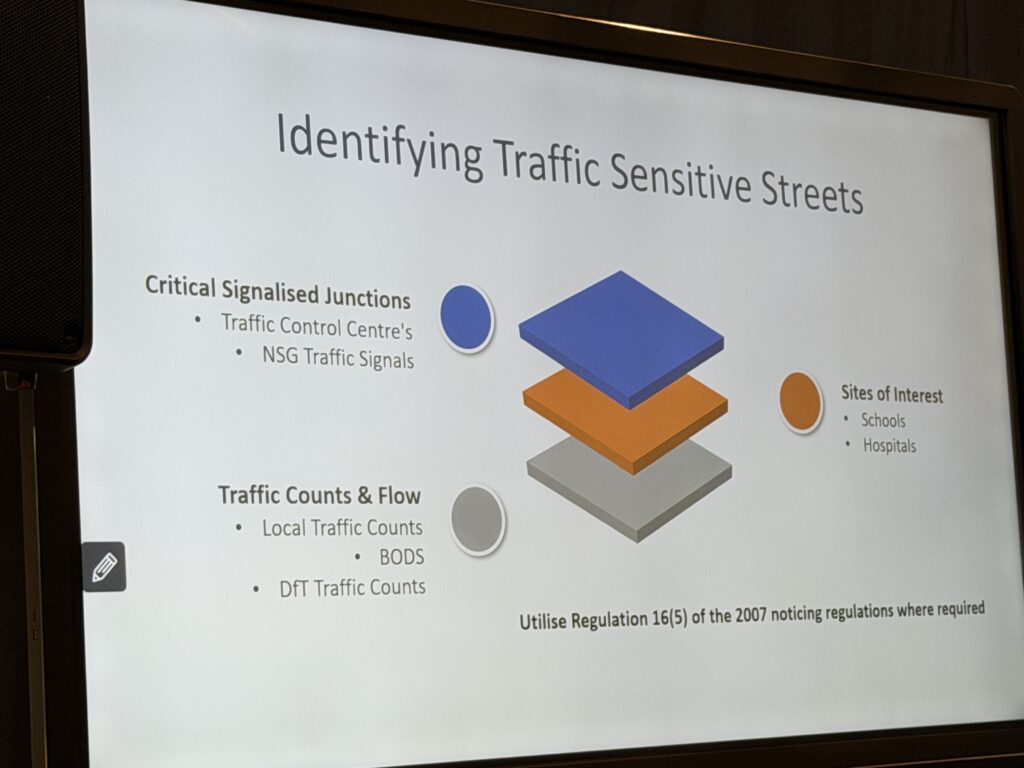
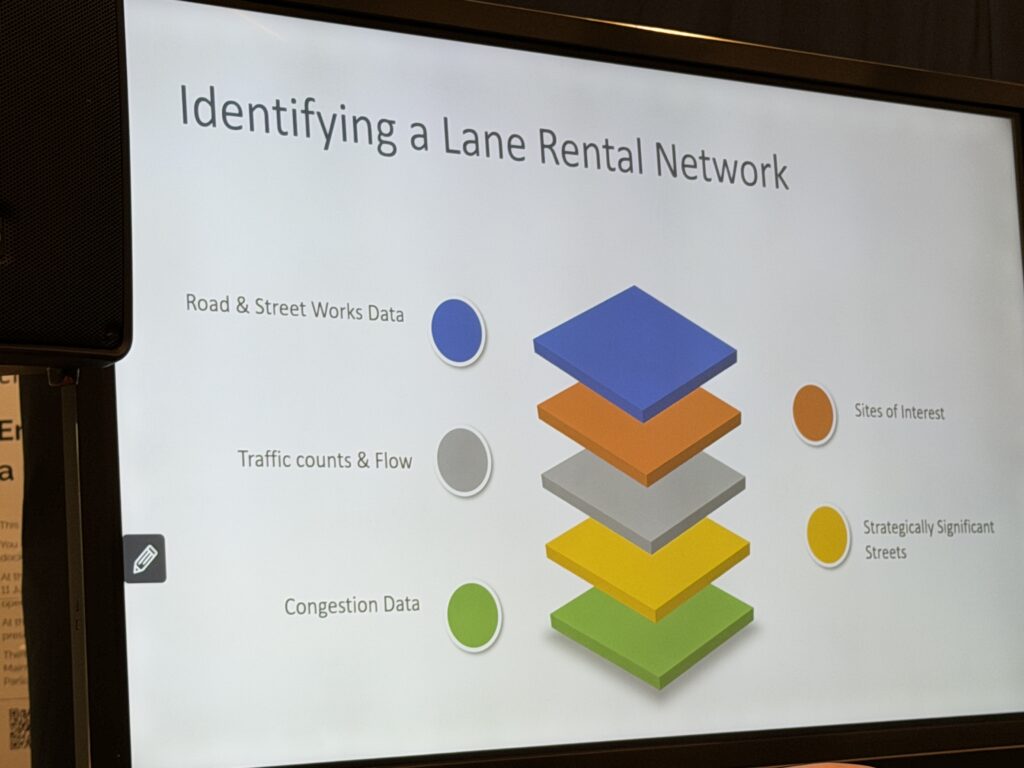
He summarises this guidance on moving to a lane rental scheme, highlighting best practice. A key slide was this about identifying traffic sensitive streets suitable for lane rental schemes.
14.30
Holger Kessler, Stakeholder Manager at AtkinsRealis is up next. He’s talking aboout collaborative Utility Streetworks Planning – a decade of experience.
He summarises utility solutions, with a lot of data around utility search reports, exclusion zone maps, utility search maps and a utility legal view. He mentions the Collaboration Handbook – a guide to the co-ordinated delivery of utility infastructure, which is worth a read.
Better streetworks management is possible, he says, “if enough people have a common aim and common outcomes.” He spoke about the vast amount of data already available in the street works and utilities sector, and the opportunity to use it far more effectively. He explained that his organisation had long worked in areas such as utility search reports and national data systems, including the NUAR. Drawing on this experience, he argued that the industry already had extensive, layered datasets, ranging from asset locations to ground conditions—and that the real challenge was not collecting more data, but using existing information in a more transparent and evidence-based way to support better decision-making.
He reflected on past initiatives, such as collaborative trials in Croydon and the development of NUAR, to show that large-scale data sharing across organisations was possible when there was a common goal. These efforts had demonstrated that utilities, authorities, and other stakeholders could work together to build unified systems that benefit the whole sector, rather than operating in silos. He stressed that transparency, shared data, and collaboration were essential foundations for improving how street works are planned and managed.
Mr Kessler also highlighted the rapid advancement of digital tools and technologies, suggesting that the industry was not fully exploiting what was already available. He pointed out that modern tools, including AI and geospatial platforms, could quickly integrate multiple datasets and even generate prototype systems in a short time. In his view, many current processes, such as complex workflows for permits, could be significantly streamlined or automated if organisations embraced these capabilities and focused on improving data quality and usability.
Finally, he encouraged the sector to look internationally for inspiration, citing countries like Estonia and Finland where highly integrated, user-friendly digital systems had transformed public services. He argued that the UK already had the foundations to achieve similar outcomes, but needed to think more ambitiously and collaboratively. Rather than adding complexity or pressure, he emphasised that innovations like lane rental and digital systems should ultimately aim to create greener, safer, and more efficient streets, while reducing friction for those working within the system.
14.40
Now let’s hear about the Oxfordshire Lane Rental Scheme with Phil Whitfield, the County Counci’s Head of Network Management.
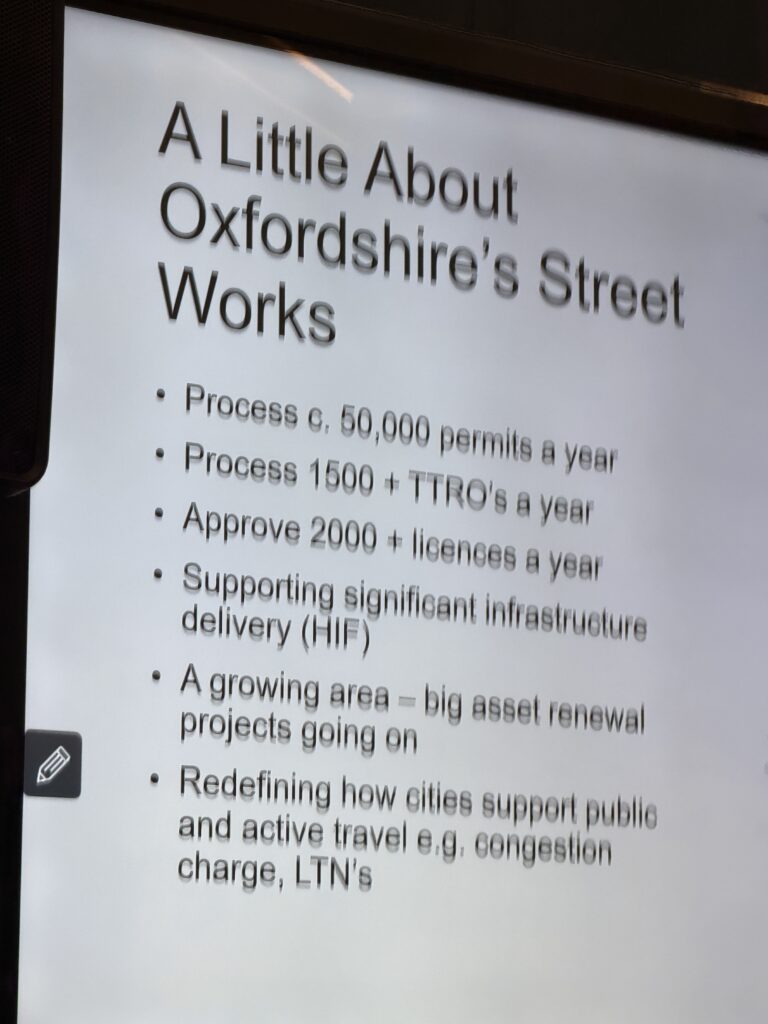
“What additional tools have we got in our box, which keeps this network flowing and that’s where lane rental came in,” he says. He talks about the county being one of the last authorities to apply for a streetworks permit scheme, so decided to be one of the first to become a Lane Rental Authority.
He talked about scoping the scheme, taking members and managers on the “journey”, selling the benefits in a practical way and how the scheme needed to consider societal impacts as well as operational and societal, and making it a resident-centric approach with access to data and experiences. One of the big drivers was supporting active travel and public transport policies.
The key question that should be asked is “what difference will a lane rental scheme make to the average Oxfordshire resident?”. They would look at examples and ask “if we had a lane rental scheme here, what difference would it have made.”
To take the stakeholders with them, they set up a Joint Development Group to get the scheme underway, with those who would be involved, so it wasn’t “something that was done to them.” The purpose was to design the scheme document, charges document (what fees will be charged and when) and an evaluation plan. All the documents are all based on the standard HAUC templates, and the documents were written while reviewing schemes elsewhere.
“Mission critical”, he said, was internal engagement. So they worked with the authority’s legal team, street works colleagues, highway maintenance and term maintenance contractors, procurement, finance, HR and senior managers and elected members.
Mr Whitfield then talked about consulting and applying for powers, discussing drafting of documents, a formal consultation with open meetings, a submission to the DfT which then led to the document being updated based on feedback, and then an implementation version.
They are currently implementing the scheme and have established a “joint implementation group”, recruited a team, procured software packages, confirmed financial and procedural processes. There is a shado scheme being run now, with a go live date of 5 May.
He concludes with some key advice to delegates:
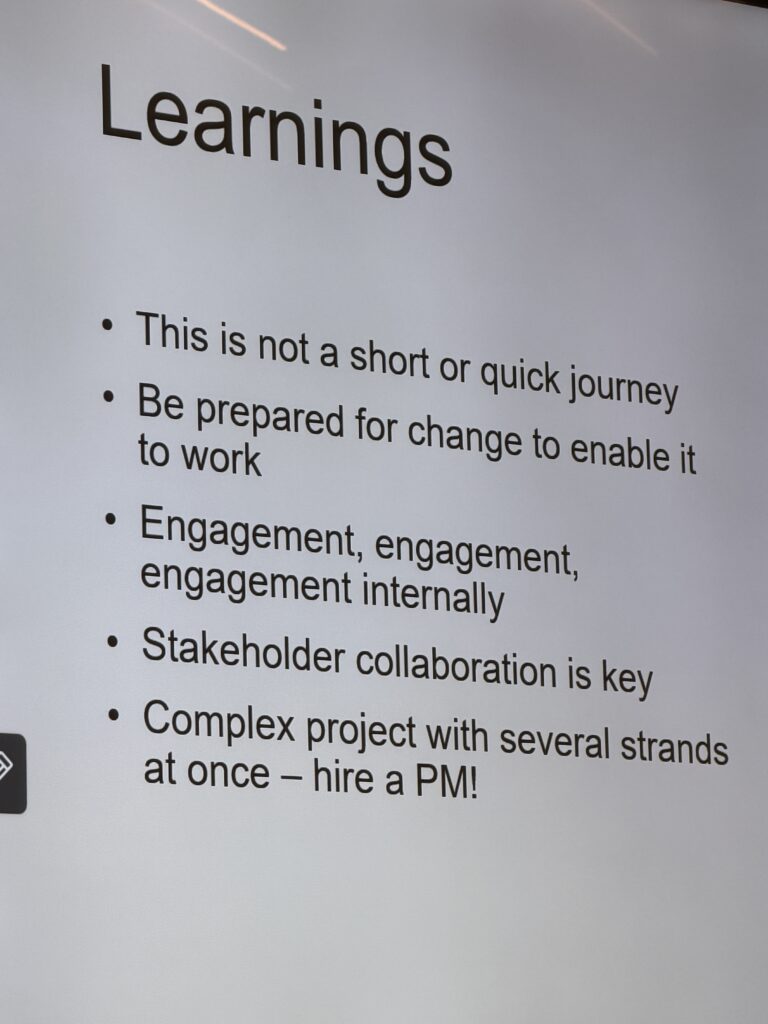
… and adds that his future hopes and dreams are a growth in the scope of his scheme, “exciting and ambitious” innovations and further support to encourage collaboration.
And he then states: “A successful lane rental scheme is one that does not generate surplus, but delivers measure to reduce disruption”.
15.05
And we finish with Susanne Ingham from LCRIG giving a plug for the Innovation and Learning Festival. Which is a great event so I’ll give my personal plug for this too.
15.10
Paul Chandler then wraps up the event and praises the energy in the first event. “We need to work out the future of these events” he says – but we can be sure it’ll be something that will happen again.
And that’s a wrap!
(All pictures courtesy of Transport Technology Forum).