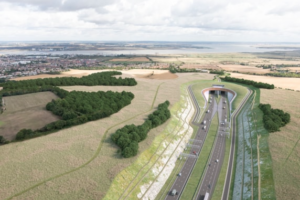

A new report by the Tax Payers’ Alliance has explored why major government projects are often over budget and delivered late. The Lower Thames Crossing is one of the four ongoing major projects examined in the report which are “experiencing overruns which will illustrate the substantial costs and delays caused by flawed forecasting.”
“Proposals for the road tunnel linking Essex and Kent were first made in 2009 with costs for the different options varying from a few hundred million for upgrades to the existing crossing to over £10 billion for the largest, most well-connected version,” says the report, entitled Big Spending Projects Gone Wrong. “In March 2025, the government approved the development consent order for the project. The approved plan will make it the UK’s longest road tunnel, but costs for it have almost doubled since 2016 when the estimated cost was between £4.3 billion and £5.9 billion.
“Until March 2025, no decision had been taken on where to build the crossing with deadlines for the decision
being repeatedly postponed to collect more information and allow for further deliberation. The project has cost £800 million so far, with the planning application alone costing £297 million. As found by Britain Remade, this means the planning fees alone already cost more than double the entire construction costs of Europe’s largest road tunnel located in Norway when adjusted for inflation.”
However, the current estimated date for completion is now March 2032, meaning a delay of five to six years on the original completion estimate, if construction starts 2026 and there are no further delays. This delay alone, says the report, will take more time than the tunnel in Norway took to construct. The approved crossing has
already cost two thirds of the amount as the entire construction costs of Wembley Stadium at £1.2 billion.
The report also maintains that the main cost driver for the Lower Thames Crossing so far has been the lengthy consultation process. Large infrastructure projects of national significance already have a route to fast-track planning processes through the nationally significant infrastructure projects (NSIP) framework. The NSIP regime was established in 2008 with the aim of reducing the time taken for major infrastructure projects to achieve development consent and avoid lengthy conventional planning inquiries.
“Over time, NSIPs have become less successful in increasing the speed and ease for large projects to get through the planning application stage due to the corresponding national policy statement (NPS) being outdated, and therefore open to legal challenge. Despite being an NSIP, 38 the Lower Thames Crossing has been unable to start construction until now because the government has stated it needs more time to consider the development order.”
The government must decide on whether to bolster the NSIP framework and NPS to ensure major projects in
the future, like the Lower Thames Crossing, do not have to wait 16 years before being approved or scrapped,” the report suggests.
“This will cut any unnecessary pre-construction costs and have the benefits of such projects felt sooner. After
16 years, it’s welcome the biggest road scheme in the UK has been approved, but the substantial funds
already used on it, the increase in the total cost estimate and delay to its completion has meant the project
won’t deliver results for taxpayers until the 2030s.”
The full report is available HERE.
(Pic: National Highways)