
A major overhaul of the Manual of Contract Documents for Highway Works (MCHW) has been outlined, aiming at reshaping how highway schemes are specified and delivered.
Contractors and suppliers are being urged to familiarise themselves with the changes by checking the updated MCHW, now available via the Standards for Highways website. It represents what National Highways describes as a “historic change” in the way contract documentation is structured and used across the sector.
One of the most significant changes is a move from a complex seven-volume system to a streamlined structure of just three document sets: the Specification for Highway Works, Instructions for Specifiers, and the Method of Measurement. This is designed to simplify navigation and improve consistency across projects.
All new contracts let from September onwards are expected to adopt the updated format, although existing contracts will continue under the previous system, avoiding disruption to live schemes.
A key feature of the update is the introduction of “work specific requirements” (WSRs), which replace the traditional contract-specific appendices. These templates will define project-specific requirements in a more structured and consistent way, placing greater emphasis on how design outputs are translated into construction deliverables.
The documents themselves have also been modernised. Previously only available as PDFs, the MCHW is now published in a digital-first HTML format, designed to make it easier for users to search, navigate and integrate into project workflows. The content has also been refreshed to align with current industry practice and the Design Manual for Roads and Bridges (DMRB), ensuring greater consistency between design and construction standards.
For suppliers, the message is one of cautious reassurance. While the structure and presentation of requirements have changed, most products and materials that met the previous standards are expected to remain compliant. However, suppliers are advised to review the updated specifications carefully to ensure alignment with new contract requirements.
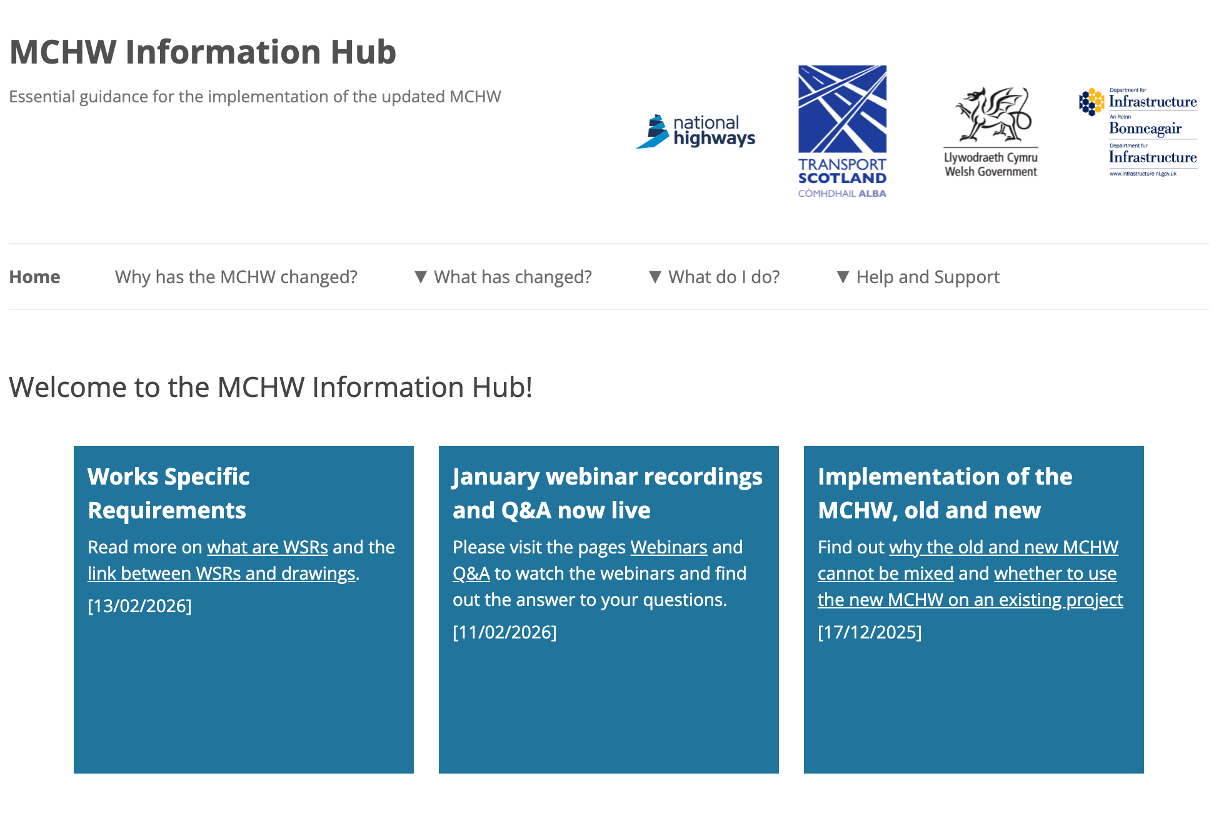
National Highways has also launched a dedicated MCHW Information Hub to support the transition. The hub provides guidance on implementation, document mapping between old and new standards, and practical advice for different roles across the supply chain.
Ultimately, the changes aim to bring greater clarity, consistency and efficiency to highway project delivery, by removing ambiguity in specifications and standardising how requirements are presented.
(Picture – Standards for Highways website)