
TOPAS’s Kealie Franklin writes for Highways News:
The choice is stark: Invest in standards now, or pay for their absence forever. The TOPAS (Traffic Open Products & Specifications) board says, in the wide-ranging article that follows, that it doesn’t need charity. It needs champions who understand that boring infrastructure done right is what makes exciting innovation possible.
It is not much of a stretch of the imagination to picture a local authority procurement officer faced with shrinking budgets, triumphantly announcing a £50,000 saving by purchasing non-TOPAS compliant traffic controllers from an overseas manufacturer.
Six months later, that same council is haemorrhaging money on emergency callouts, custom integration work, whatever the opposite of what turn-key might be called. The “bargain” equipment can’t communicate with existing infrastructure, the promise of AI features turns out to be marketing samoflange and when something goes wrong, as it will, as it does, guess what? no accountability, no support, and no recourse.
This isn’t a hypothetical. It’s happening across Britain right now.
Standards Are Infrastructure’s Immune System
TOPAS isn’t bureaucracy, it’s institutional memory crystallised into specifications. Every requirement represents a lesson learnt, often paid for in blood, delays, or public money wasted on failed experiments. When we abandon these standards to save money, we’re not being innovative or agile. We’re choosing amnesia.
Consider what standards actually deliver:
• Interoperability: Your Company X controller talks to your Company Y detector talks to your Company Z UTC system. Without standards? Welcome to the Tower of Babel, where every component needs a bespoke translator, nothing works out the box, vendors blame each other and nothing ever gets resolved. True Story.
• Competition: Standards create level playing fields. Remove them, and watch vendor lock-in return with a vengeance. That cheap proprietary system becomes very expensive when you’re held hostage by a single supplier and those value add ons.
• Evolution: Standards aren’t static they evolve through collective intelligence. TOPAS has adapted from simple traffic lights to complex adaptive control systems. Abandon it now, just as we’re integrating AI and connected vehicles? That’s like disbanding your R&D department just before a technological revolution.
And lets not forget, TOPAS itself was born from disruption, created specifically to prove that industry self-governance could deliver higher standards than government mandate.
The Funding Crunch Fallacy
“We can’t afford standards” is perhaps one of the most expensive sentence in infrastructure management. It’s the equivalent of saying “we can’t afford brakes” whilst driving downhill. The real question isn’t whether we can afford standards it’s whether we can afford their absence.
It does not take much of a stretch to imagine how every pound saved by circumventing TOPAS compliance becomes how many more pounds spent on:
• Integration nightmares
• Maintenance without documentation
• Safety validation without benchmarks
• Procurement without competitive tension
• Innovation without foundations
Britain invented modern traffic management. We export our expertise globally. Product TOPAS compliance isn’t red tape, it’s a mark of quality. Abandon it and we’re not just compromising domestic infrastructure we are surrendering our position as a global leader in transport technology.
The AI Wild West Is Coming
Now here is what’s truly provocative, just as traffic management faces its greatest transformation with AI, connected vehicles, and “smarter cities”, some suggest abandoning the very frameworks that could make this revolution coherent rather than chaotic.
Without standards like TOPAS, the AI revolution in traffic management won’t be revolutionary it’ll be anarchic. Every vendor will claim their black-box algorithm is “intelligent”, with no way to verify, validate, or ensure these systems work together. We’ll have “smart” junctions that can’t talk to “smart” vehicles, predictive systems that can’t share predictions …sound good? No, I didn’t think so.
The Path Forward
Constraints of funding adversely affect TOPAS and tie its hands. The answer isn’t to abandon it, it’s to make it indispensable. That means:
• Demonstrate value relentlessly: Every TOPAS requirements clearly link to saved money, saved time, or saved lives
• Accelerate evolution: Standards that don’t adapt become obstacles. TOPAS must lead on AI, sustainability, and active travel, not follow
• Build coalitions: Local authorities, manufacturers, and operators all benefit from standards. Unite them
• Make non-compliance costly: If standards are optional, they’re worthless.
Procurement frameworks should penalise non-compliance, not reward it Here’s the truly uncomfortable truth: The funding crunch will affect TOPAS. But it isn’t really about money. It’s about vision. It’s easier to not act than act. It’s easier to buy cheap than to buy smart. It’s easier to fragment than to coordinate.
Standards aren’t a luxury of prosperity they are the very foundation of it. The question isn’t whether we can afford to maintain TOPAS. It’s whether we can afford to become a nation where every junction is an experiment, every upgrade is a gamble, and every innovation is incompatible with the last.
Standards matter because chaos is expensive. And in traffic management, chaos isn’t just expensive it can be lethal.
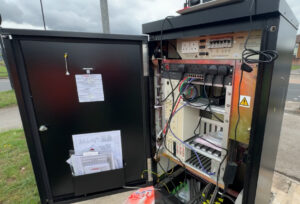
(Picture: Highways News)