The Transport Technology Forum Conference is underway in Leicestershire.
Highways News is keeping you up to date with the latest talking points.
9.40
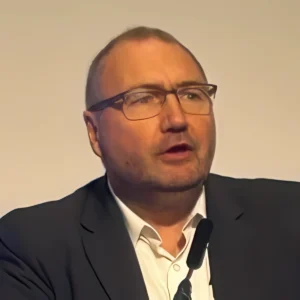
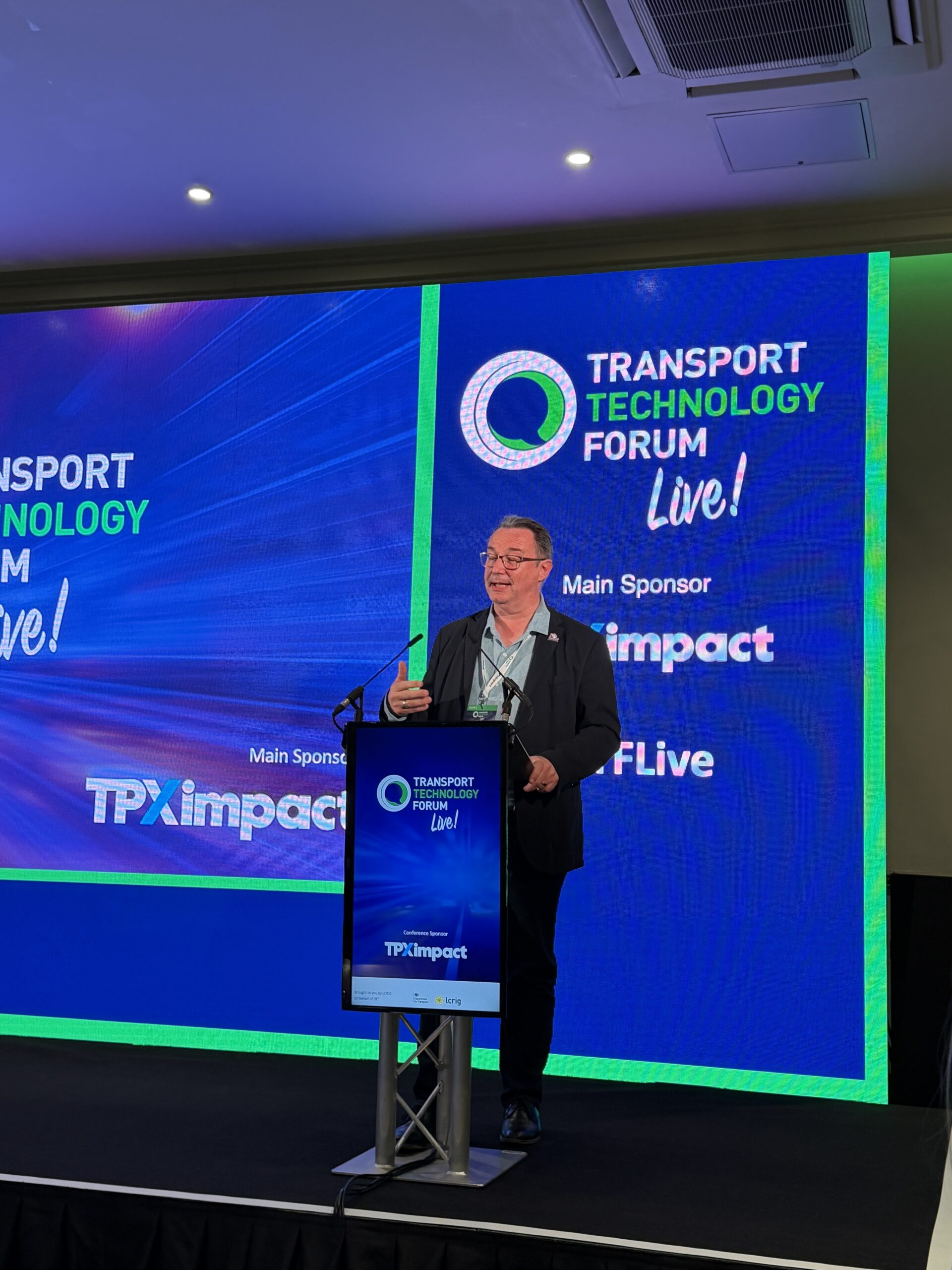
Darren Capes, TTF Manager and Head of Road Infrastructure Technology at the Department for Transport gets the event underway.
He welcomes delegates and talks about the key data demonstrations to come during the two days here.
“We are seeing more of a focus about how we use data in the infrastructure and in vehicles to deliver new services,” he says.
He talks about the Road Safety Strategy and how technology is vital to achieve the targets.
9.45
The DfT’s new Chief Scientific Adviser, Professor Patricia Thornley, gives her first keynote to the TTF.
Professor Thornley comments that she’s impressed by the exhibition and then talks about science, innovation and technology and how it can shape future transport.
She says to get innovation through, government, industry and academia must work together, and points to a number of papers published by government. She says the industrial strategy is powering government policy but hardly mentions transport, so we as an industry must promote transport.
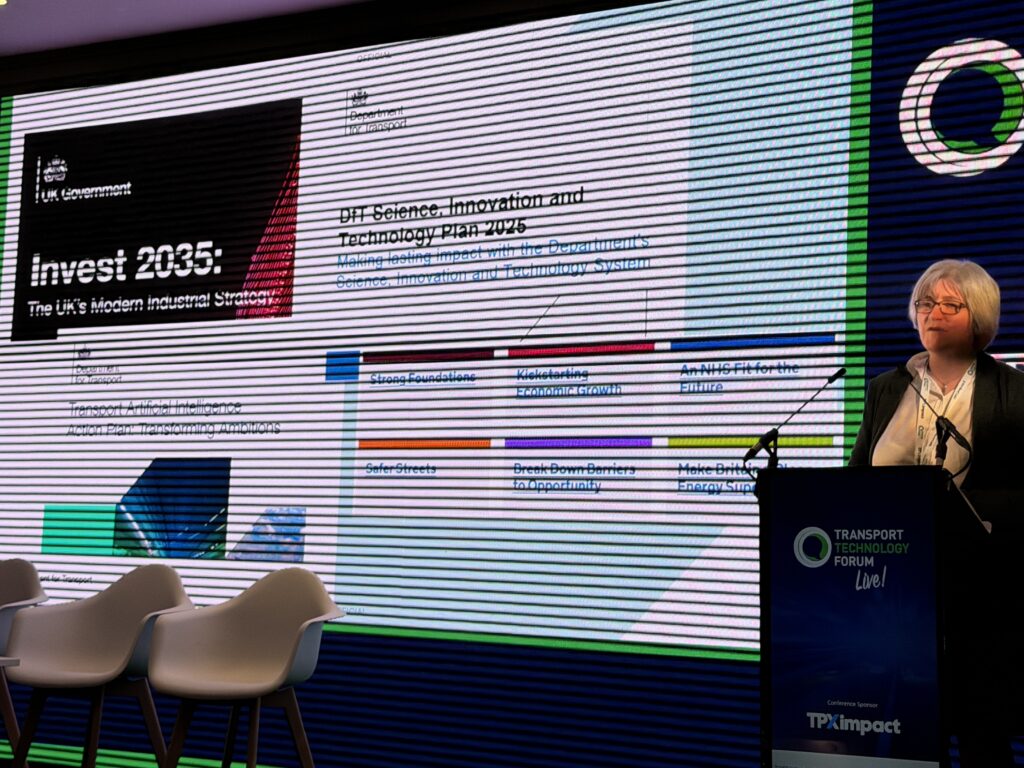
AI and autonomy are really, really important, she says. There is a huge focus on the ability of AI and other technologies such as quantum to kick start growth. If you can’t find money in transport, look at AI and quantum funding and see how you can get transport into that.
She stresses alignment with policy to get products adopted and to get the concepts to people beyond the transport sector.
We want to understand better how to use AI and how we can use it to provide data around how we are kickstarting economic growth and delivering growth. (See here).
“If I can get data from you that shows how technology is improving transport around the country, I can make the case,” she says.
10.00
Next up, DfT Head of Digital Twins George Economides.
He defines a digital twin as a two-way communication between a physical asset and its digital representation with a functional output, and that digital twins lend themselves to increasing automation, with right time inforamation to keep up to date and enable predictive management.
He lists examples where digital twins have helped, from reduced emissions to improved safety, accelerating new technolgies.
He summarises the DfT programme around leadership, infrastructure, applications, skills and communications and talks about working with the National Digital Twin Programme to enable safe, secure and interoperable access.
10.15
Next we’re talking about the importance of fitting in with European Standards with Mohanad Ismail, Associate Director of WSP, talking about “Why Europe Matters”.
He opens sayin ghat the government should do less, and to reuse things if possible.
He summarises the European Transport and Mobility Landscape around EU policy and strategy, data and digital mobility, connected and automated, sustainability and standardisation and collaboration.
He explains how the current UK position mirrors the EU direction, for example around road safety, and there are parallels in data ecosystems. He says CAM ambitions are aligned, urban mobility and EV transition is following similar trajectories and there are shared standards.
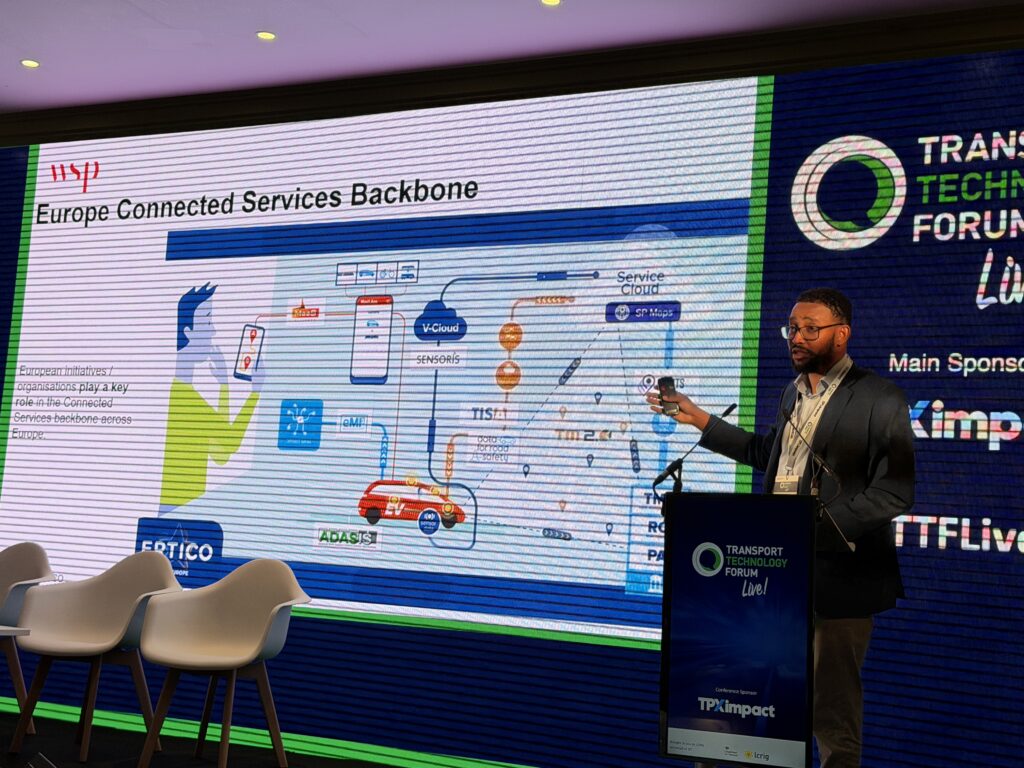
He then focusses on a “practical real life example” – the Data for Road Safety initiative and lists key benefits around supporting the UK’s road safety strategy, enhances hazard detection, future proofs Euro NCAP integration and contributes to Vision Zero goals. He points to this site.
Mr Ismail then talks about potential future benefits to the UK around napcore, Sensoris, TISA/C-Roads and Euro NCAP.
10.30
We now hear from Michaela Nelson, Head of Advanced Connectivity Technologies at DfT to talk about assessing the digital connectivity requirements of the UK’s transport network.
She explains how fragmented connectivity is:
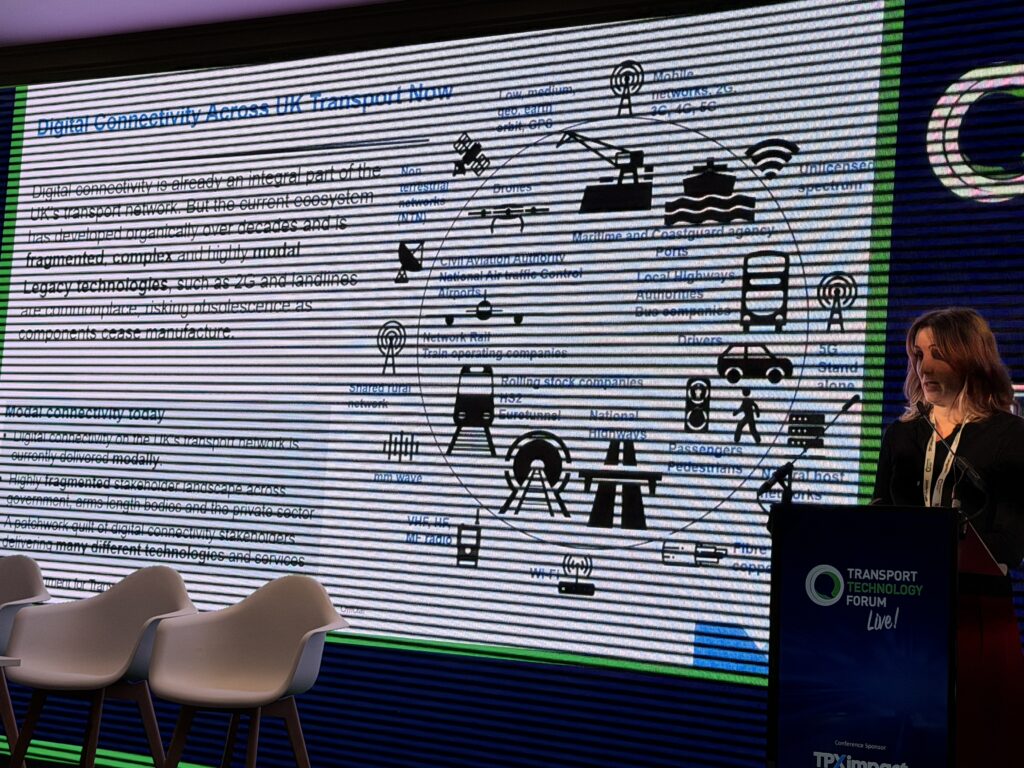
And discusses a delivery approach until 2027 across transport, water and energy.
The opportunities identified are around cross-modal opportunities including real-time data for trnasport integration, dynamic traffic management and infrastructure monitoring for predictive maintenance and improved safety, with strategic opportunities around new 5G system FRMCS on railways, connected vehicles and beyond line of site operation of unmanned arial systems.
Users and use cases are around travellers, logistics and transport operators, vehicles and infrastructure managers.
She summarises the needs assessment for the road network and use cases and impacts:
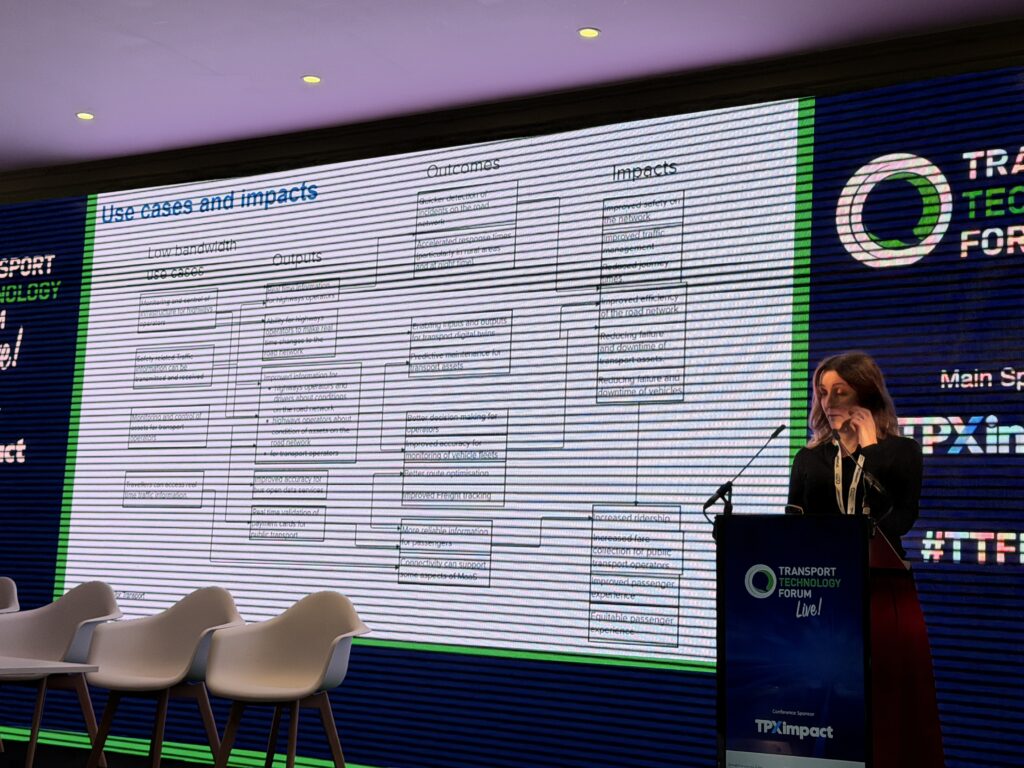
She says it is difficult to track how digital connectivity delivers quantifiable benefits so they are working on making a clear case for improving digital connectivity and plugs this survey.
10.45
We now hear from Michael-Jordan Faucher-Folie, transport lead at sponsor TPXimpact to talk about what transport can learn from the rest of government.
He talks about Hackney community transport and how it supported individuals to find and connect with individuals, help carers and and the cared for get about. And he learned how transport is a means to make positive change for citizens in our society.
He lists lessons learned across government, from building a community of local planners to make it easier to apply for funding. “Across all of our projects, there is a theme – data challenges are human challenges.”
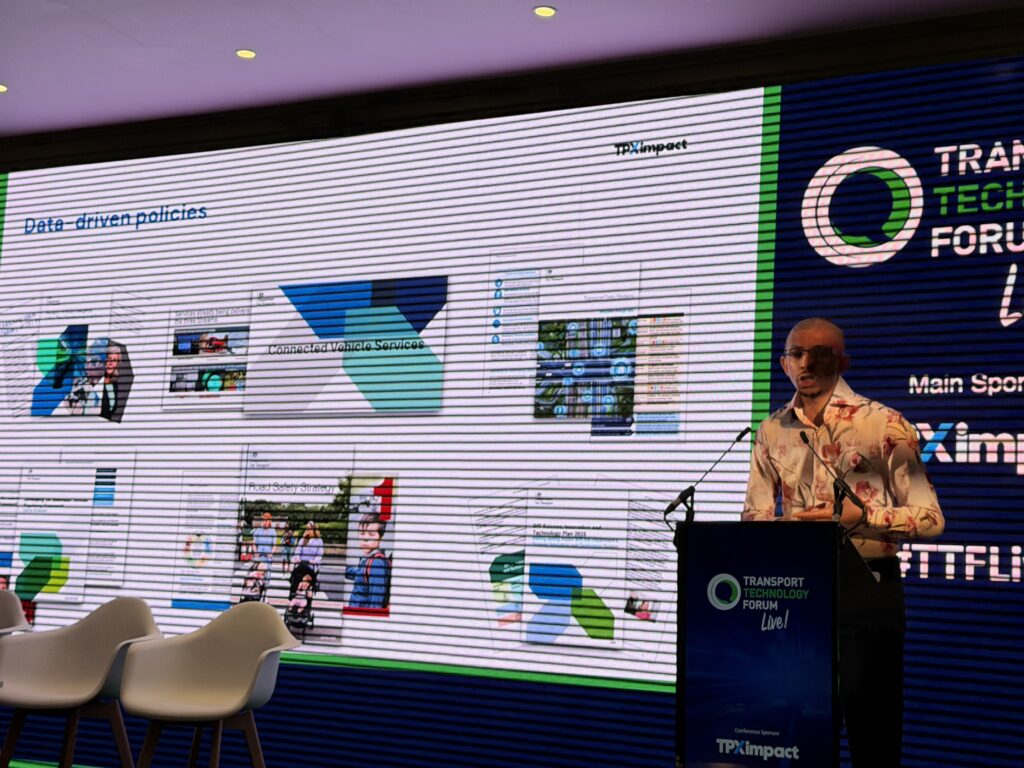
He points out “the planning system was not designed for the internet” and then says “the planning system was not designed”. He explains “we were brought in to make planning work for the 21st Century’ and opened the open digital planning community, around standards, services and support, and built the Planning Data Platform.
He asks the audience “what areas of transport require a human approach to data?”
He then talks about his initiative to reduce paperwork and he talks about his equivalent to Woolworth’s Pick n Mix to be pick n mix for applications, saving assessors and increasing applications by 400%, and draws a parallel between funding service design and transport, so instead of creating multiple unique application processes and streamline the funding mechanism that we can all use.
11.00
We’re now taking a break for coffee and visiting the exhibition. See you at 11.45.
11.45
We’re back and Head of Road Infrastructure Technology at the DfT, Darren Capes, is talking about developing a set of deliverable connected vehicle services.
He explains it’s a new concept and we are thinking about data as a massive resource that is under-used.
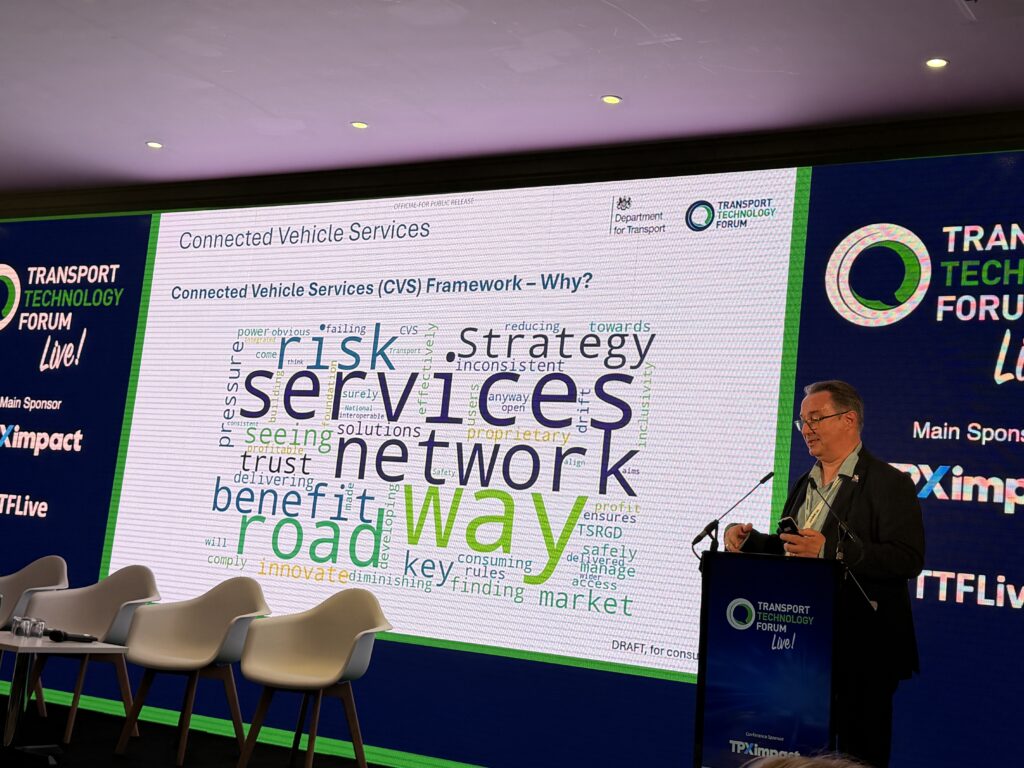
He explains there are connected vehicles with increasing levels of data, and connected infrastructure, connected services and then users. So this framework is considering a likely range of services, providing a tool for thinking about services and interventions. It allows services to be ordered into groups that can be delivered now or later, and provides a mechanism for considering policy.
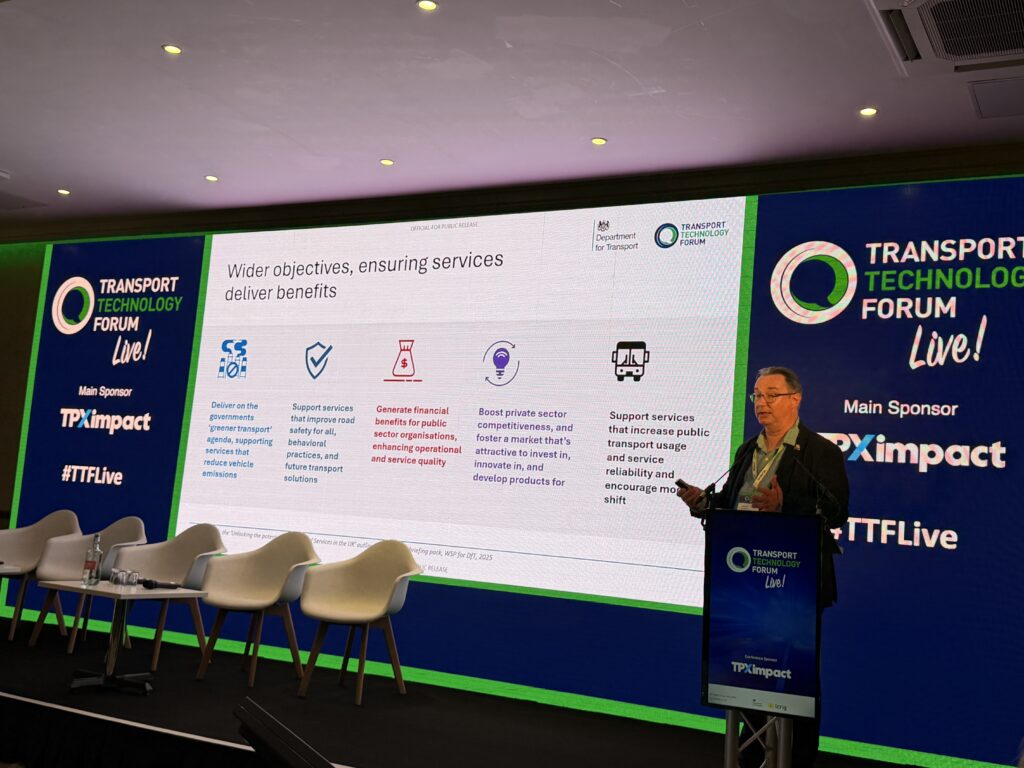
He sums up the wider objectives, ensuring services deliver benefits:
Darren Capes explains the three connencted infrastructure/vehicle streams:
Stream 1 is infrastructure to vehicle, stream 2 is the vehicle to infrastructure and stream 3, later, is two-way connectivity.
This delivers benefits around moving from the roadside to delivery of data in vehicle, while using vehicle-derived data to better understand the state of the network. Stream 3 can automate management of vehicles and payment for services. He then goes into detail about examples of potential connected solutions that will be demonstrated during interactive sessions on Wednesday (18 March).
He shows the here-and-now solutions that can be better exploited:
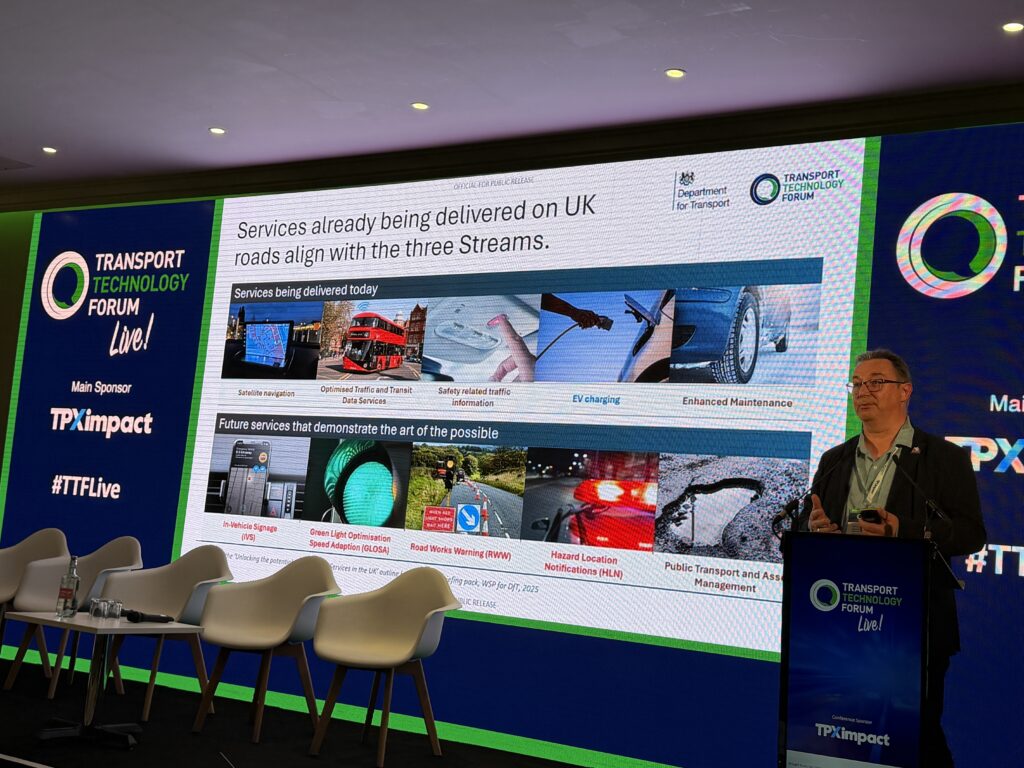
He uses the “WhatsApp example” to describe the solutions he is talking about.
“If we don’t do the work we won’t get the funding, so we’re doing the work now,” he concludes.
12.09
He now welcomes Jo Britton, who is director of PACE Development, and independent facilitator who has worked in the consultation on the CVS.
“I observed in the sector so much enthusiasm, and willingness to collaborate,” she says as she summarises the results.
She explains that they consulted with 37 local highway authorities, 42 senior representatives across all English regions, along with 55 organisations in the supply chain, with 72 senior representatives and broad market coverage. She was testing the CVS Framework, identifying adoption barriers and enabling actions.
Local Authorities said connected vehicle services are about evolution of existing transport systems, with a route to proactive network management and an enabler of safer multimodal transport. The supply chain said it’s technically capable of delivering CVS< has a strong commercial appetite and international experience of delivering services. The key is, there is sector alignment and they all support the direction of travel.
A key point is that language is important – it must not just be vehicles but multimodal, framing strengthens the case for adoption and public benefit.
“Data is a strategic enabler”, but the focus is now on governance and ownership, interoperability, efficient sharing at scale and avoiding duplication and lock-in with vendors. Clear frameworks are needed.
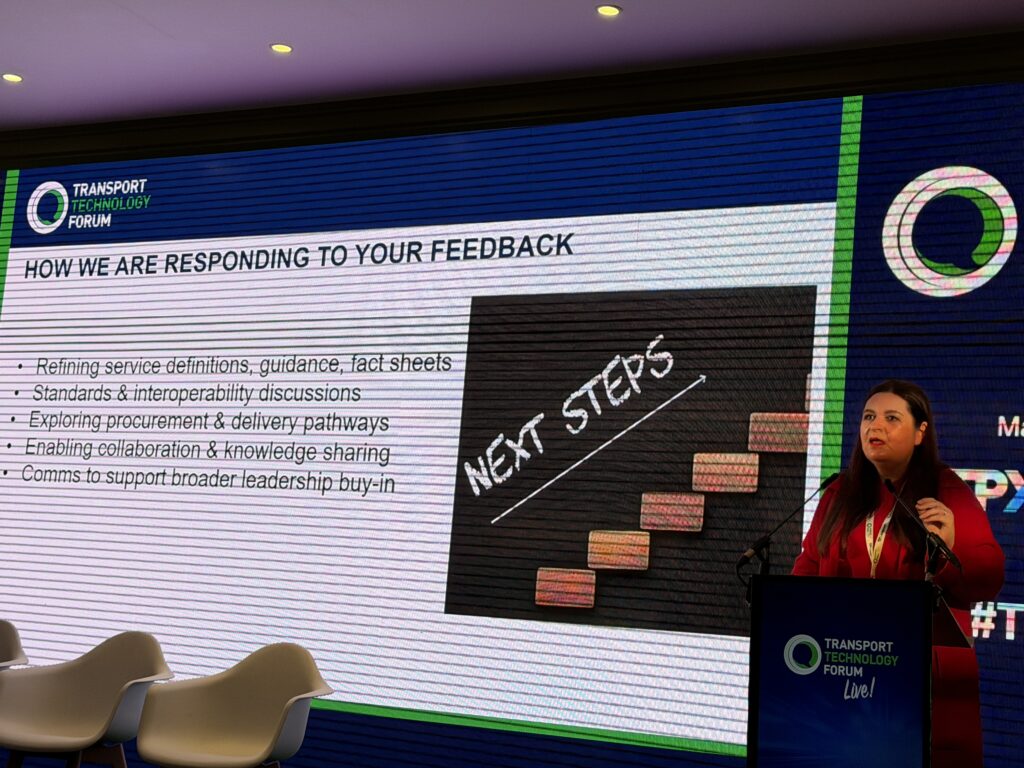
They talked about unlocking adoption:
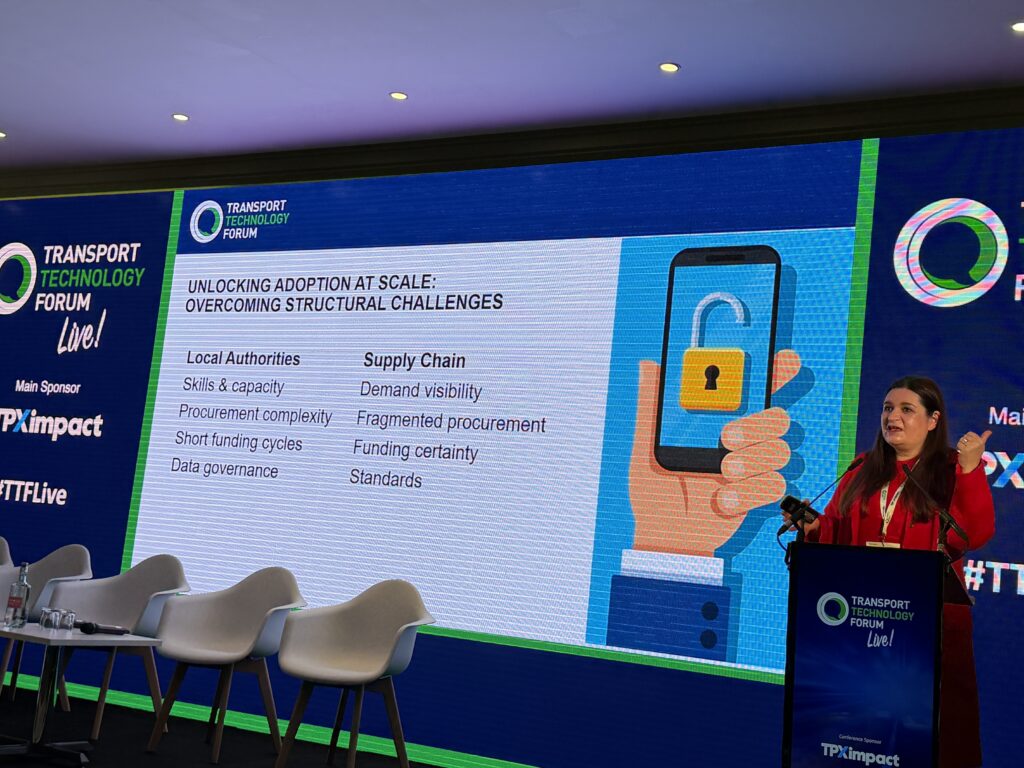
Moving forward, the TTF with LCRIG have worked from understanding and alignment, moving onto enablement and adoption and then scaling this. The next step ois to help create the conditions that enable authorities to adopt services and the market to deliver them at scale.
12.22
Next up, Darren Capes returns to the stage to talk about the Manual for Smart Streets. He says it is a really useful framework to provide guidance for adoption of technology, but he feels it has been under-used. “We now have a strong opportunity to do that,” he says, and he is rethinking the MfSS to turn it into a single point of guidance.
“The MfSS provides a central resource for supporting local authorities and their supply chains in the use of technology to meet wider strategic aims.” He says it’s the took for the DfT to use to support implementation of connected services.
And explains how it may look in the future:
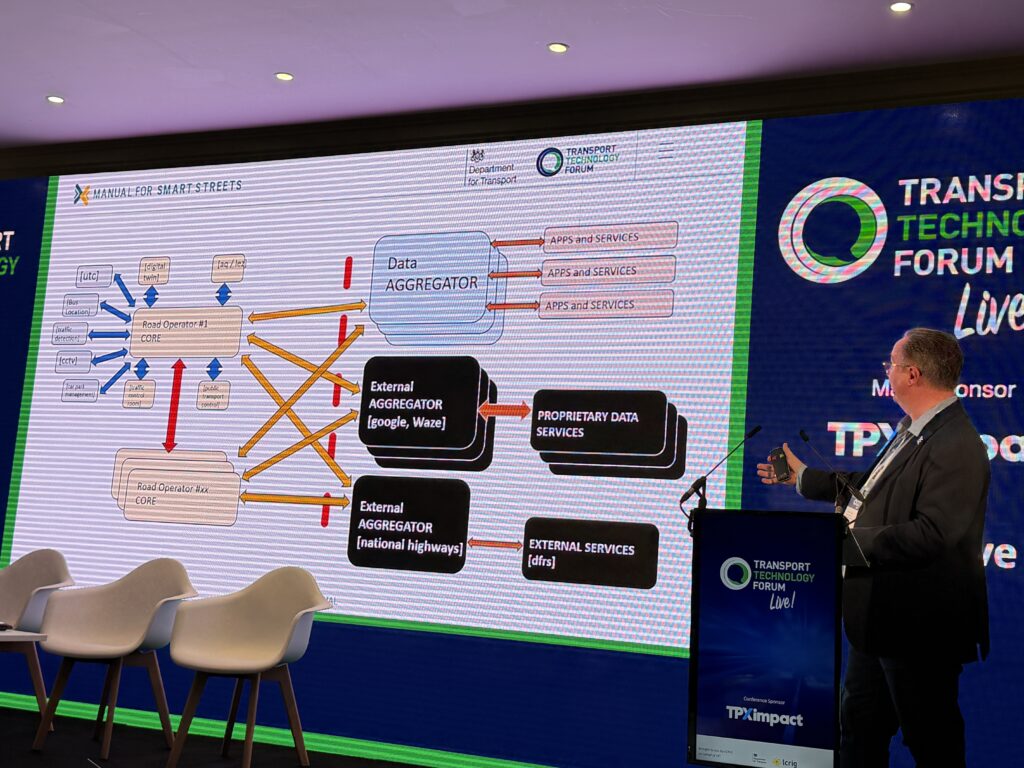
“It won’t be government’s job to deliver that, we will help local authorities and combined authorities deliver this through the Manual for Smart Streets.” He then adds: “By this time next year, we’ll be providing the guidance to help authorities deliver what’s needed for connected services.”
12.32
A panel now discusses the MfSS, supporting the adoption of connected services. The panellists are (L-R in picture):
- Mark Pleydell – DCIS – Digital Controller Interface Standard
- Jonathan Mann – CVS – WSP
- Paul Chandler – DTRO Service Owner at DfT
- Mark Cartwright – UTMC
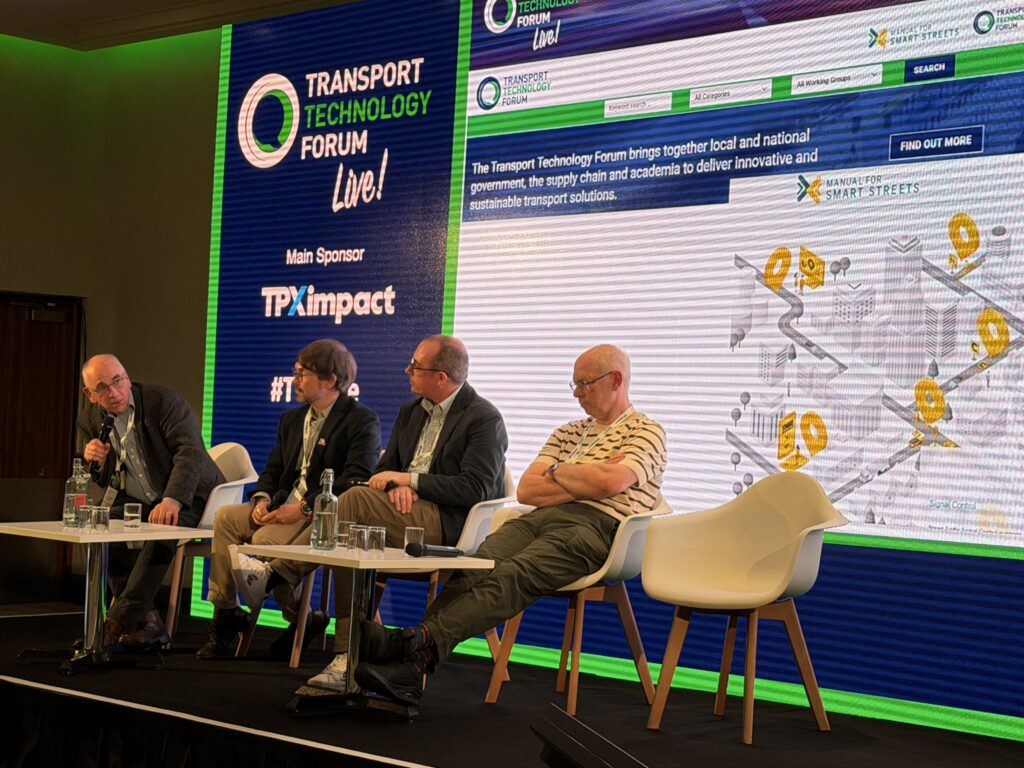
The panel focused on how better use of data, standards, and collaboration can transform traffic management and enable connected vehicle services. With DCIS, it was highlighted how standardising information about traffic signals ranging from basic network data to detailed configurations and real-time controller outputs, allowing systems to predict and respond to network conditions more effectively.
Speakers emphasised that strong technical foundations already exist, with evolving standards and frameworks (like UTMC) now shifting toward defining practical services that local authorities can implement. The importance of interoperability and avoiding “reinventing the wheel” was repeatedly highlighted.
Digital Traffic Regulation Orders were identified as a major opportunity, enabling accurate, real-time information for drivers and connected systems.
The discussion also stressed empowering local authorities with accessible guidance, shared knowledge, and proven use cases to reduce risk and accelerate adoption. Finally, the UK was positioned as a global leader in this space, with export potential for its standards and data-driven approaches.
13.00
It’s lunchtime now, back at 14.15 for a session chaired by… Paul Hutton.
14.15
We’re back after lunch and we start with Paul Hutton giving a summary of the Round Table held yesterday (Monday 16 March). It featured:
- Sponsors AECOM for the supply chain and consultancies
- National Government
- A city council
- A county council
- A combined authority
- A non-UK national authority
- ITS UK
Our question was:
Technology In Transport – Opportunities for Road Users. What do we think are the key ways that transport will be transformed by technology in the next five to ten years?
Key Action Points
- Develop clearer national transport technology priorities and policy direction.
- Create open standards for transport data and connected vehicle systems.
- Expand national transport data platforms and ensure high-quality, validated datasets.
- Improve business case frameworks so digital investments can be assessed more effectively.
- Address the skills gap in digital and data expertise within transport authorities.
- Promote collaboration and knowledge sharing across authorities and industry.
- Integrate digital systems into wider transport planning and infrastructure investment.
- Improve communication of technology benefits to politicians and the public.
Key Lessons from the Discussion
- Funding and governance structures are bigger barriers than technology itself.
- Digital infrastructure is becoming as important as physical road infrastructure.
- Authorities must maintain control of trusted transport data.
- Transport technology benefits are often system-wide and harder to quantify.
- Skills shortages in data and digital systems are slowing adoption.
- Technology will likely improve existing networks rather than replace them.
- AI and predictive analytics offer opportunities but depend on better data.
- National leadership and standardisation will be essential for scaling solutions.
What they asked for/quick wins:
- Harness more data into more services to be effective
- Show the art of the possible
- Make the most of work the private sector has done, like use the Insight Platform from Clearview Intelligence, was an example given
- It’s not just transport planning now, it’s pre-emptive information to optimise and influence the user
- eCall data not only to emergency services but to road operators too
- Continue to show the art of the possible
14.26
Andrea Reacroft from Tees Valley Combined Authority now is talking about the “Smart Region Journey”.
She talks about the £500,000 DfT Traffic Signals Fund payment 2021-23 and then introduced a new UTMC system, leading to a number of improvements including a new control room, additional CCTV camerass and links to the control room, new VMS, counters and ANPR cameras.
The £10 million Tees Velley Digital Transport Delivery Plan delivers a digital twin, digital services and a regional data platform, which involves live Aimsun modelling, incident detection module and greater bus reliability.
In phase 2, there will be enhanced incident detection, Aimsun Plus which is an advanced simulation and modelling tool to test scenarios, more floating vehicle data and blackspot detection and sensors.
The authority is using digital services including Fusion, In-vehicle VMS, real time passenger information, lift and escalator statuses application, further UTMC development and the bringing of the UTMC team in-house.
There is now a £60 million Transport City Region funding pot for 2027-32, using more on the digital twins and digital data, to create a single platform across Tees Valley.
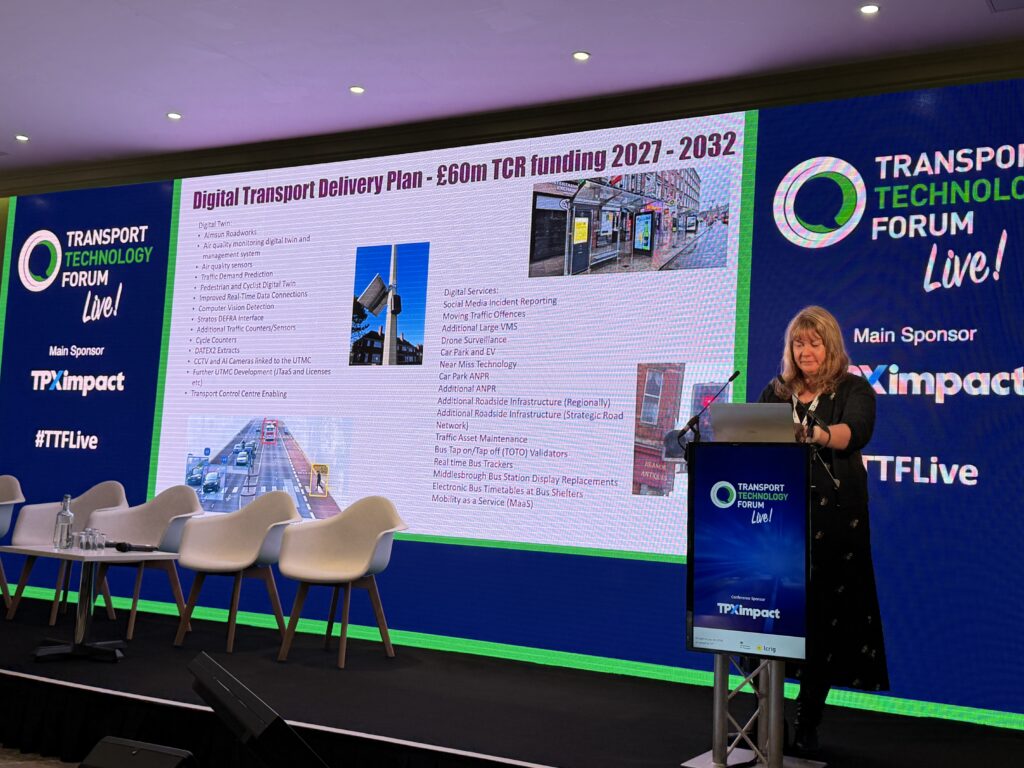
There is also an autonomous test bed at the local airport helping baggage movement and some passengers.
14.40
Paul Bowker from the London Borough of Hackney is next talking about connected services – a view from inner London.
He says they have an 87% sustainable mode share, and 65% of residents are car-free. Since Covid there has been a 4.3% reduction in traffic and since 2017 there has been a 49% improvement in air quality. But 44% of traffic in Hackney is through-traffic.
Paul Bowker says his issue is not connected vehicles, it is connected users because of the number of people who do not rely on the vehicle.
“Can we get more sustainable transport and allow autonomous vehicles in our borough?” he asks. Does it enhance the safety case and not increase the amount of traffic, he asks.
He talks about future modes being pedestrians, cyclists and bus rapid transit – in that order. He wants pedestrians to get priority. He also wants to do that with cyclists so they have safe priority.
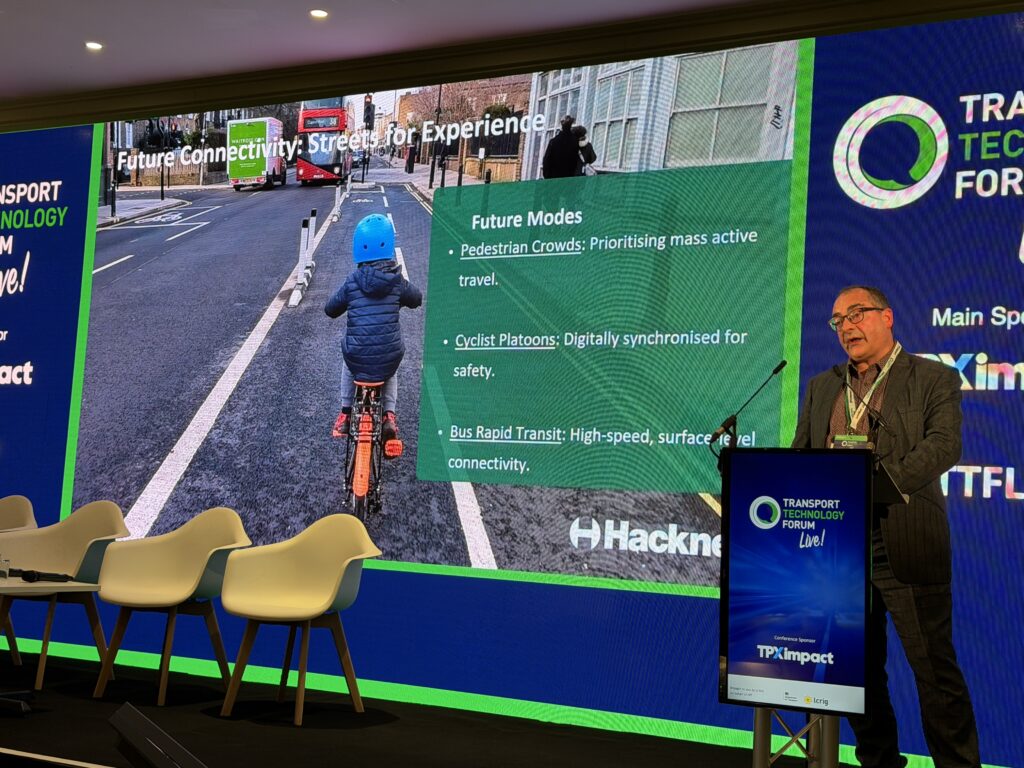
Mr Bowker explains the smart integration, with air aware live air quality data, dynamic kerb management and personal health data linking travel choices to environmental impact.
“I want to volunteer to DfT and TfL – talk to us so we can run pilots and be a test bed,” he says. He then gives a case study around connected services and the council’s housing maintenance processes – “if you have a solution, come and talk to me because we want to buy it!” he says.
He then concludes he wants to collaborate and demonstrate. “A connected user in Hackney is a user with the freedom to choose sustainability every single day,” he says.
14.50
Carl Gillyon, Head of Highway Network Management at the East Riding of Yorkshire Council is next, talking about “from collision clusters to connected insight.”
His question is: “What are you going to do – traffic management team – about fixing this accident waiting to happen?”
He talks about limitations of historic crash data, false safety assumptions, lack of leading indicators and a shift to proactive safety. He is worried that any solution without data could “engineer in” a problem, rather than “engineer out”, but if there is a perception of a risk at a location, then there probably will be an issue.
He says this means you have to move to a much more proactive solution to decide where you engineer and intervene, with a proactive risk focus, modern data utilisation, supporting of vulnerable users, with community trust and policy alignment. “I truly want to make decisions using connected vehicles to allow us to make decisions.”
15.00
Paul Hutton then hosted a panel with Paul Bowker of Hackney Council, Carl Gillyon from ERYC, Ian Large of Blackpool Council and Darren Capes, HORIT at DfT.
The panel focused on how connected vehicle and data-driven technologies can improve transport systems by shifting the emphasis from vehicles to connected users and journeys. Speakers highlighted that most trips don’t involve cars, so connectivity should support all modes – walking, cycling, public transport – not just vehicles. A key theme was the value of real-time and predictive data to improve safety, manage congestion, and enable more efficient, informed travel choices.
Local authorities described differing challenges (urban vs rural), but shared common needs: better access to usable data, tools to manage traffic flows, and ways to influence traveller behaviour. However, barriers remain, including procurement complexity, limited resources, and uncertainty about what data is most useful.
The discussion stressed focusing on outcomes rather than technology, with frameworks helping define goals like safer, more efficient journeys. Collaboration with suppliers is crucial, particularly around open standards and interoperability. Overall, the session positioned connected data as a way to make travel more seamless, efficient, and user-focused, while acknowledging the practical challenges of implementation.
Paul finished with a plug for the ITS World Congress 2027 in Birmingham.
15.30
Afternoon tea and networking break.
16.24
We’re back with the ITS World Congress with Chris Lane, Strategic Head of Transport Innovation, Transport for West Midlands. He says the live event tomorrow is a “dry run” for the event next year. He lists the “what’s in it for you” around auditioning global showcases, changing your thinking, accessing money, forming partnerships. He says “everyone’s talking about it” – not surprising given the scale of the event.
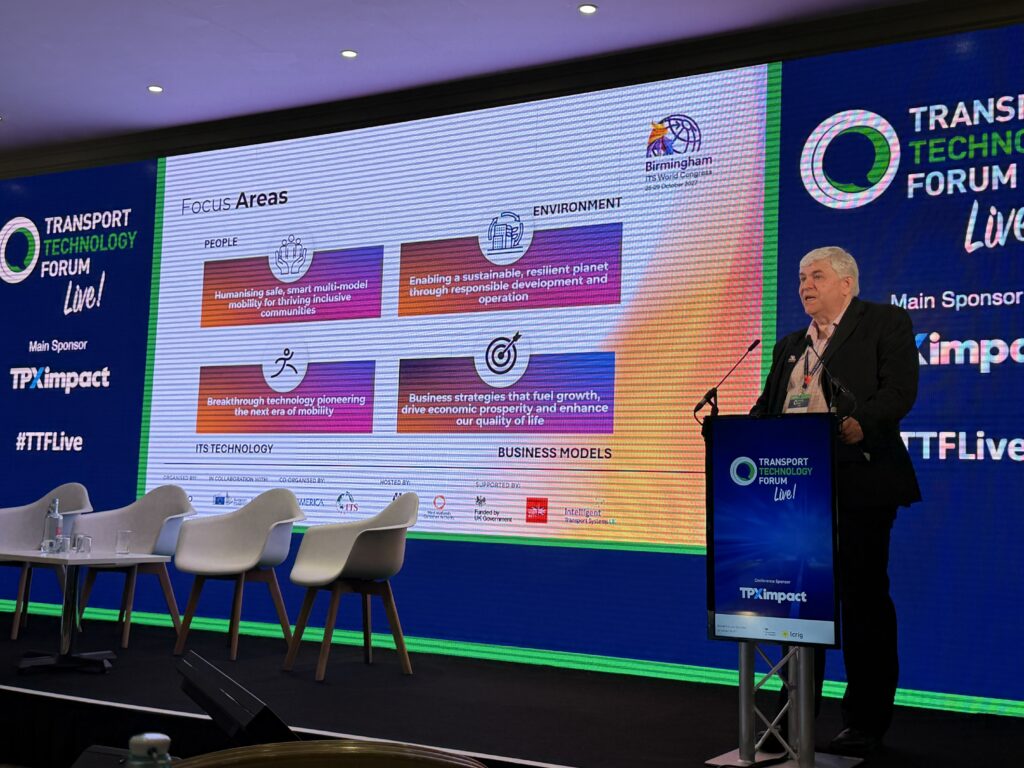
Mr Lane enthuses the room talking about the event, and innovations across the country will be promoted.
16.35
Next it’s Lee Street, Director and Head of Technology Services at AECOM. He is talking about Ireland’s Connected Vehicle Pilot – its outcomes and transition to operations.
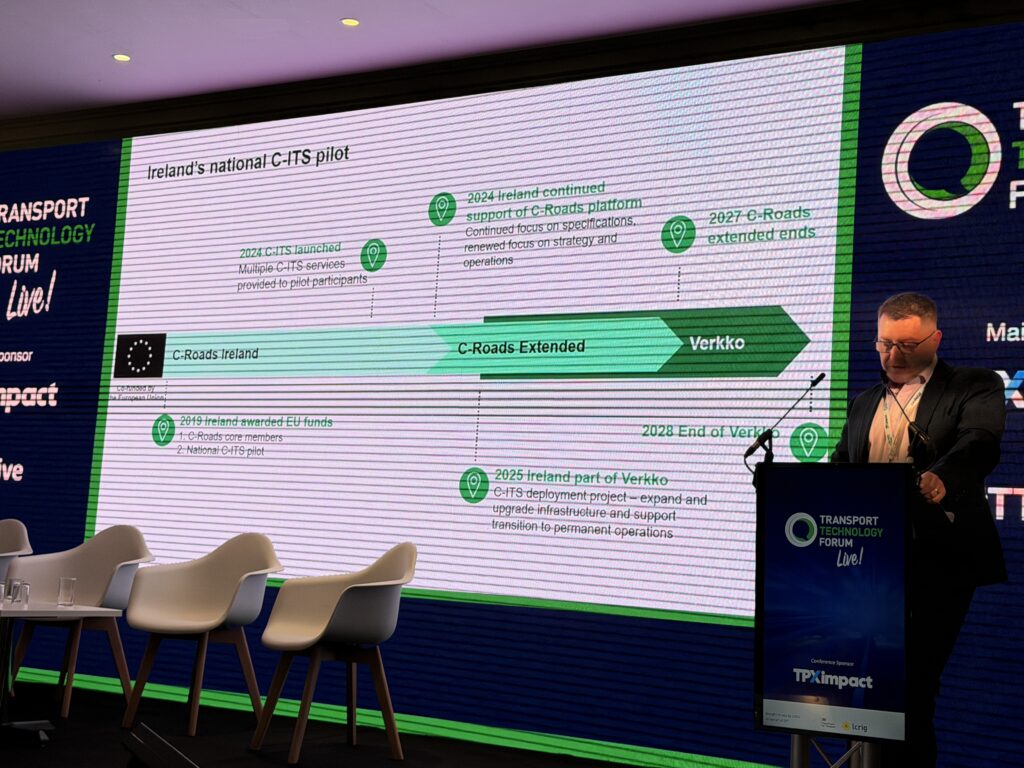
He explains the pilot’s timeline.
Key achievements to date include integration of C-ITS into Traffic Infrastructure Ireland’s traffic management centre, has hybrid communication, C-Roads compliance, in-vehicle device services and a technical and impact evaluation.
“We had improved safety, better efficiency, reduced journey times and lower emissions, and a key reason for that was behavioural drivers made earlier and better informed decisions, and that was the consistent feedback we got back from the user data,” he said. “Technically the system met all the requirements. It operated reliably, reliably, securely. We have low latency communication, and we integrated that widely.”
He then explains: “This platform delivers huge efficiencies in deployment, removes duplication, manages risk, and it ensures the systems that interoperable across Europe.and it also will provide a level of deployment with traditional its systems as well.”
16.49
Dr Andy Hamilton, Head of Product Management at Yunex Traffic, talks about “bringing FUSION to the UK”.
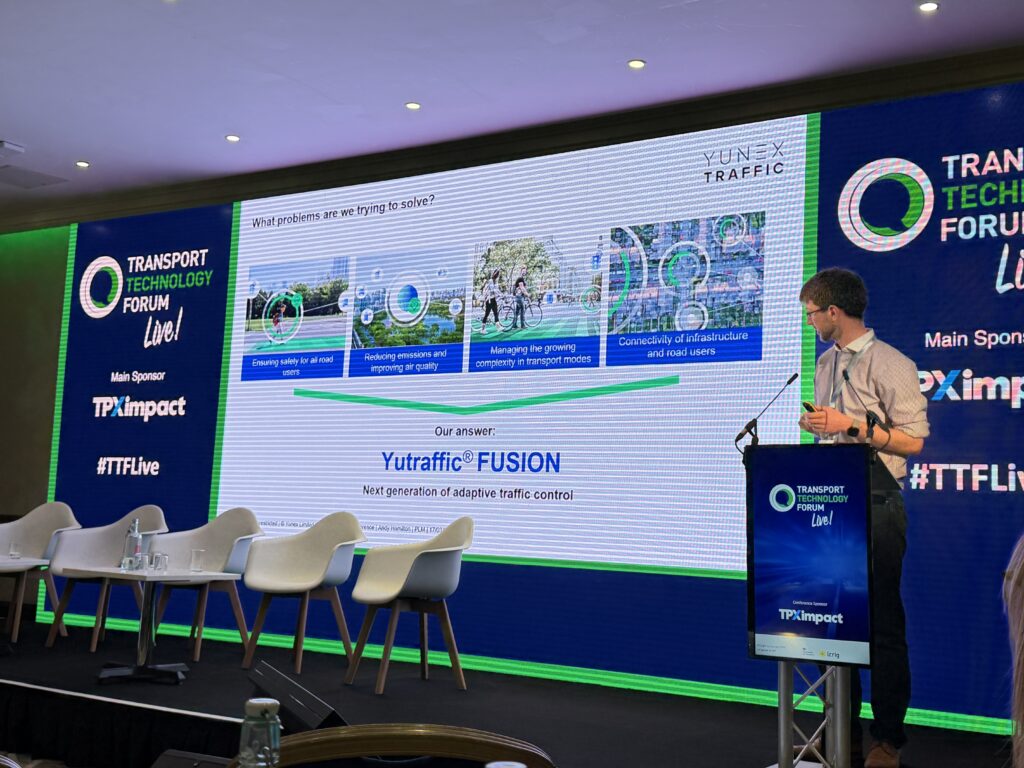
The presentation outlined the development and deployment of Yunex Traffic’s FUSION adaptive traffic control system, created in partnership with Transport for London. Designed as a modern replacement for legacy urban traffic control systems, FUSION adopts a multimodal, user-focused approach, considering pedestrians, cyclists and public transport alongside vehicles. Its core aim is to improve road safety, air quality and network efficiency while addressing the growing complexity of urban mobility.
He explained how the system has been developed collaboratively and iteratively, using agile methods and continuous feedback from deployments. It is designed to work with existing infrastructure, avoiding costly hardware replacement, while incorporating evolving data standards and connectivity capabilities. FUSION has already been deployed across hundreds of sites in London and internationally, with expansion into Europe, the Middle East and the US.
Key benefits include improved traffic flow, reduced journey times, and increased usability for traffic engineers, with faster configuration and greater flexibility. Ultimately, FUSION represents a scalable, globally applicable solution that supports smarter, more sustainable transport networks while enabling local customisation to meet diverse city needs.
17.00
Darren Capes closes the day and invites everyone back to tomorrow.
All the sessions are being recorded and will be shared on the TTF website in due course.
(All pictures – TTF)