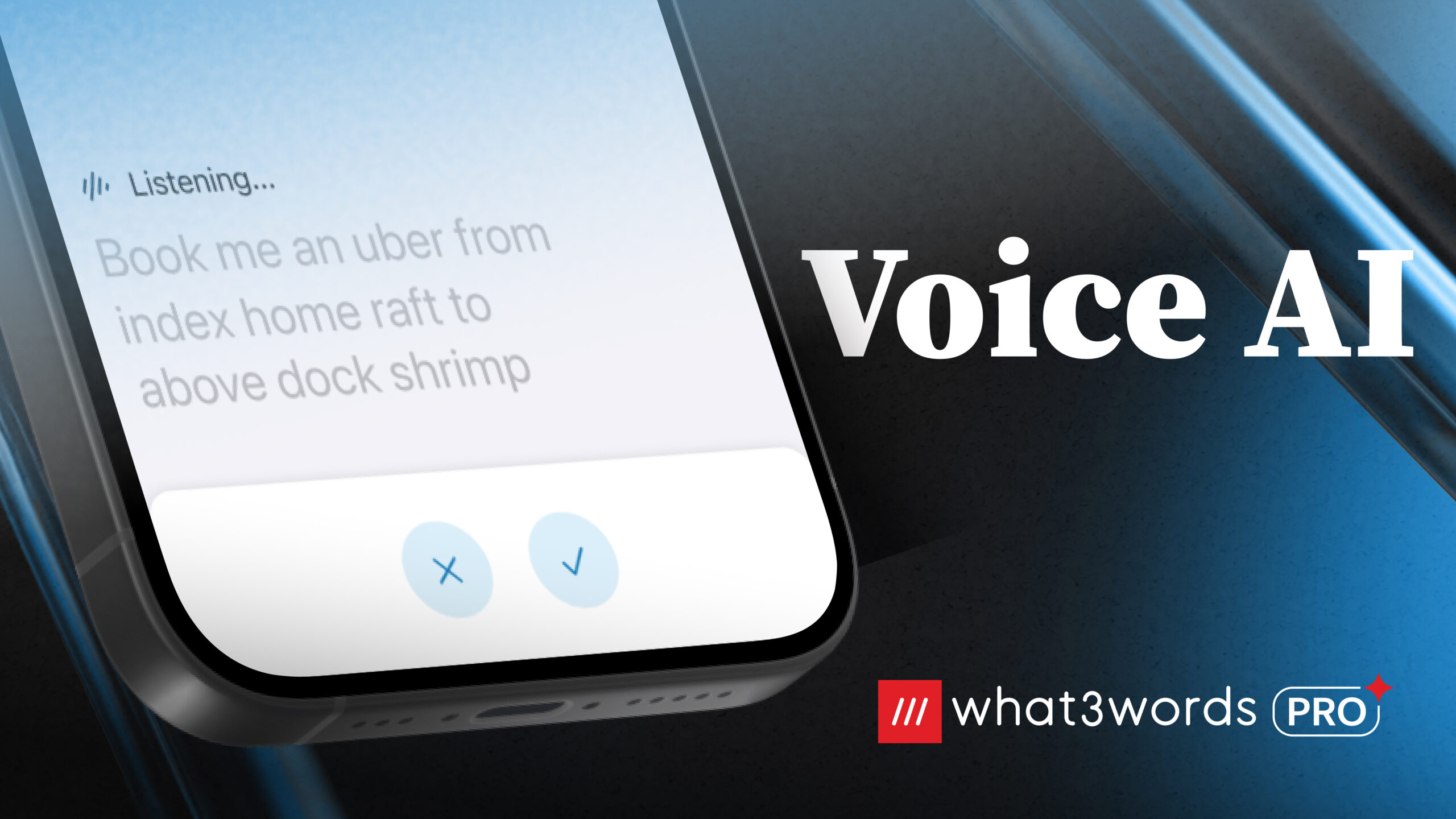
Innovative location technology what3words has announced the launch of what3words AI, an intelligent assistant fully integrated with its core technology.
The AI tool can instantly recognise, understand and organise what3words addresses seamlessly from natural language inputs via voice and text commands, simplifying and accelerating location-based tasks. Businesses can access what3words AI via the new Pro tier in the app or online map, or embed it directly into their existing AI tools and agents via an API. This empowers teams to easily input, query and organise accurate location data in different formats and volumes, enabling efficient planning and better customer outcomes. The system leverages OpenAI’s frontier AI technology to create this powerful, robust and accurate solution.
The AI revolution has highlighted an increased expectation for these tools to handle real-world tasks across industries – from e-commerce journeys to field operations. However, an underlying limitation still persists: street addresses weren’t designed for the 21st century. AI tools can struggle with the ambiguities of traditional addresses, which can be long, cover large areas, are often duplicated and sometimes don’t even exist for newbuilds or remote locations. These inconsistencies, combined with frequent database updates and varied global formats, further complicate AI processing. Even the smartest AI is only as accurate as the data it can access, which is why what3words’ new offering is a solution to making voice-first AI functional and reliable for a variety of use-cases.
what3words has divided the world into a grid of 3m x 3m squares, and assigned each square a unique combination of three words: a what3words address. This means every stadium gate, parking space, warehouse entrance, and point on the motorway has its own what3words address. For example, ///filled.count.soap pinpoints the exact entrance to what3words’ London HQ, which can be difficult to find with its traditional address. The technology is available in over 60 languages to date, and is free to download as an app for iOS, Android, or use via the online map at what3words.com
AI and voice technology are fast becoming the preferred interface between humans and machines, and the consistent format of what3words addresses (///word.word.word) is inherently well-suited for AI processing. Years of public usage and millions of online references meant that, when development began, LLMs were already primed to recognise what3words addresses with ease. The challenge in building a functional AI chat lay in configuring LLMs to accurately identify and geocode what3words addresses from natural language inputs. what3words’ solution leverages OpenAI’s frontier AI technology, including gpt-4o-audio and gpt-4.1 to deliver an intuitive, voice-first AI chat that can optimise and simplify operations using accurate location information.
Matt Weaver, Head of Solutions Engineering for EMEA at OpenAI, said:
“what3words’ new voice enabled AI chat is a great example of how businesses can apply frontier AI to solve real-world challenges; in this case, making finding locations faster, easier, and more intuitive. By harnessing OpenAI’s latest multimodal models – spanning voice, text and vision – what3words’ new Pro features are a powerful demonstration of how advanced AI can be embedded across a product to deliver genuine value for the people and businesses who rely on it every day.”
Building on its core offering, what3words AI can now be experienced in the new Pro tier of its app and online map to make light work of complex location tasks. The new chat capability brings advanced AI features directly to the user’s fingertips from £3.49 per month, with enterprise packages available. Benefits include:
- what3words Voice AI: The voice AI feature can identify what3words addresses in natural, conversational speech, allowing users to enter queries in their own words
- Import files: Instantly pull multiple what3words addresses from PDF, CSV and image files – streamlining and speeding up working with large numbers of precise locations
- Live Scan: Use the device’s camera to scan multiple addresses at once – and then save or map them with just one tap. This feature is particularly useful for extracting locations from printed documents, signs or job lists
- Organise addresses: Business users typically handle large lists of what3words addresses, and the AI chat makes it easy to organise and use saved locations for key sites assets, delivery locations and much more
- Plan routes: The AI chat can connect to a navigation provider like Apple Maps or Google Maps to make an optimised route to – and between – multiple what3words locations. Handy for organising delivery routes or navigating to specific locations
(Pic: what3words)