The Department for Transport has published its accounting officer assessment summary for the Lower Thames Crossing project.
The assessment was completed after a re-baseline of costs and a decision on the preferred funding model for the Lower Thames Crossing project taken as part of the Autumn Budget in November 2025. This accounting officer assessment (AOA) has been produced by DfT in conjunction with National Highways.
Among the Government’s conclusions were:
The accounting officer assessment (by the UK Department for Transport and National Highways) supports continuing public funding for the LTC project. The preferred financing model is a regulated asset base (RAB) structure, in which the project is funded and paid for largely through charges on users (e.g., tolls) and private sector investment, limiting direct taxpayer exposure.
Under current plans, government spending on the crossing is committed until 2028/29, and legal powers for construction were secured with development consent in March 2025.

Financing and Risk:
Officials judge that the RAB model could keep the project off the government’s balance sheet (meaning it would not count as direct public debt), but acknowledge significant uncertainty remains and further consultation with the Office for National Statistics is planned to confirm this. New primary legislation will be required to set up the regulatory regime and charging powers needed for the RAB approach.
Value for Money:
The assessment finds that all three examined funding options – full public funding, a hybrid model, and the RAB model – would have benefits exceeding costs, but all fall into the “low value for money” category.
The hybrid option performs worst, while value for money under RAB is close to full public funding, though more user charges in the RAB model could reduce its advantage.
Officials have emphasised the strategic case for the crossing: relieving congestion at the existing Dartford Crossing, improving reliability for vehicles, and boosting economic connectivity.
Feasibility and Risks:
The assessment suggests that the project could be delivered under either the RAB or full public funding, and work is underway (e.g., procurement restructures and the creation of a delivery vehicle) to support a RAB company. Officials highlight delivery risks, including investor appetite, user charge levels, legislative requirements, and schedule pressures, which will be reviewed in future business case stages.
As for next steps, the assessment points to further detailed work ahead, including refinement of value for money analysis and preparation for the full business case, with another assessment expected at that point.
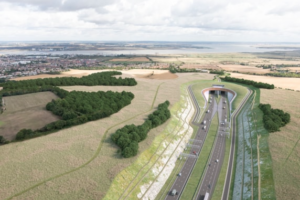
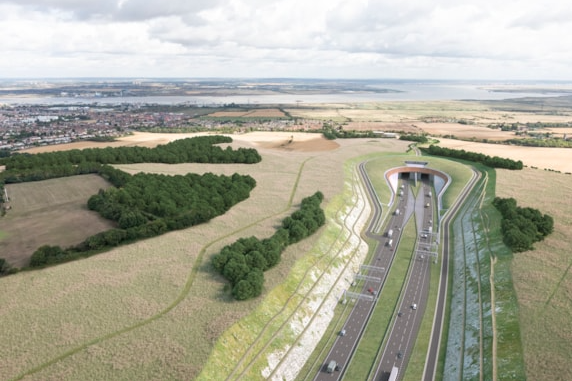
(Picture: National Highways)