
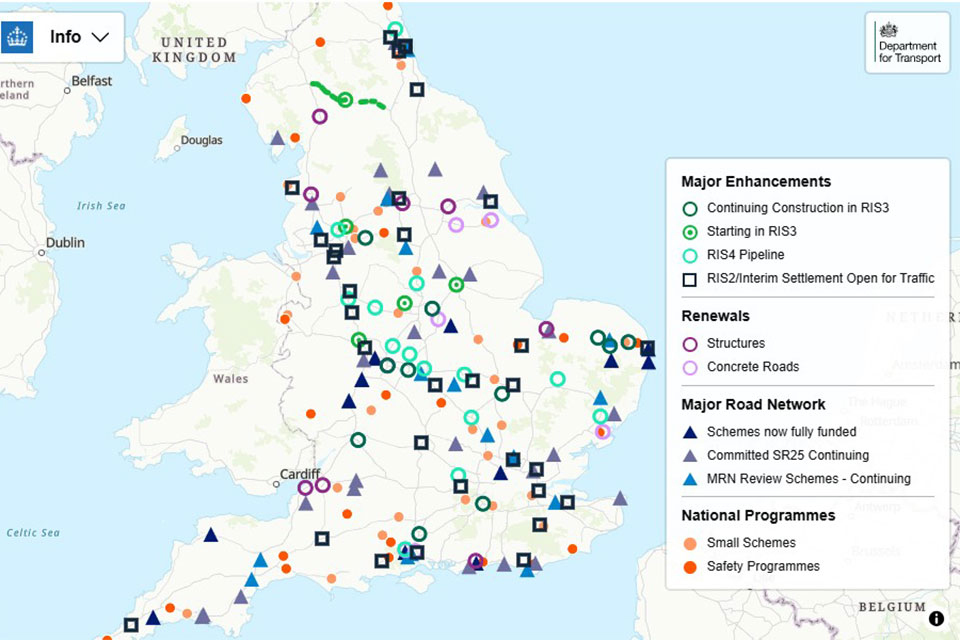
The highways sector has reacted to yesterday’s publication of the Government’s long-awaited £27bn Road Investment Strategy 3 (RIS3).
James Birch, managing director for Transportation at Kier Infrastructure said:
“We welcome the RIS3 announcement and long-term commitment to renew and strengthen the strategic road network for communities across England, as well as supporting economic growth.
“Our teams have already started delivery on major upgrades, such as the A66 Northern Trans-Pennine upgrade, the A417 Missing Link and the Lune Gorge resilience programme, and we’ve recently been appointed to the Legacy Concrete Roads Reconstruction Framework, putting us in the best possible position to support this next phase of improvements for road users.”

Tom van Vuren, Director of Policy at the Transport Planning Society, recognised the opportunity that RIS3 offers to improve travel conditions not just for private car and freight traffic, but across all modes of travel that make use of roads.
“The road investment strategy should recognise the interplay between levels of hierarchy and between travel modes, ensuring that all benefit. In a previous study on the M25 it was found by Na onal Highways itself that investments off the strategic road network may deliver the intended outcomes easier and cheaper than by expanding the SRN. It would be refreshing to see the funds available in RIS3 for such alterna ve interven ons, be that the lower er network, or other modes, such as ac ve travel for personal trips or rail for freight movement. Climate resilience and maintenance of exis ng assets should be priori sed. In any case, the strategy needs to align with strategies at the local level (such as emerging Local Transport Plans) and other na onal policies, such as decarbonisa on.
“Reducing the need to travel, rather than providing for predicted traffic growth is one way of doing so. The latest DfT Road Traffic Forecasts are now more than 3 years old, and uncertainty should be at the heart of road investment related decision-making. TPS believes that this implies a review of all schemes approved in the previous RIS.”
David Giles, Chair of the Asphalt Industry Alliance felt that the Government’s commitment to another five-year funding package for the strategic road network (SRN) was great news for users of England’s motorways and major A roads.
“RIS3 continues to provide National Highways, which manages the SRN, with sustained and targeted investment supported by a long-term funding horizon, allowing it to implement a planned, proactive approach to the maintenance of this infrastructure – exactly what we’ve been calling for for local roads.
“In her Ministerial Foreword, Secretary of State for Transport, the Rt Hon Heidi Alexander MP, said: ‘By investing in the SRN, we will reduce regional inequalities, ensuring that all parts of the UK benefit from free running, safer and more reliable road travel.’ I think most road users would agree that achieving the same ambition on our local road network – which makes up more than 97% of roads in England – is a very, very long way off.
“RIS3 sets out a target of maintaining the SRN so that at least 96.2% is in good condition; a target that National Highways is able to meet, in part, due to structure of its funding. In contrast our recent Annual Local Authority Road Maintenance (ALARM) survey reported that only 52% of local roads in England are in good structural condition – the legacy of decadesof underfunding and short-term cash injections.
“The Government’s pledge to allocate £7.3 billion over the next four years to local roads is an important step forward. However, it will be some time before the impact of increased funding levels, if fully delivered, will be noticed by the public. However, the dial could be moved quicker if the Government’s commitment to additional funding was front-loaded, rather than ramping up in the years to 2030.
“This would support a shift away from the seemingly endless cycle of pothole patch and repair and allow local authority highway teams to deliver necessary resurfacing andproactive programmes that prevent potholes forming in the first place to improve the experience of all road users.”
The Chartered Institution of Highways & Transportation (CIHT) has also welcomed the publication of the Government’s Road Investment Strategy 3 which sets out priorities and investment for England’s strategic road network over the next five years.
CIHT particularly welcomes the certainty provided by a clearly defined five-year pipeline of work, which gives the highways and transportation sector greater confidence to plan, invest and deliver more efficiently over the long term.
Sue Percy CBE, Chief Executive, CIHT said:
“The publication of Road Investment Strategy 3 is a decisive step forward for the highways sector. A clearly defined five-year pipeline will hopefully provide the certainty the industry has long needed to plan properly, invest with confidence and retain the skills required to deliver.”
“CIHT has consistently called for long-term, stable funding to move away from stop-start delivery and achieve better value for money. RIS3 should now provide a more predictable framework – and it is essential that government, National Highways and the supply chain work together to turn this certainty into timely delivery. The focus must now be on maintaining momentum, providing clarity on programmes, and ensuring the
strategy is delivered in full for the benefit of road users and the wider economy.”
RIS3 sets out how Government intends to invest in, operate, maintain, renew and improve England’s motorways and major A roads between April 2026 and March 2031. The strategy provides long-term visibility for industry, clients and supply chains, supporting improved programme planning, skills development and more effective delivery.
CIHT has consistently called for stable, long-term funding settlements to replace short-term or stop-start investment approaches, which can undermine value for money, workforce retention and supply-chain
resilience. The publication of RIS3 responds to these long-standing calls by establishing a more predictable framework for the sector.
RIS3’s emphasis on maintaining and renewing existing assets, alongside targeted enhancements, aligns closely with CIHT’s long-standing priorities. The Institution has repeatedly highlighted the importance of
focusing on the condition, resilience and performance of the existing network while ensuring infrastructure investment supports economic growth, connectivity and road user needs.
However, the lobby group the Transport Action Network said the strategy is based on out-dated forecasts and white elephant road schemes, although it did welcome the increased budgets and emphasis on maintenance and renewing the ageing road network. The group said it is concerned that RIS3 methodology has led to the inclusion of “a number of poor value road schemes, such as the A38 Derby Junctions and A66 Northern Trans Pennine, that are more likely to increase congestion than solve it”.
(Map: National Highways)