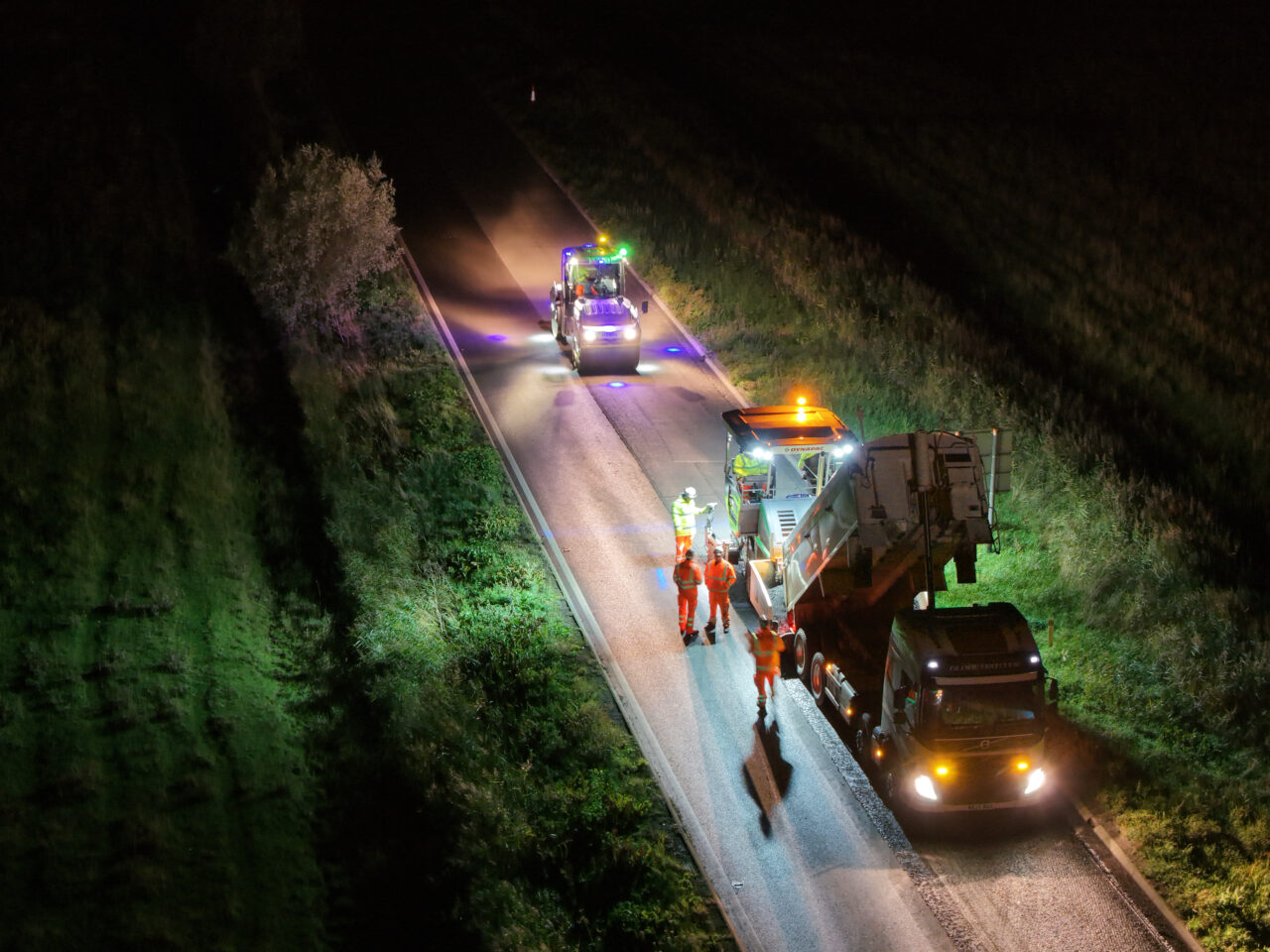
Around 4,500 tonnes of CO2 have beeb saved after National Highways funded 11 road construction and resurfacing schemes last year. The schemes reduced carbon emissions by using low carbon construction methods, as well as materials that will reduce carbon emissions over the whole life of the road surface.
Through the Low Carbon Demonstrator Fund, National Highways is scaling-up the use of market-ready low-carbon techniques for resurfacing on England’s major roads, with the organisation investing around £2.5 million.
By piloting these methods, it is hoped the results will be used to break down barriers to wider use on the road network and lead to low-carbon resurfacing becoming business as usual.

National Highways Head of Carbon and Air Quality Angela Halliwell said:
“We’re changing the way we work to decarbonise construction and maintenance on our roads and meet the crucial challenge of helping the UK to thrive as a low carbon economy head on.
“Our Low Carbon Demonstrator Fund is helping make these possible and together we’re making positive steps towards a sustainable future. Projects like these will help pave the way for industry-wide changes, resulting in significant carbon savings, improved roads for drivers, and quieter roadworks for our neighbours.”
Many of the schemes used materials such as long-life binders which are designed to make the road surface more resilient, reducing the need for further maintenance while bringing down costs and carbon over the whole lifespan of the road surface.
The findings showed significant improvements with building materials firm Holcim estimating the long-life binder used on a resurfacing scheme on the M5, between J28-30, could increase the service life from 15 to 20 years.
Managing Director of Contracting at Heidelberg Materials UK Scott Cooper said:
“The scheme is a great example of supply chain collaboration in action. We worked with National Highways and scheme designer WSP to make the case for using evoBuild foamed asphalt for the binder course.
“It is a cold recycled bound material (CRBM) manufactured by injecting water and air into hot bitumen under high pressure. It allows the re-use of the existing road and is produced at a lower temperature, resulting in significant carbon savings.”
Each of the schemes focused on multiple solutions to lowering carbon emissions – demonstrating how market-ready materials and techniques could be used holistically.
(Picture: National Highways)