Salisbury councillors have given their backing in principle to National Highways’ £25 million proposals to upgrade the A36 Southampton Road corridor, following debate over the scheme’s potential impact on traffic, green space and neighbouring routes.
Salisbury City Council approved its position at a full council meeting last week, with councillors weighing the proposed improvements to network performance against concerns over the loss of part of Churchill Gardens and 25 trees.
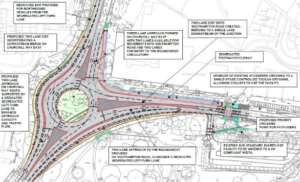
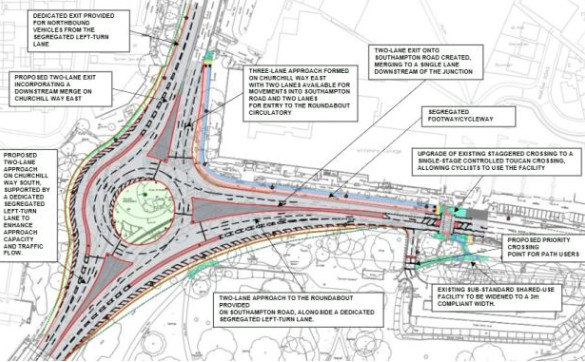
The scheme centres on the reconstruction and enlargement of College Roundabout, which would be converted into a fully signal-controlled junction. Additional lanes are intended to improve traffic flow, reduce queuing and deliver greater journey-time reliability along the corridor.
Plans also incorporate measures for pedestrians and cyclists, including upgraded crossing facilities, wider shared-use paths through Churchill Gardens and a new toucan crossing.
A separate package of improvements at Bourne Way Roundabout has been proposed, including a westbound slip lane, upgraded pedestrian crossings and new footway connections. However, delivery of this element would be dependent on funding being secured.
Before voting on the wider scheme, councillors approved a request for National Highways to undertake traffic modelling across the entire corridor, rather than assessing the proposed junction improvements in isolation.
Cllr Andrew Suddards said the upgrade was necessary but warned that improvements at one location could simply shift congestion elsewhere.
“I agree with this, and it is definitely needed; however, I don’t want to see this cause a traffic jam just 500 yards down the road,” he said.
He proposed adding a requirement for National Highways to carry out corridor-wide traffic modelling, an amendment seconded by Cllr Taylor and subsequently approved by the council following debate.
Opposition to the proposals centred on the loss of public green space and concerns that additional capacity at College Roundabout could displace congestion to other parts of the network, including Harnham and Exeter Street.
Cllr Patricia Podger said a survey she conducted in the area during the summer indicated opposition to the plans, with 79 per cent of respondents reportedly rejecting the proposal.
“This summer I did a survey in the area, and 79 per cent of people said no to this,” she said.
“They did not like the idea of losing the parkland, and they said that traffic would just move down to the next bottleneck in Harnham or Exeter Street.”
(Picture: National Highways)