The Victorian Government in Australia is trialling an innovative Perceptual Countermeasures (PCM) scheme to improve motorcycle safety on high-risk roads. This trial is part of a national trial being led by the Centre for Automotive Safety Research (CASR).
The project has successfully obtained Commonwealth funding through the National Road Safety Action Grants Program. The Department of Transport and Main Roads (TMR QLD), Department of State Growth (TAS), and Transport for NSW are also installing similar road safety treatments in their states as part of this trial.
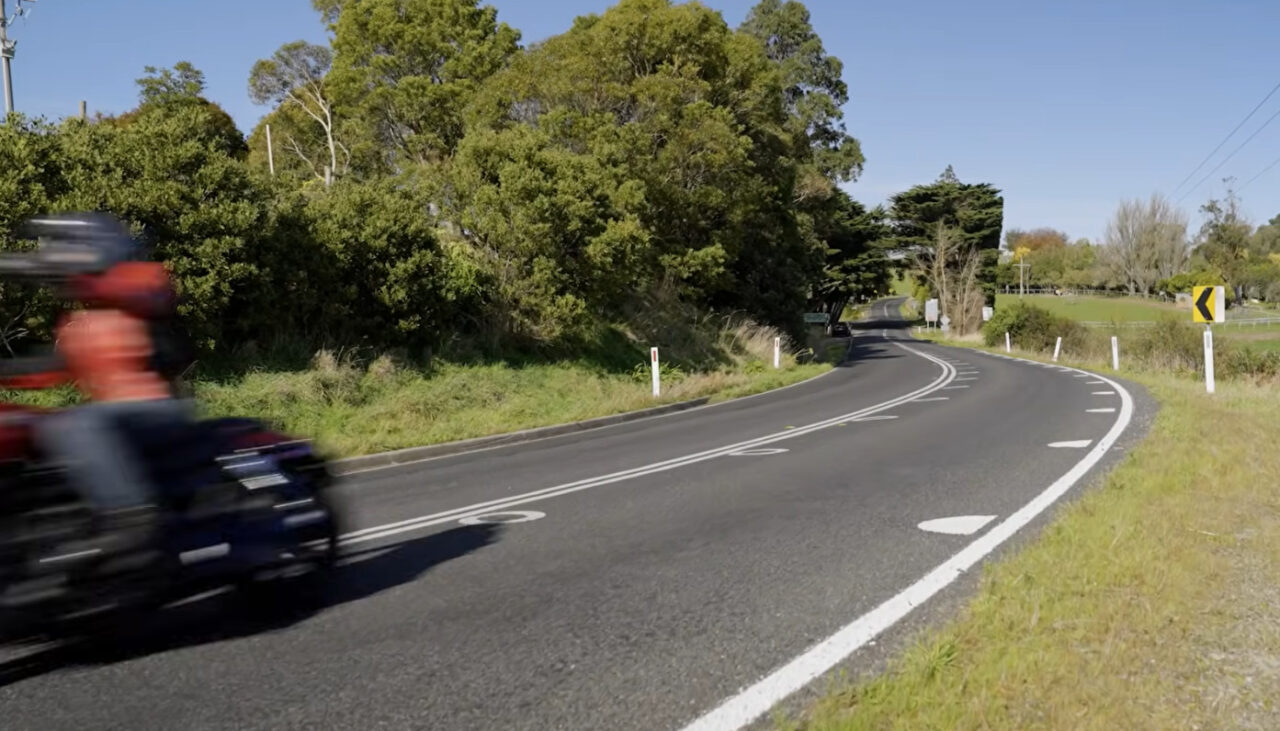
PCMs are a type of infrastructure treatment implemented to subconsciously alter motorists’ perception of the road environment. In this trial, PCM line marking will be trialled to reduce loss-of-control crashes on curved roads. They will work by influencing motorcyclists’ choice of safe travel path while also lowering their travel speeds as they navigate curves on the road.

This trial focuses on right-hand curves, which are known to present a higher risk for motorcycle riders. On these bends, riders may unintentionally drift towards or across the centre line, increasing the risk of a serious crash with oncoming traffic.
The PCM treatment reinforces a well-known rider training principle known as “start wide, finish tight.” This principle encourages riders to:
- Enter a bend from a wider position within their lane.
- Gradually move toward the inside of the lane as they exit the curve.
The trialled PCM design will use painted markings on the road surface to provide guidance to motorcyclists, helping them adopt safer cornering lines and maintain better lane discipline through the bend.
Previous research, including an Austroads trial published in 2023, found that similar PCM line marking significantly reduced the proportion of motorcyclists riding close to the centre line at the sharpest part of the bend (curve apex). Before the change, more than half of riders were travelling close to the centre line. After the change, only a small number did so, meaning riders were keeping a safer position in their lane.
These results suggest PCMs can encourage riders to position themselves more conservatively within their lane, hence increasing safety margins.
This Victorian trial will build on that research by assessing how PCMs perform in local conditions.
Similar trials have been previously conducted in Austria and Scotland.
In Austria, a 2019 trial found that similar curved road markings led to a large drop in motorcycle crashes at treated bends. In some locations, motorcycle crashes were reduced by as much as 80 per cent.
(Picture: Transport Victoria/YouTube)