
National road authorities AWV (Belgium), Vegvesen (Norway), and Trafikverket (Sweden) have demonstrated a cross-border federated data sharing environment, with the data consumed and showcased directly in BMW vehicles.
Alongside BMW, technology providers RISE, Monotch, and Bosch realised this demo in close coordination with the respective road authorities at last week’s 5GAA (5G Automotive Association) conference in Gothenburg, Sweden.
For the demonstration, the production environments of AWV (Mobilidata) and Vegvesen were connected in a network of federated data exchanges, joined by the Trafikverket pilot Interchange. The federation was realised using the C-Roads II interface, with central federation components provided by Dutch digital infrastructure and connected mobility platform providers Monotch.
The featured use case focuses on exchanging safety-related road information, demonstrating how warnings such as road works notifications can be exchanged efficiently across national environments and seamlessly reach connected vehicles. That matters because passenger cars, trucks, and logistics fleets cross borders every day, while road works and hazards do not recognize national boundaries.
Reinhard Jurk, Senior Expert Automotive Cloud, BMW, said:
“Ensuring our BMW vehicles could receive Road Works Warnings through federated platforms was straightforward within a standardised environment such as Mobilidata. This allowed our teams to establish the connection efficiently and with limited integration effort.”
The Gothenburg showcase reinforced a broader industry reality: connected mobility advances fastest when proven public infrastructure and private innovation work together in real time. Together, cross-border interoperability is brought from ambition to an operational reality.
Wim Vandenberghe, Senior Advisor ITS at Mobilidata, concluded:
“This demonstration shows how investments in digital infrastructure can extend beyond national deployment. By enabling federation with other countries, we can ensure that safety-related information continues to reach road users, even when they cross borders.”
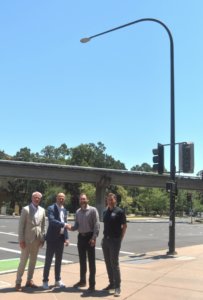
(Picture: Monotch)