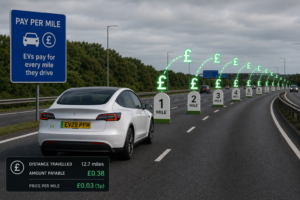
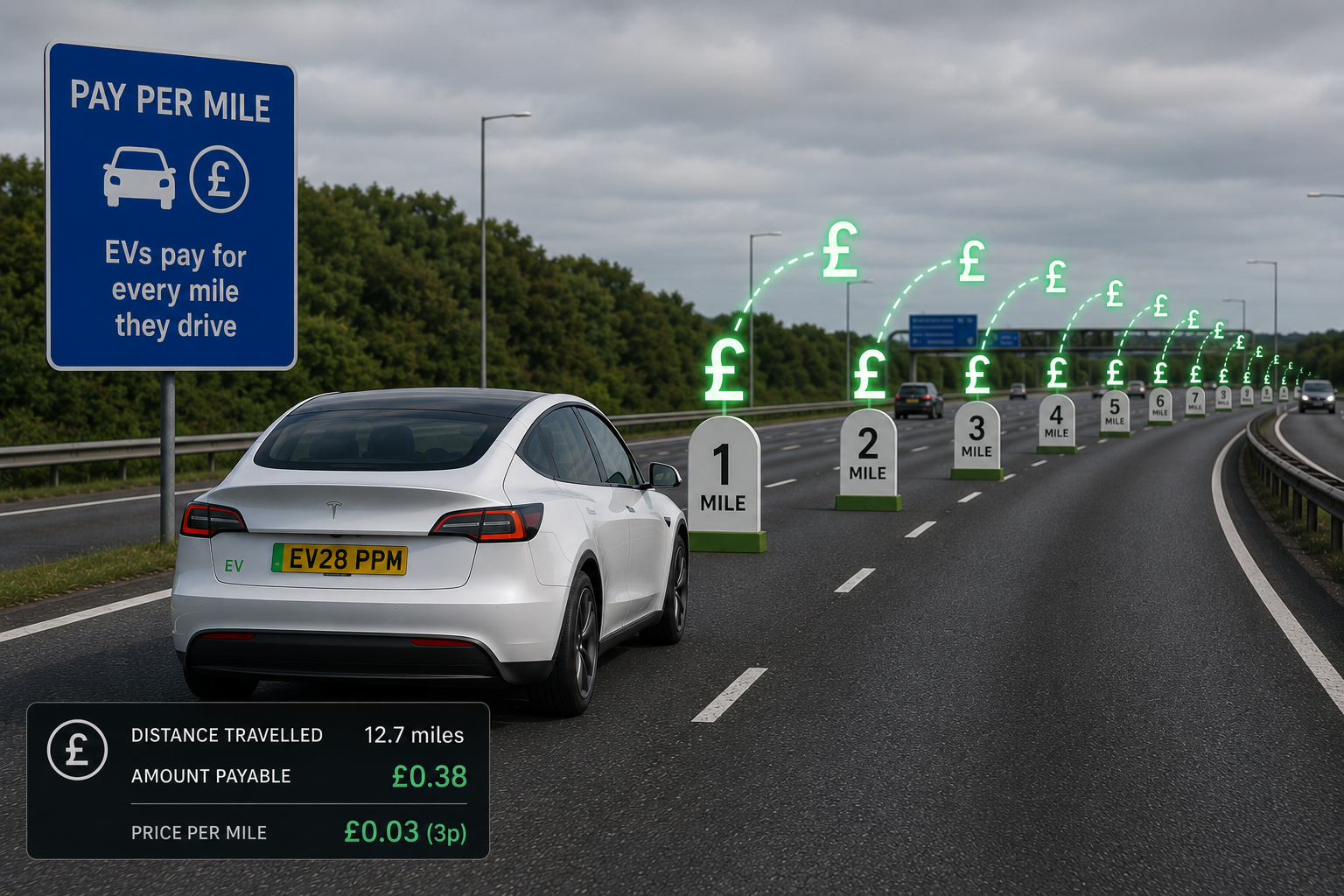
The Campaign for Better Transport has urged ministers to build greater flexibility into the Government’s proposed Electric Vehicle Excise Duty (EVED) scheme, with industry leaders warning that relying solely on odometer readings could create practical problems, limit policy options, delay wider transport goals and ultimately lose public support.
The event in Parliament discussed the Chancellor’s plans to bring in a mileage-based tax for zero-emission and plug-in hybrid cars from April 2028. Speakers from transport technology firms, motoring groups and electric vehicle advocates agreed that some form of road user charging is inevitable as the Treasury faces a growing hole in fuel duty revenues caused by the shift to electric vehicles.
However, while there was broad support for the principle behind EVED, it was argued the Government must avoid locking itself into a single, simplistic approach based only on annual mileage declarations, and that if it did there was a real risk of losing public acceptance and creating a pushback that could damage the whole concept.
Campaign for Better Transport chief executive Ben Plowden opened the discussion by highlighting transport’s dependence on fossil fuels and the need to decarbonise the sector rapidly. He said the transition to electric vehicles was “critically” important, but warned it would have “significant second order consequences, not least in terms of the public finances”.
Silviya Barrett, the Campaign’s Director of Strategy and Research explained that EVED was needed to replace declining fuel duty revenues, which she said could leave a “£27 billion revenue gap by 2040”. She said she believes the scheme would not derail EV adoption, adding that even with the additional charge, electric vehicles would remain “roughly over £1,000 per year cheaper to run than petrol and diesel cars”.
But much of the debate centred on whether the Government’s proposed odometer-based model is flexible enough for future transport policy needs. Tim Wray, UK and Ireland Sales Director at Kapsch said ministers should offer drivers a choice between a simple odometer-based model and a location-based system using existing vehicle technology.
“This can be delivered in two ways,” he said. “The first is odometer-based – easy to introduce, easy for people to understand – but it is also carrying all of the limitations that fuel duty gives us today.”
Mr Wray argued location-based charging systems would allow governments to influence travel behaviour, support active travel and manage congestion more effectively. He stressed the technology was already widely available in electric vehicles and insisted “there is no black box”.
“It’s only location-based systems that can give the MPs, that can give the government levers to support policy,” he said. “If you want to promote active travel, we can financially incentivise the public. If we want to spread the peak, we can incentivise the public to do that.”
He added that objections to location-based charging were largely about politics rather than engineering. “The technology is established,” he said later in the discussion. “This is all about building an understanding across the general public and acceptance across the general public.”
The Chief Executive of ITS UK, Max Sugarman, also warned against relying solely on odometer readings, arguing that technology-based systems would be better at reducing fraud and handling cross-border travel between Northern Ireland and the Republic of Ireland.
“I do think that odometer readings… are going to be open to fraud,” he said. “A tech-based system will be far easier to investigate where fraud happens.”
Mr Sugarman said introducing EVED represented a major political breakthrough after years of discussion about replacing fuel duty. “We have been talking about the impending need to cover fuel duty… but it felt like there wasn’t much going on in terms of political debate,” he said. “EVED is a massive step forward.”
However, concerns were raised about whether the proposed 2028 implementation date is realistic.
Vicky Edmonds, Chief Executive of EVA England, which campaigns for current and prospective EV drivers warned that many remain worried about the cost and design of the scheme, particularly for motorists without access to home charging.
“Half of our drivers pay more to run their electric car than petrol diesel because of the high cost of public charging,” she said. “Then you add an extra tax on top, and the economic case for switching to electric falls away.”
Dr Edmonds said drivers were also uneasy about paying estimated mileage costs upfront and raised concerns about privacy surrounding telematics systems. She argued the Government should delay implementation until charging infrastructure and pricing issues are resolved.
“We definitely think it needs to be delayed,” she said. “This is not going to be possible to sort out by 2028.”
Wrapping up the debate, Steve Gooding, Director of the RAC Foundation and former senior Department for Transport official, echoed concerns about the timetable, warning there was “absolutely no space whatsoever for any bells or whistles” if the scheme is to launch on time. “Getting this to go live on the announced date is going to be a massive stretch,” he said. “These things take time.”
The event concluded with agreement that while EVED is likely to be necessary, ministers face a delicate balancing act between simplicity, flexibility, public acceptance and the practical realities of delivery.
You can hear the event in this week’s Highways Voices podcast, out on Wednesday morning.
(Picture – Highways News)