
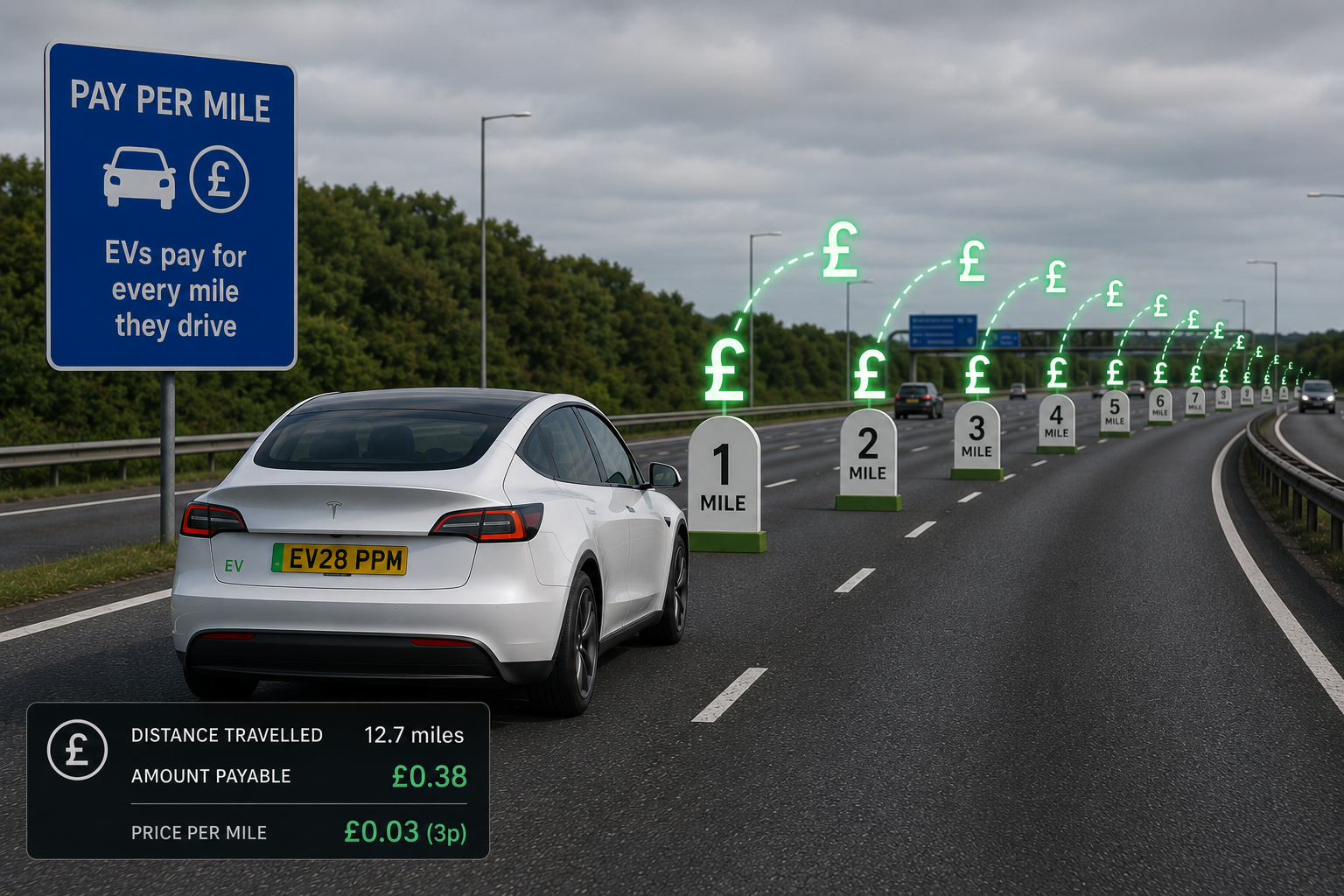
Road user charging specialist Tim Wray has renewed calls for the UK Government to allow motorists to choose between a simple, odometer-based pay-per-mile charging system and a location-based alternative.
The UK and Ireland Sales Director at Kapsch TrafficCom was responding to ministers’ confirmation that electric vehicle drivers will be charged for mileage driven overseas under the upcoming Electric Vehicle Excise Duty (eVED) framework. Mr Wray argued that while an odometer-based system may be simpler to introduce,
relying on it entirely fails to provide the flexibility needed to support wider transport policy objectives.
“This can be delivered in two ways,” Mr Wray said. “The first is odometer-based – easy to introduce, easy for people to understand – but it also carries all of the rigid limitations that fuel duty gives us today.”
The comments follow the Government’s published response to the eVED consultation, which confirmed that mileage driven outside the UK by UK-registered electric vehicles will still count toward the future pay-per-mile charging system.
Ministers argued that excluding overseas mileage would require the mandatory collection of location data to determine where journeys took place, raising privacy concerns. They also suggested that overseas driving accounts for only about 2% of the total distance travelled by UK cars, making it proportionate to prioritise simplicity and privacy over a more complex system.
The consultation response stated:
“The government has ruled out charging tax based on where people drive, to protect motorists’ privacy. This means non-UK mileage driven by UK registered cars will be included within the scope of eVED.”
The Government added that, as with traditional fuel duty, it “does not consider it proportionate to distinguish between different types of journeys or locations,” arguing that introducing checks to deduct non-UK mileage would create unnecessary administrative burdens.
“Privacy is of course a key consideration, but two per cent of miles travelled still amounts to a lot of overpaid taxes”, Mr Wray highlighted. “Personally, I would prefer to make my own choice between paying more or paying less.”
Mr Wray argues that offering motorists a choice is the logical solution. It would allow drivers who prioritise absolute privacy to use the basic odometer-based approach, while enabling others to voluntarily opt into a more sophisticated, location-based system capable of protecting them from overseas taxation. Furthermore, he says that location-based charging would give governments tools that a simple mileage count never could:
• Supporting Transport Policy: Giving the government the ability to encourage specific, sustainable travel behaviors rather than simply taxing raw distance.
• Managing Congestion: Introducing incentives that reward motorists for traveling outside of peak congestion periods.
• Encouraging Active Travel: Allowing authorities to financially incentivise drivers who switch to walking, cycling, or public transport for certain journeys.
• Leveraging Existing Technology: Utilizing the connected vehicle technology already built into most modern EVs, avoiding the need for any additional, aftermarket hardware.
• Future-Proofing Road Infrastructure: Creating a flexible digital transport ecosystem that can scale, while still preserving a low-tech, odometer-based alternative for those who prefer it.
“It’s only location-based systems that can give MPs and the government the levers to support policy,” Mr Wray told Highways News. “If you want to promote active travel, we can financially incentivise the public. If we want to spread the peak, we can incentivise the public to do that – and people may well find that if they opt into such a scheme and adapt their behavior, they end up paying less.”
“The technology is already established. This is all about building understanding and acceptance across the general public. I just think we should let people choose what works best for them.”
(Picture: Highways News)