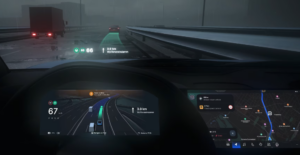
An AI system capable of pinpointing a device’s location in dense urban areas without relying on GPS has been developed by researchers at the University of Surrey. Narrowing down localisation errors from 734 metres to within 22 metres, the innovation could be a significant step forward for technologies such as self-driving cars and aid delivery vehicles.
In a paper published in IEEE Robotics and Automation Letters, researchers describe PEnG (Pose-Enhanced Geo-Localisation), a technology that combines satellite and street-level imagery to determine location using only visual data. In environments where GPS signals are weak or obstructed, such as tunnels, cities like New York, or regions with poor connectivity, PEnG offers a reliable and precise alternative for navigation.
Tav Shore, Postgraduate Research Student in AI and Computer Vision, said:
“Many navigation systems depend on GPS, but coverage isn’t always guaranteed. Our goal was to develop a solution that works reliably using only visual information. By combining satellite and ground-level imagery, PEnG achieves a level of accuracy previously thought unachievable without GPS – and could help unlock new possibilities for autonomous vehicles and smart navigation tools.”
Unlike previous methods, which are limited by how often satellite images are sampled, PEnG uses a two-step process – first narrowing down the location at street-level, then refining it using relative pose estimation, a technique that analyses exactly where a camera is and which way it is facing. The system delivers high accuracy even when using standard monocular cameras found in most vehicles.
Dr Simon Hadfield, Associate Professor (Reader) in Robot Vision and Autonomous Systems, added:
One of the most exciting aspects of this system is how it turns a simple monocular camera into a powerful navigation tool. PEnG is designed to operate without GPS, making it ideal for fast-moving, unpredictable scenarios. That kind of flexibility is exactly what’s needed for the next generation of autonomous vehicles and robotics operating in challenging environments.
(Pic: Yay Images)