The people who plan, design, build and run Britain’s transport network overwhelmingly recognise that women and girls face distinct safety risks on it. Almost none of them feel equipped to act, according to the first sector-wide survey of its kind, published today by Women in Transport.
The Women’s Safety Baseline Survey, delivered in partnership with WSP, gathered 737 responses from transport professionals across every mode and the wider built environment. It is one of the largest UK surveys to date focused on practitioners rather than passengers.
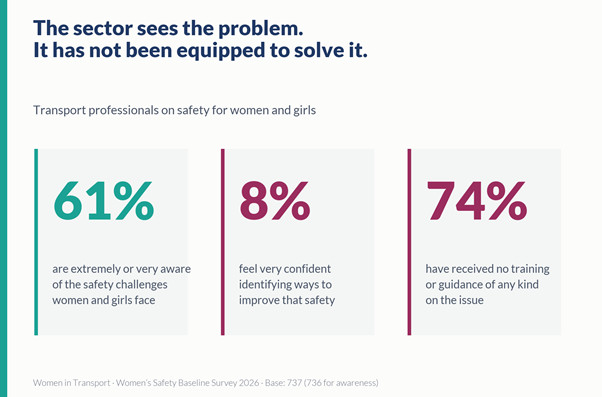
Its central finding is a gap between concern and capability. Sixty-one per cent of respondents say they are extremely or very aware of the safety challenges women and girls face. Only 8% feel very confident identifying ways to improve it. Seventy-four per cent have received no training or guidance of any kind.

The survey also found that the professional guidance already written for the sector is barely reaching it. Respondents were tested on eight established UK and international design and policy resources, including toolkits published by the Greater London Authority, the Royal Town Planning Institute and West Yorkshire Combined Authority. Not one had been used by more than 4% of respondents. Not one was known to more than 22%.
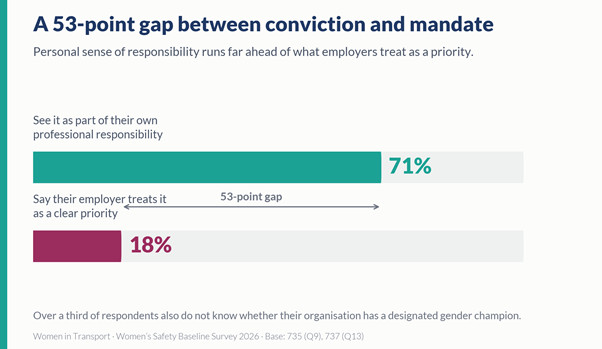
Seventy-one per cent of practitioners say they see women’s safety as part of their own professional responsibility. Just 18% say their employer treats it as a clear priority – a 53-point gap between personal conviction and institutional backing.
The sector also struggles to measure the problem it is being asked to solve. Only 12% of respondents believe their organisation regularly collects and actively uses safety data broken down by gender, age or ethnicity. Three times as many (36%) do not know whether their organisation collects this data at all.
Sonya Byers OBE, Chief Executive of Women in Transport, said:
“The transport sector clearly recognises the importance of addressing the safety of women and girls across our network. More than that, transport professionals feel personally responsible for tackling the issue. However, we have made limited progress on recommendations for better training, data collection and consistent reporting set out by the VAWG Transport Champion, Laura Shoaf and Anne Shaw, in 2021. We are at a pivotal moment for transport across the UK. Women in Transport is calling on our sector leaders to demonstrate their commitment to the safety of women and girls’ and equip transport professionals with the training and confidence to make travelling across the UK feel safe for everyone. This is our collective responsibility. The time to work together is now.”
Asked what would most enable progress, respondents named strong leadership commitment more often than any other factor: 41%, against 16% for funding. Visible senior ownership, which costs little to mandate, was cited by more than two and a half times as many practitioners as new money.
The most-cited barrier was a lack of awareness and understanding among staff (63%), ahead of funding (53%) and competing workload pressures (50%). Cultural and societal attitudes ranked lower, at 42%.
Every barrier ranked above cultural attitudes in the dataset is something a transport operator, local authority or government department can address directly, without waiting for wider social change.
(Picture: Women in Transport)