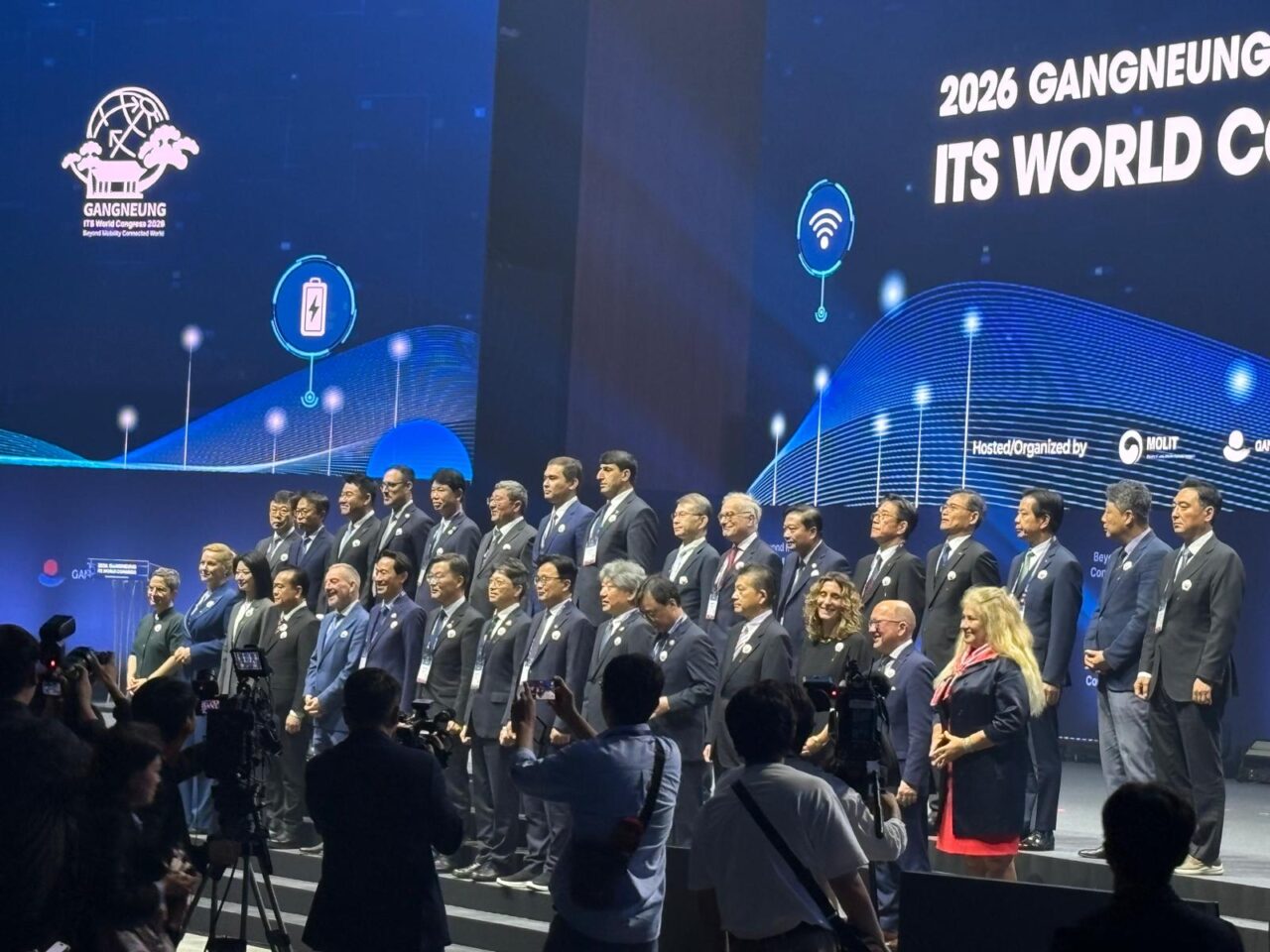
Transport technology must deliver safer journeys, faster emergency responses and a better quality of life, international ITS leaders have told the opening ceremony of the ITS World Congress in Gangneung, South Korea.
Speakers from Asia-Pacific, Europe and the Americas stressed the importance of turning advances in artificial intelligence, automation and connected infrastructure into practical benefits, while the Korean hosts highlighted opportunities to improve transport in small and medium-sized cities.
The five-day Congress, running until 23 October under the theme “Beyond Mobility, Connected World”, brings together government, industry and academic representatives for discussions, exhibitions and demonstrations.

Secretary General of ITS Asia-Pacific and President and CEO of ITS Japan Akio Yamamoto said his own AI analysis of the Congress programme had revealed that safety remained a central concern.
He told delegates that “safety” was the fourth most frequently used keyword, behind mobility, ITS and traffic, appearing more often than AI, automation, data and infrastructure.
“I believe this tells us something essential: technology itself is not our ultimate goal. Safety, sustainability, and the quality of life are our outcome,” he said.
Mr Yamamoto also highlighted the importance of resilience across a region regularly affected by natural disasters, urging delegates to explore how ITS can help communities prepare for, respond to and recover from crises.
President and CEO of ITS America Laura Chace said the simultaneous development of several technologies was creating new capabilities for transport networks.
“What makes this moment significant is it’s not about any single technology, but about the convergence of many technologies: artificial intelligence, automation, connected systems, digital infrastructure, and real-time data that are all accelerating at the same time,” she said.
These developments were enabling systems to sense conditions, communicate information and adapt in real time.
“The next evolution of ITS will not be defined just by connections, it will be defined by what it enables: safer mobility, faster emergency response, transportation systems that serve everyone more efficiently.”
Chief Executive of ERTICO – ITS Europe Joost Vantomme described the Congress as a “festival of ideas”, emphasising the value of international partnerships in addressing shared challenges.
“It’s a festival of ideas, but also of connecting, connecting people, connecting data, and definitely connecting ideas,” he said.
“Everywhere, we have the same issues, we have the same problems, but also solutions.”
He urged participants to turn their exchanges into action, concluding: “Let’s go home with new ideas. Get it done.”
Welcoming delegates, President of Korea Expressway Corporation and chair of the Congress organising committee Yoo Jung-hoon said mobility stood at a profound turning point as AI, automated driving, big data and advanced communications transformed transport.
“As technology advances, it becomes ever more important to ensure it improves people’s everyday lives and enables safer, convenient connections between cities and nations,” he said.
South Korea’s Minister of Land, Infrastructure and Transport Hong Jee-sun encouraged delegates to experience the technologies on display and exchange lessons from practical deployment. He said Korea would share its experience internationally and support Korean companies in contributing to global markets.
Governor of Gangwon Special Self-Governing Province Woo Sang-ho highlighted the significance of hosting the Congress in a smaller city, saying Gangneung offered an opportunity to explore how ITS could improve connectivity beyond major metropolitan areas.
He pledged to provide a testbed for new approaches, helping small and medium-sized cities benefit from transport innovation.
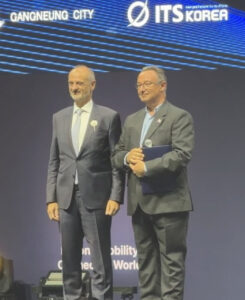
The opening ceremony also recognised individual contributions to the sector, with Professor Phil Blythe inducted into the ITS Hall of Fame. Unable to attend in person, his award was accepted on his behalf by Darren Capes, Head of Road Infrastructure Technology at the UK Department for Transport.
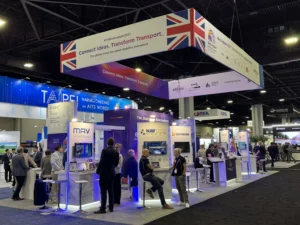
The recognition provided a British highlight ahead of the next ITS World Congress, which will take place at Birmingham’s NEC from 25–29 October 2027.
The Asia Pacific award went to Australian transport innovator John Gaffney, while Steve Dellenback of the Southwest Research Institute in Texas was honoured by the American region.
(Picture – Highways News)