National charity Cycling UK says local authorities are being held back from creating more safe cycling and walking routes by a mismatch in perceptions that masks how popular they are. The statement comes as the charity launches its new report designed to encourage and inspire councils to build high-quality infrastructure, titled The Route Forward: The people and places being transformed by cycling.
Many measures making cycling safer are much more popular than they are believed to be, revealed by figures from a YouGov survey of UK adults commissioned by Cycling UK. The charity points to the survey results showing a clear mismatch between how much people support a given measure, and how much they believe others support it.
For example, 73% of respondents supported redesigning local residential streets to make them safer for children to play in, but only 55% believed that other people in their local area also support it. This difference was echoed in further questions around residential streets and motorised traffic. While nearly two-thirds (64%) believed the UK as a whole would be improved with less motor traffic on roads, only 45% believed others locally would agree. Over half (56%) of respondents said they support making more residential streets access only for motor vehicles, but only 41% believed other people in their local area would agree.
A separate survey YouGov conducted in March 2026, also for Cycling UK, showed that 70% of the public supported school streets – roads outside schools closed to traffic at drop-off and pick-up times – but only 49% believed others in their community did.
The charity believes this mismatch may be leading politicians to think support for good cycle routes in their communities is lower than the reality. It’s an example of what’s sometimes called pluralistic ignorance – a type of cognitive bias where people believe their views differ from others’, coined by Professor Ian Walker, Head of the School of Psychology at Swansea University.
Duncan Dollimore, Associate Director at Cycling UK, said:
“The YouGov survey confirms what we have long suspected – that many people don’t realise how popular safe routes for walking and cycling are, even if they themselves are in favour. But what’s surprising is just how pronounced this difference in perceptions is.
“We all fall prey to cognitive bias, and people who make decisions on infrastructure are human just like everyone else. That’s why we decided to collect some of the strongest success stories into our new report, to make it really clear that people want this, and will thank councils for delivering safer streets for walking and cycling.”
Cycling UK’s new report, The Route Forward, challenges the misconception, showing that modern cycle routes are popular and benefit communities. The report’s 11 real life success stories showcase a wide variety of projects and the people who have benefited from them, and aims to inspire councils to support, commit funding and deliver better cycle infrastructure in their areas. Where high-quality cycle schemes like these have been implemented across the UK, they have boosted the number of people cycling every day, transforming people’s lives and enhancing the places they serve. The report highlights these as examples of best practice, as well as drawing on them for lessons and making recommendations.
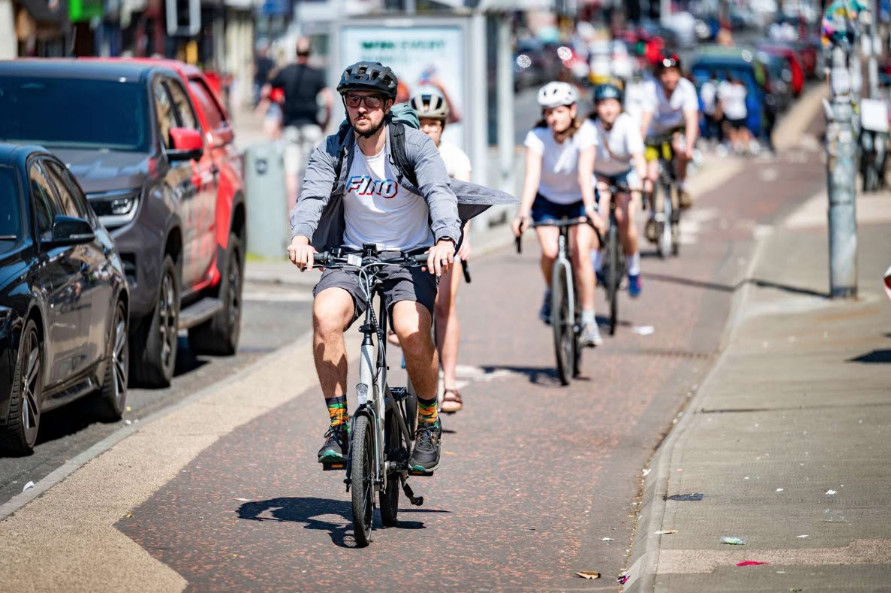
One of the schemes is the South City Way in Glasgow (pictued), a 3km uninterrupted cycle route, completed in July 2024, which connects Glasgow’s south side with the city centre. The scheme introduced protected cycle lanes, redesigned junctions, improved crossings and lighting alongside other changes to create a safer and more accessible corridor for everyday journeys.
The results have been striking. More than half of surveyed residents (56%) said they are cycling more often, and 23% walking more often since the improvements. On some sections, such as Victoria Road, cycling accounts for around 15-20% of all journeys.
With The Route Forward, Cycling UK calls for:
- Investment to create safe, high-quality cycling infrastructure and deliver participation programmes
- Designing continuous routes and safe junctions that connect homes with schools, jobs, shops, healthcare and public transport
- Embedding cycling schemes into wider transport, health and climate strategies
- Engaging communities early and throughout delivery, while maintaining a clear long-term vision
- Trialling, refining and phasing schemes where appropriate
- Monitoring cycling levels, safety, modal shift and public opinion before and after delivery.
(Picture of Glasgow’s South City Way supplied by Cycling UK).