Eight studies exploring how autonomous vehicles could benefit businesses and communities across the UK have received funding from a UK Government-backed initiative aimed at accelerating the rollout of commercially viable connected and automated mobility (CAM) solutions in the UK.
The Feasibility Studies 2 competition, part of the £150m CAM Pathfinder programme, has provided funding to selected projects across the UK, seeking to demonstrate a business case for the deployment of connected and automated mobility (CAM) solutions in strategic, near-commercial environments.
Among the projects to have received funding is an initiative to establish how self-driving vehicles could boost the aviation sector; how self-driving freight vehicles could lift the nation’s automotive industry and how private-hire automated vehicles could be deployed on London roads.

The CAM Pathfinder programme – announced in the Government’s Advanced Manufacturing Sector Plan - aims to grow the UK’s £3.7bn Connected and Automated Mobility (CAM) industry and is being delivered by the Department for Business and Trade, in partnership with Zenzic and Innovate UK
The aim of the Feasibility Studies 2 competition is to support organisations to overcome key barriers to investment decisions in CAM technologies, both in private and public sector environments. Through the studies, organisations will set out to produce the robust business cases that will unlock advanced, at-scale deployments of CAM across the UK
The eight projects are:
ASPIRE – A study addressing a critical UK mobility challenge: structural driver shortages, rising operational costs, and the need to maintain connectivity while meeting zero-emission mandates.
Project Partners: Bamford Bus Company, Loughborough University, Queen’s University Belfast
Develop & Quantify Business Models – A study by Fusion Processing to identify the staff, processes and investments required to deliver operational cost saves and efficiencies at UK airports.
Project Partners: Fusion Processing
Private-Hire Services in High-Demand London Corridors – Odysse’s feasibility study for Level-4 automated vehicles (AVs) on private-hire services in high-demand London corridors will explore how emerging self-driving technologies could help shape the future of urban mobility in one of the world’s most dynamic cities.
Project Partners: Odysse Limited
North East Vehicle Autonomous Corridor – A feasibility study into the deployment of autonomous electric HGVs on the strategic road freight corridor between the Nissan Motor Manufacturing UK (NMUK) Sunderland Plant and the Port of Tyne.
Project Partners: BCA Automotive Limited, National Highways, Newcastle University, Perform Green, South Tyneside Council, Sunderland City Council
Sentinel Shuttle – A future-ready feasibility study to unlock safe, scalable driverless shuttle operations across NHS hospital and care estates, enabled by real-time onboard monitoring and remote oversight.
Project Partners: Moonbility Limited
TACTIC – A six-month feasibility study led by iC4DTI, with CENEX as partner, to produce an investment-ready business case for a driver-out CAM freight service on the Teesport to Teesside International Airport corridor within the Teesside Freeport.
Project Partners: International Centre for Trade and Digital Innovation (C.I.C), Cenex
V-CAL Feasibility Study – Assessing the commercial viability of deploying autonomous yard tractors on the Vantec–Nissan route in Sunderland. This nine-month project builds on the successful outcomes of the 5GCAL and V-CAL initiatives, moving from technical proof-of-concept to a robust business case for full-scale deployment without safety drivers.
Project Partners: North East Automotive Alliance, Newcastle University, Oxa Autonomy Limited, LOGISTEED UK Limited
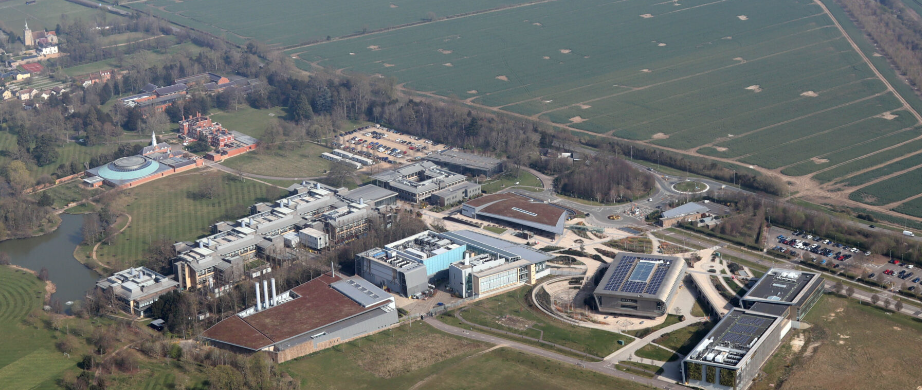
Wellcome Genome Campus (pictured) – This project will deliver a feasibility study for one of the UK’s first dedicated corridors for Connected and Autonomous Vehicles (CAVs), linking the Wellcome Genome Campus (WGC) to Whittlesford Parkway railway station in Cambridgeshire.
Project partners: Wellcome Genome Campus
Mark Cracknell, Programme Director at Zenzic, said:
“CAM solutions have the potential to unlock new business opportunities and economic growth in all corners of the country. These feasibility studies will help to articulate the impact that market ready CAM technologies can have on both business productivity and economic growth.
“We are excited to start working with the organisations delivering each of the eight projects to further develop their businesses cases, demonstrate the commerciality of their solutions and paint a clearer picture of the commercially viable CAM solutions coming down the road.”
(Picture: Wellcome Genome Campus)