A major road safety improvement at Bootle in Merseyside is being delivered from a zero-emissions construction compound powered by green hydrogen – for the first time on a National Highways project.
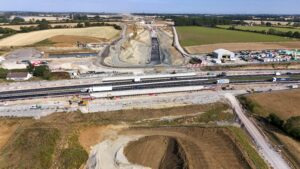
National Highways is delivering new pedestrian crossings at the A5036 Dunnings Bridge Road and Park Lane crossroads at Netherton. And, in a company first, all the electricity for the construction compound is being powered by hydrogen rather than from the grid or diesel generators.
Galliford Try, National Highways’ lead constructor for the £7m project, has been trialling the use of a hydrogen fuel cell generator to power the site compound. Three site offices, toilets, kitchen, drying room and two EV charging points have all being powered by the hydrogen system since the scheme, due to be completed by Friday 12 June, began in November.

The successful pilot project is significant as a cleaner, greener and quieter alternative to diesel generators when a site connection to the national grid – always the preference – is unavailable. The use of green hydrogen is also important as it is produced sustainably using renewable, emission-free and often surplus wind or solar power.
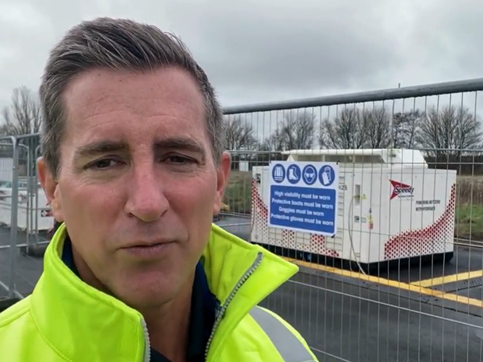
Duncan Smith (pictured), National Highways’ chief operating officer, said:
“At National Highways we’re totally committed to decarbonising the way we operate, maintain, repair and improve our roads. We expect companies in our supply chain to share those goals, so when I visited the site, I was delighted to see ourselves and Galliford Try working together to trial this new, greener way of running the construction compound.
“It’s a pilot project and as the price of this technology comes down, this has to be the future compared to burning fossil fuels when we cannot connect a site to the grid.”
Poppy Parsons, Head of Low Carbon for Galliford Try, added:
“Diesel Hybrid generators have traditionally been our go-to solution for sites with limited or temporary access to mains power. By switching to green hydrogen, we’ve been able to remove all carbon emissions from site power generation, improve local air quality, and minimise noise disruption.
“The transition has allowed us to show this new technology works in reality, lowering environmental impact without compromising on reliable power, and we are now looking to expand its use within our business.”
(Picture: National Highways)