
A Proof of Concept (PoC) in Hamburg has demonstrated how TLEX – the Traffic Live Exchange platform – can help make more use of existing real-time traffic signal data.
The City of Hamburg wanted to better understand what it could do with the C-ITS data already available in the city. Using real-time SPaT data from Hamburg’s traffic signals, Monotch showed how TLEX can exchange, interpret, and visualize that data, and how the same technology could support additional use cases at a larger scale.
The project brought together the City of Hamburg, Hamburg University of Applied Sciences (HAW Hamburg), Yunex Traffic, TraffGO Road and Monotch. As part of a research program, HAW Hamburg used traffic signal data to compare input from different sources and better understand the information behind it.

For Hamburg, the project offered a practical way to see what TLEX could add to its existing connected mobility environment.
Nils Gayer, Project Lead at the City of Hamburg, said:
“What impressed us was how straightforward it was to connect systems and share data, while maintaining very low latency. The PoC demonstrated how smoothly real-time data exchange can work in practice and gave us a clearer view of its potential for connected mobility in Hamburg.”
Traffic Signal Controllers in Hamburg already generate Signal Phase and Timing (SPaT) data. The project therefore did not focus on creating new data, but on showing what else could be done with data that was already there. Monotch connected TLEX to the SPaT cloud provided by Yunex Traffic. The team then used the data to demonstrate several TLEX capabilities, including real-time data exchange, a dashboard, and a demo application.
Hamburg’s existing setup reflected earlier technical choices and local implementations. During the integration, the Monotch team therefore had to understand how Hamburg structured its MAP data and how it encoded its SPaT data.
This is a familiar challenge in connected mobility. Standards are essential, yet real-world implementations vary. Technology must bridge these differences to enable reliable communication across systems.
TraffGO Road brought local market knowledge to the project, coordinated the different stakeholders, and identified opportunities throughout the process.
Monotch brought TLEX and its experience with real-time data exchange and interoperability. Together, the teams showed how the technology could work within Hamburg’s existing infrastructure and data environment.
Joachim Wahle, Managing Director of TraffGO Road, commented:
“Connected mobility only works if technology fits the reality on the ground. By combining our knowledge of the German market with Monotch’s TLEX technology, we were able to show Hamburg what can already be done with the C-ITS data available today.”
The PoC turned an existing real-time data stream into something Hamburg could see and assess in practice.
TLEX showed that it can connect different actors, handle local variations in standardized data, and make real-time traffic signal data available to applications. The dashboard and demo application made that much easier to understand than a technical architecture alone.
For Hamburg, that was the real value of the project: it showed how existing C-ITS data could support more than one application or use case, without first needing a completely new data environment.
Nicolas Mercier, Deployment Manager at Monotch, concluded:
“The exciting part is that the data is already there. TLEX helps make that data usable across different systems and shows how one real-time data stream can support multiple connected mobility use cases.”
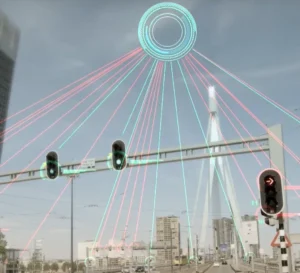
(Picture: TLEX)