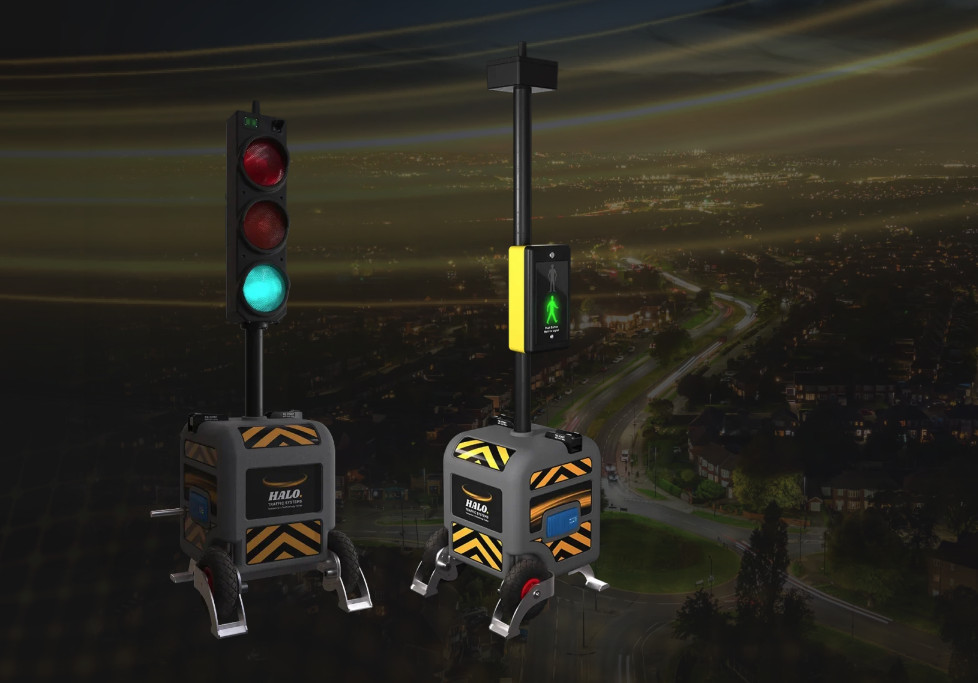
A team of highways and traffic management specialists has launched HALO Traffic Systems, unveiling a new portable signal and live control platform the company says will revolutionise how the industry delivers, monitors and controls temporary traffic signals on site.
Founded by people who have spent their careers living with the pain points of existing equipment, HALO set out to build a solution from the ground up rather than adapt legacy designs. The result is an innovative platform paired with a redesigned portable signal, offering two routes to the same outcome: Halo Command, where operators retain direct control of every signal and asset from a single screen, and VS1, where HALO manages it on their behalf. Both give real-time visibility of every site, every signal and every asset – location, status and power level – with the ability to switch phases, hold signals and adjust sequences remotely.
The company says the shift addresses a long-standing blind spot in the sector: faults, flat batteries and failing comms that go unnoticed until a client complains, an engineer is called out, or a site sits in fault for hours. HALO’s platform is designed to surface those warning signs before they become costly emergency callouts.
The signal itself has also been re-engineered.
Traditional units have relied on heavy frames and corrosive batteries, materials that HALO says haven’t meaningfully changed in a generation. HALO’s version is built to be lighter to lift, cleaner to run and more durable in the field, without a trade-off in performance.
“We’ve spent our careers on the site side of this industry, so we know exactly where the current equipment falls short. HALO isn’t a tweak to what already existed – it’s been built from the ground up, around the problems operators actually face every day. Friday is the start of that becoming widely available to the industry.” said Tim Mooring, Managing Director of HALO Traffic Systems.
The company was founded on what it describes as a simple structure guiding every decision: does it strengthen performance, allow greater investment in people and product, and ultimately deliver more for the client. HALO calls this its “Pyramid Principle” – starting with the client’s problem and working back to the solution, rather than the other way around.
The platform and new signal are the result of an in-house build process, manufactured at HALO’s own facility rather than developed through renders or third-party mock-ups.
The website went live at noon today, alongside further details of the Halo Command and VS1 offering.
(Picture: HALO Traffic Systems)