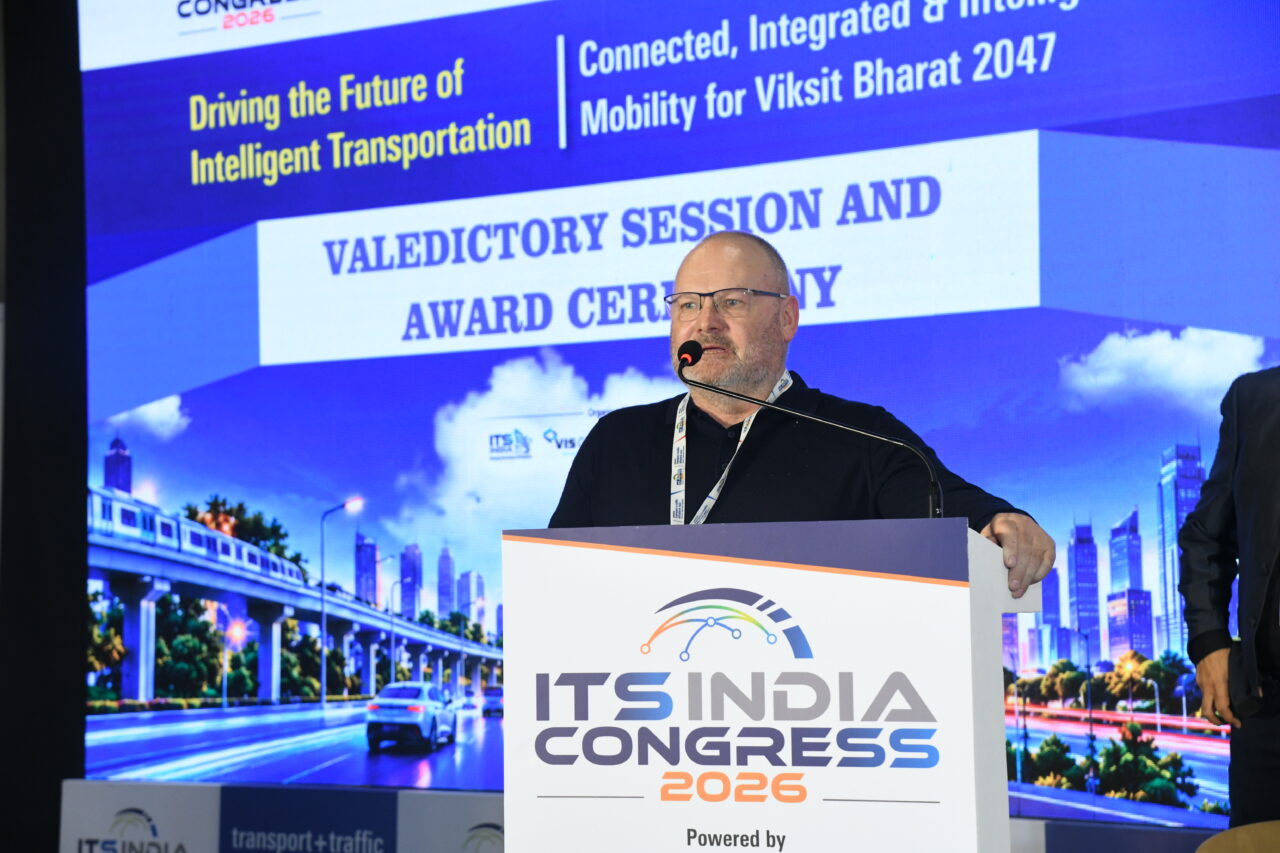
Simplifai Systems’ sales director Andy Hamer was a member of a recent UK delegation to India as part of the Great North Mayors Trade Mission.
Returning to the UK after two weeks across Delhi, Mumbai, and Bengaluru, the operational reality of rapid economic expansion was brought into sharp focus. Between discussions at the ITS India Congress and high-level bilateral trade engagements during the Great North Trade Mission, one theme emerged above all. Writing exclusively for Highways News, Andy says that India’s transport sector is confronting an historic inflection point.
When John F. Kennedy delivered his seminal “We choose to go to the Moon” speech in September 1962, he articulated a governing philosophy: societies choose ambitious goals not because they are straightforward, but because overcoming their sheer difficulty forces us to organise the very best of our energies and skills. Solving urban gridlock across India’s Tier-1 and Tier-2 metros requires that identical posture. The operational conditions are demanding, the asset densities are punishing, but the underlying engineering challenge is far from insurmountable.
The Fallacy of the Paved Solution

The Indian Government has committed over US$3 trillion toward nationwide transport infrastructure. Major expressways, metro extensions, and smart city corridors are transforming intercity and suburban connectivity. However, relying primarily on ribbon-cutting new roads to remediate dense metropolitan traffic is an established global fallacy.
The underlying arithmetic explains why:
Current Vehicle Densities:
• Cars: ~45 per 1,000 citizens (~50 million total)
• Motorised Two-Wheelers: ~185 per 1,000 citizens (~260 million total)
5-Year Outlook:
• Projected Private Car Fleet: 3x increase (approx. 150 million cars)
• Capital Construction Lead Time: 3 to 7 years for major arterial interventions
Vehicle ownership in India remains an enduring milestone of middle-class economic success. As wealth scales, car penetration will surge. While physical highway expansion takes years to plan, procure, and construct, millions of vehicles enter the active road network every quarter. Civil engineering simply cannot widen corridors fast enough to match unconstrained private vehicular growth.
The resulting macro drag is severe. Headline congestion costs in each of India’s five largest cities comfortably eclipse $1 billion annually. When accounting for broader externalities – severe respiratory health burdens, carbon generation, missed freight delivery windows, and hours lost to commutes averaging below 10 km/h in corridors across Bengaluru – the actual economic drain is substantially higher.

Moving from Reactive Enforcement to Active Network Control
During dialogues with Police Commissioners and transport authorities across Delhi, Mumbai, and Bengaluru, administrative teams consistently acknowledged the strain. In several hubs, municipal networks must absorb more than five million vehicle trips daily. The awareness of the crisis extends to the highest levels of national leadership, reflected in targeted capital interventions, such as central funding grants exceeding £150 million deployed to help Delhi Police address severe junction choke points.
The core vulnerability, however, is structural: current investments remain heavily weighted toward static enforcement technology (such as automated fine issuance) rather than dynamic, active traffic management.
When an arterial junction collapses into gridlock, standard operating procedure often defaults to deploying traffic police officers to manually direct vehicles. Commuters and fleet operators frequently note that overriding automated signal cycles manually introduces human latency and subjective judgement, which worsens queue spillbacks across neighbouring nodes.
Waiting half a decade for new flyovers cannot be the primary mitigation strategy. Transport authorities must maximise the operational capacity of their current street footprint through three immediate priorities:
- Adaptive Signal Automation: Transitioning fixed-time or manually overridden signals to dynamic algorithms that adjust green splits in real time based on actual corridor queue lengths.
- Prioritised Mass Transit Corridors: Avoiding the historic misstep of Western infrastructure planning, which starved public transport of operational priority. Dedicated, signal-prioritised bus lanes must protect public transport speeds to provide a credible alternative to private vehicles.
- Data-Led Incident Clearance: Deploying automated incident detection cameras and rapid-clearing response teams to remove disabled two-wheelers, minor collisions, and roadside stalls within minutes rather than hours.
Designing Around Local Constraints
A frequent counterargument raised notably during a panel session at Deloitte is that the Indian driving environment is uniquely impervious to international Intelligent Transport Systems (ITS) due to non-standard lane discipline and a high mix of two- and three-wheelers.
This argument mistakes an engineering parameter for an impasse. High vehicle heterogeneity and flexible lane utilisation simply dictate that Western off-the-shelf lane-occupancy sensors must be adapted. Video analytics, radar-based volumetric tracking, and edge-AI camera vision are entirely capable of reading total road surface saturation regardless of lane paint.
In the UK, the systematic deployment of active corridor management, dynamic speed controls, and smart junction interventions consistently delivered traffic throughput gains exceeding 30%. Implementing even half that operational improvement on Indian metropolitan arteries would reclaim billions of dollars in lost productivity.
A Solvable Endeavour
India possesses the sovereign capital, the domestic software capabilities, and the political mandate to modernise its urban mobility landscape. The barrier is not technical impossibility; it is the habit of treating traffic management as a manual policing task rather than an integrated, data-driven systems engineering discipline.
Solving urban traffic in India will be difficult, relentless, and computationally intensive. That is precisely why the engineering and policy community must take it on. Few domestic achievements would do more to accelerate economic productivity, improve public health, and elevate quality of life for hundreds of millions of people.
(Pictures: Andy Hamer/Simplifai Systems)