The Mayor of London, Sadiq Khan, has hailed a decade of change on London’s school run, as new TfL data shows there are now an average of 73,915 fewer car trips on each school day than when the Mayor took office ten years ago.
Across the capital, more children are walking, wheeling and cycling to school with the Mayor’s programme of measures making active travel an easier, safer and more attractive choice for families.
In 2024/25, two-thirds (66 per cent) of primary school-aged children travelled to school using active travel, while the proportion travelling by car fell to its lowest level in a decade. Data shows a 16 per cent decrease in the number of journeys to school made by car between 2015/16 and 2024/25, falling from 461,000 to 387,000.

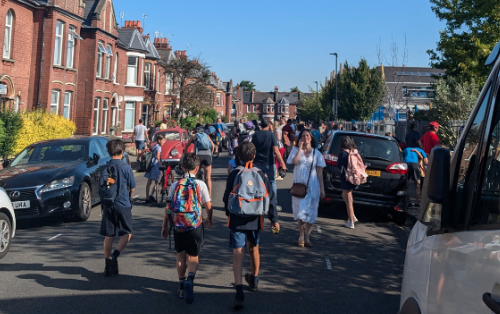
One of the most visible changes has been the growth of School Streets – areas outside schools where motor traffic is restricted at drop-off and pick-up times. There are now more than 870 School Streets across London, compared with none when he became Mayor in 2016.
The benefits go beyond encouraging children to walk and cycle, with Breathe London monitoring data revealing School Streets can reduce nitrogen dioxide levels by up to 23 per cent during morning drop-off, helping children and families breathe cleaner air on the school run. The Mayor’s Walking and Wheeling Action Plan, delivered with TfL, will build on this progress, with an ambition to expand School Streets so that 1,000 schools across the capital benefit.
The Mayor is also supporting children to develop the skills and confidence to cycle. More than 90 per cent of London schools now have scooter and/or cycle parking, while around 196,688 children received cycle training through TfL’s Bikeability programme between 2021/22 and 2025/26.
Andrew McCracken, Director of External Affairs at Asthma + Lung UK, said:
“The drop in car journeys to and from schools is good news for little lungs. Fewer car journeys mean cleaner air and healthier kids.
“London has made impressive progress on cleaning up dirty air, but the job isn’t done. Our own air quality monitoring project found that 95% of participating London schools reported rates of nitrogen dioxide – a harmful air pollutant – above World Health Organisation target levels.
“There is much to learn from London’s success. Seventy years on from the first Clean Air Act, we need today’s politicians to show similar courage and implement a nationwide approach to tackling the hidden harms in the air we breathe.”
(Picture: London Borough of Lambeth)