
Seven leading business organisations representing companies that depend on Britain’s roads have launched the Road Pricing Coalition, as the Government faces an increasingly urgent challenge over how road use will be taxed as fuel-duty revenues decline.
The independent, cross-sector Coalition brings together the Road Haulage Association (RHA), Logistics UK, British International Freight Association (BIFA), British Vehicle Rental and Leasing Association (BVRLA), Chemical Business Association (CBA), British Association of Removers (BAR) and Construction Plant-hire Association (CPA).
The Coalition’s launch comes two weeks before the Government’s Budget on 28 October, with the Chancellor facing significant pressure on the public finances and limited fiscal headroom. Fuel-duty rates are due to be confirmed at the Budget, but there has so far been no indication that the Government will use the fiscal event to set out a wider long-term approach to the decline in motoring-tax revenues.

That longer-term challenge is becoming increasingly difficult to ignore. Fuel-duty raised around £24.4 billion in 2024/25, but the Office for Budget Responsibility expects receipts to halve during the 2030s and approach zero by 2050/51 as the vehicle fleet electrifies.
Fuel-duty and Vehicle Excise Duty currently generate more than £33 billion a year, and it is not ring-fenced for transport spending, meaning its decline has implications for the wider public finances as well as the road network. At the same time, road use is not disappearing: vehicles travelled 342.6 billion miles on Great Britain’s roads in 2025, 1.2 per cent more than before the pandemic.
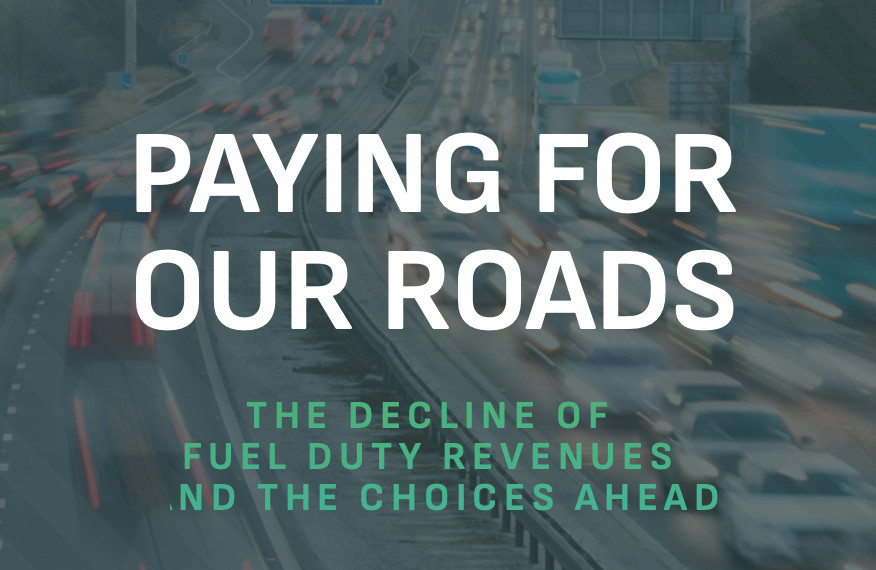
The Coalition is launching alongside its first report, Paying for our Roads: The decline of fuel-duty revenues and the choices ahead, which examines the scale of the fiscal challenge, the choices facing government and lessons from road-charging systems around the world.
The Coalition is launching alongside its first report, Paying for our Roads: The decline of fuel-duty revenues and the choices ahead, which examines the scale of the fiscal challenge, the choices facing government and lessons from road-charging systems around the world.
The report sets out the scale of the challenge created by declining fuel-duty revenues, looks at how other countries have responded, and examines some of the considerations the UK Government will need to make in the years ahead. Rather than backing a particular model, the Coalition argues that any future reform should first meet five tests to ensure it is fair, workable and supports the wider economy.
The Government has already begun that transition through Electric Vehicle Excise Duty (eVED), which will introduce a mileage-based charge for electric, hydrogen and plug-in hybrid cars from April 2028. Battery-electric and hydrogen cars will initially pay 3p per mile and plug-in hybrids 1.5p per mile. However, vans, HGVs and other vehicle types are outside the initial scheme, and the OBR estimates eVED will offset only around a quarter of the longer-term decline in fuel-duty revenues.
The Coalition says this means the debate over the future of motoring taxation is only beginning, and that businesses which rely on the road network need to be involved before wider decisions are fixed.
Tim Doggett, Chief Executive of the Chemical Business Association and Chair of the Road Pricing Coalition, said:
“The tax system for road use is going to change. The OBR’s forecasts make that increasingly difficult to ignore, and the introduction of eVED shows that the transition has already begun.
“The question is how government responds, and whether the businesses that depend on the road network are involved in shaping the answer. We are not launching this Coalition to campaign for one particular model. We are launching it because the decisions taken over the coming years will have major consequences for business costs, investment, supply chains and the wider economy.
“Government has time to get this right, but the conversation needs to start now. Commercial road users need to be in the room from the beginning, not brought in once the fundamental decisions have already been made.”
Tim Wray, Sales Director (UK and Ireland) at Kapsch TrafficCom added:
“It’s fantastic to see the industry mobilising and bringing a collective voice to the RUC debate, clearly with the introduction of eVED things are likely to now move at pace and its crucial the Government understand that decisions over technology made right now will have dramatic effects on the effectiveness and public acceptance going forward.
“There is also much to learn from other countries where we see real innovation happening right now, such as the cellular based systems found in Lithuania and ground-breaking work in New Zealand, so a wealth of evidence for DfT and Treasury to benefit from.”
(Picture: Road Pricing Coalition)