New guidance on artificial intelligence, carbon management and workforce competence will feature in the updated Well-managed Highway Infrastructure Code of Practice, which is due to launch at Highways UK on 14 October.
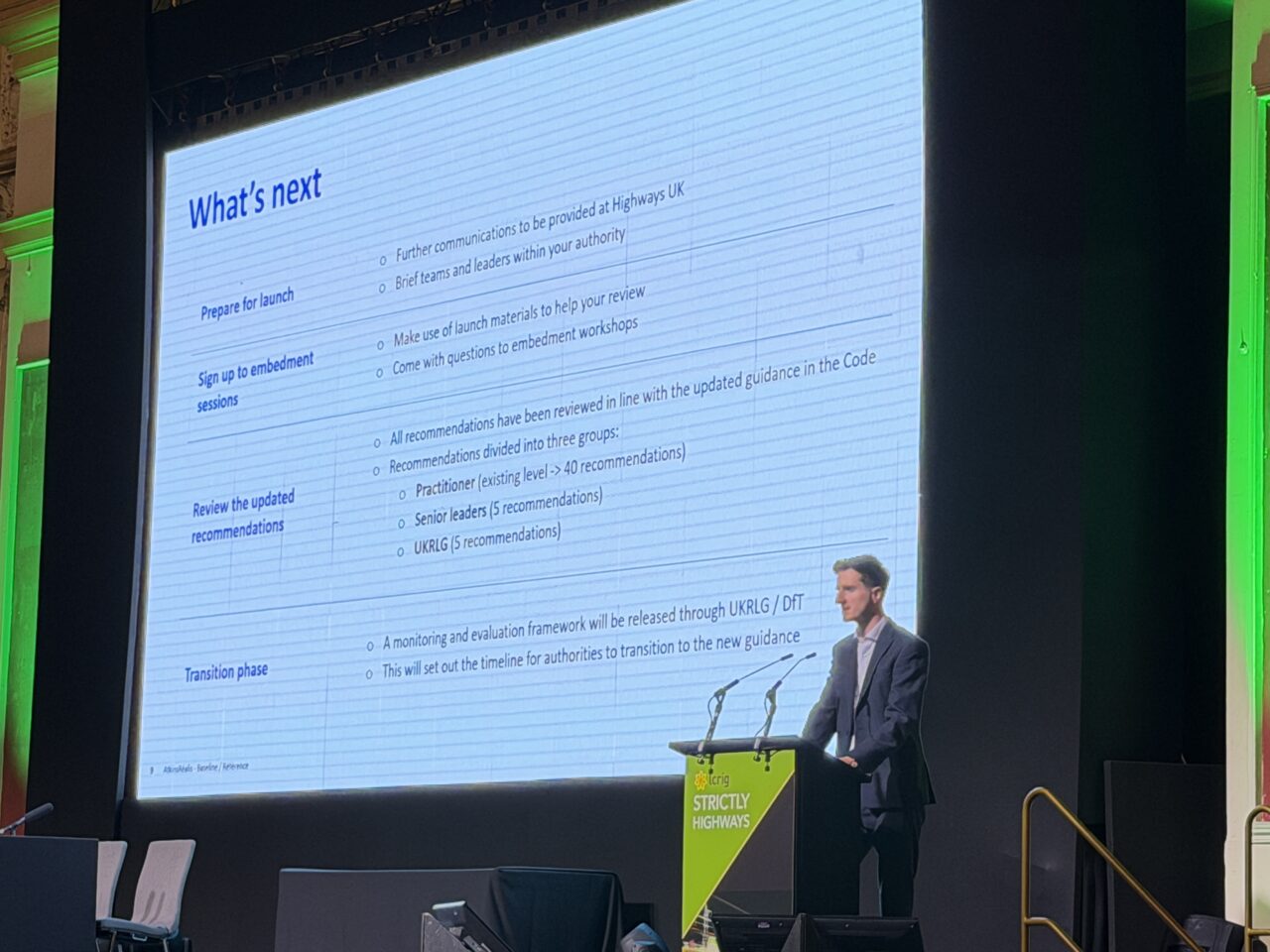
AtkinsRéalis Senior Consultant Alex Leslie (pictured) told LCRIG’s Strictly Highways conference in Blackpool that the update also introduces a dedicated section on tunnels, recommendations for senior leaders and a digital platform to make the guidance easier to access.
The revised code retains the risk-based approach of the 2016 version, allowing highway authorities to make decisions based on local needs, but provides more detailed guidance to help them develop and maintain that approach.
Mr Leslie said the project had been designed to build on the existing document, with stronger alignment around four core objectives: safety, serviceability, sustainability and customer service.
Expanded guidance covers network knowledge, finance and investment, procurement and delivery, and resilience. New sections address carbon management, AI, innovation, street works management, and workforce capability and competence, reflecting changes in the challenges facing highway authorities over the past decade.
The consultation draft sets out dedicated guidance on AI, climate change adaptation and carbon management alongside the wider asset management framework. Mr Leslie’s presentation outlined the changes following the sector’s consultation feedback.
A significant change is the introduction of three groups of recommendations. Alongside 40 recommendations for practitioners, there will be five aimed at senior leaders, including political and service leaders, to support those delivering the guidance.
A further five recommendations will be directed at the UK Roads Leadership Group (UKRLG), encouraging continuing support for the sector and updates to the code.
The document will also move onto a digital platform, allowing users to navigate directly to relevant parts, sections and assets. Mr Leslie said this would help the team understand how authorities access and engage with the guidance.
He explained that the code would act as a route into existing sector resources: “We didn’t want to duplicate all of the good work that’s been delivered by the sector.”
The launch will be accompanied by supporting material highlighting the changes in each part, together with three- to four-page quick guides explaining technical subjects for people who need an overview.
Case studies showing how authorities apply the guidance will be published on the updated UKRLG website. Full-day, face-to-face workshops and virtual sessions will follow in November.
Mr Leslie said the consultation had generated just over 1,000 comments, which had all been reviewed and addressed as appropriate. The work involved highway authority volunteers from across the UK, with UKRLG and the Department for Transport providing oversight.
He encouraged authorities to prepare their teams and leaders for the launch and consider which services should be involved in reviewing the updated code.
UKRLG and the Department for Transport will also explore how to measure its impact. Mr Leslie said the aim was to do so “fairly and proportionately across the UK without becoming an extra data collection exercise for every authority”.
(Picture – LCRIG)