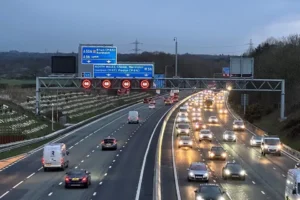
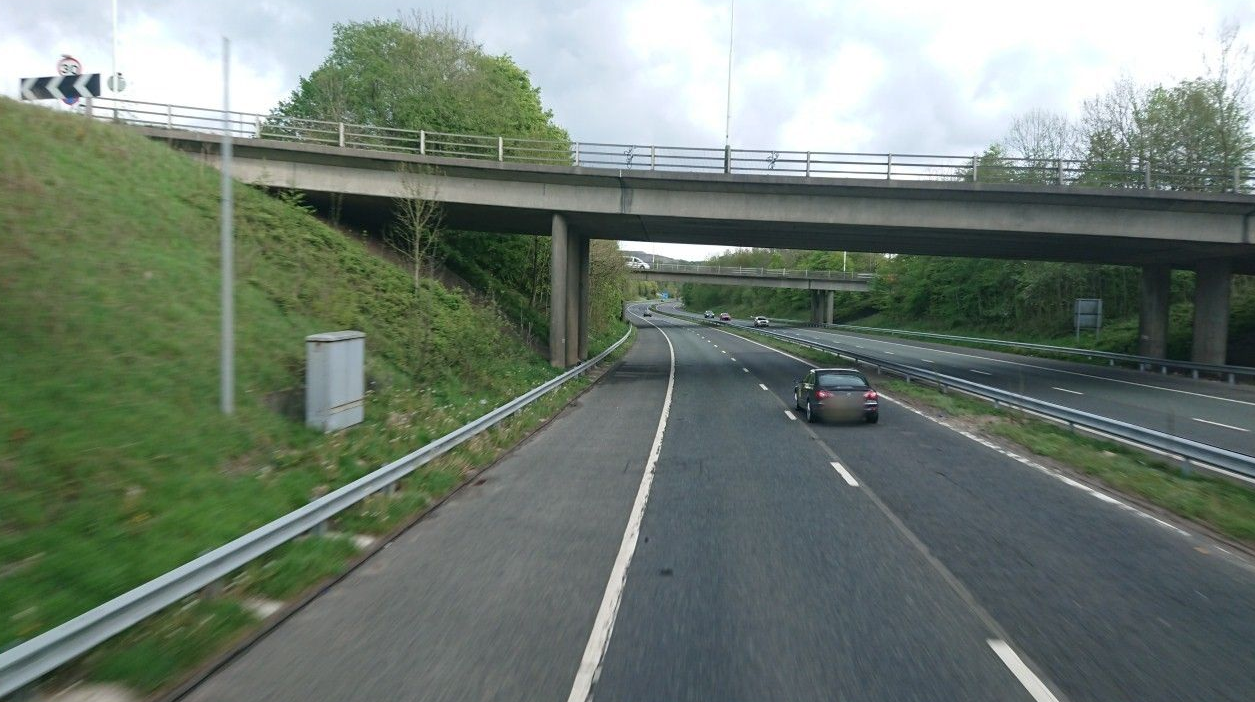
A crash that caused hours of disruption on the M66 near Bury has reignited a debate over the use of steel safety barriers on major roads. The southbound carriageway of the M66 between the A56 at Edenfield and Junction 2 was closed for almost 10 hours on Wednesday 4 June after a lorry towing a trailer carrying a road roller crashed into the central reservation, says the Bury Times.
National Highways said the incident happened at 6.26am when the vehicle collided with the central reservation barrier before jack-knifing and coming to rest on the nearside carriageway.
The crash caused significant damage to both the central reservation and verge-side safety barriers, requiring lengthy recovery operations and emergency repairs.

A spokesperson for National Highways said:
“Safety is our priority and all barriers on motorways and major A roads are required to meet stringent safety standards, which include impact tests involving a variety of vehicle sizes and weights from cars to HGVs and coaches.
“On this occasion, too, the steel barriers certainly did their job, preventing a large HGV from crossing the carriageway.”
However, the incident has prompted renewed criticism from Britpave, the infrastructure industry association, which argues that steel barriers are no longer suitable for modern traffic conditions.
Britpave said lower-performance steel barriers are typically designed to contain vehicles weighing up to 1.5 tonnes and can be vulnerable when struck by larger vehicles.
The organisation is calling for greater use of rigid concrete barriers, which it says can contain much heavier vehicles and often avoid the need for extensive repairs following collisions.
Al McDermid, chair of Britpave, said:
“The ability of concrete barriers to contain errant vehicles means that motorways do not have to be closed in both directions, and there is often no need for barrier repair or replacement. Traffic congestion is reduced. “The disruption is managed and minimised.
Lower-performance steel barriers are simply not up to the job of containing traffic compared to rigid concrete barriers that provide unrivalled strength, safety and 50-year whole-life performance benefits. Despite acknowledging the superior long-term benefits of concrete barriers, National Highways is failing to deliver its programme to replace end-of-life steel barriers.
“The crash on the M66 underlines the need for a more robust concrete solution for our busy motorways.”
(Picture: Mapillary)