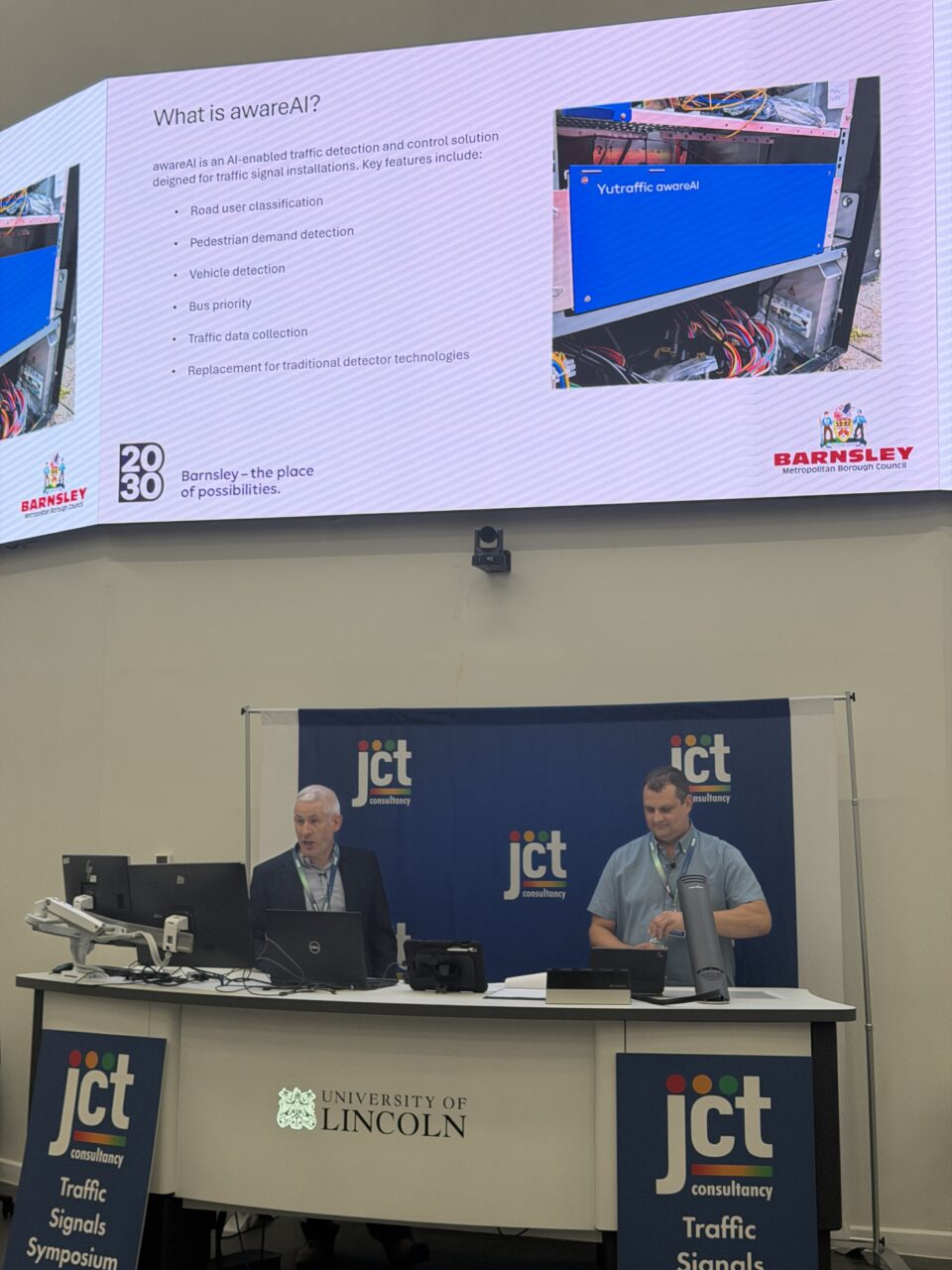
Barnsley Metropolitan Borough Council has used AI-based detection to address two distinct traffic management problems while retaining its existing signal infrastructure and avoiding extensive civil engineering work.
The applications were presented by Barnsley Council Traffic Signals Engineer Daniel Ellis and Yunex Traffic Principal Engineer Nick Rule at the JCT Traffic Signals Symposium in Lincoln.
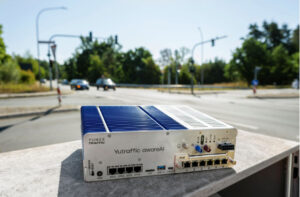
Both schemes use Yunex Traffic’s awareAI camera-based detection platform, but the speakers stressed that the technology had been selected to solve clearly defined operational problems rather than as a general AI trial.

At Bridgend in Penistone, near Penistone Grammar School, the council needed to accommodate large but variable numbers of pedestrians at a signal-controlled junction operating under MOVA.
A permanently longer pedestrian green would have affected traffic throughout the day, while a timetable-based arrangement would have required school calendars to be maintained. Conventional volumetric detection was also considered difficult to install because of the constrained footways.
Instead, two virtual kerbside zones were configured using a single wide-angle camera. When the system detects five or more pedestrians waiting in either zone, it sends an input to the existing ST800 traffic signal controller and MOVA system.
The standard minimum pedestrian green has been reduced from ten to six seconds. When the threshold is reached, the system can provide additional green time, including extensions beyond the previous ten-second fixed duration if pedestrian demand continues.
This means the crossing can respond to observed conditions rather than assumptions about school arrival and departure times. During periods of lower demand, the junction retains the shorter minimum pedestrian green and MOVA can continue to optimise its operation for the wider traffic network.
The installation required modifications to the controller inputs and MOVA dataset, but did not require a wholesale replacement of the existing control system.
A second installation at Peel Square in Barnsley town centre addressed a different problem. A radar detector had been used to identify vehicles waiting to leave the pedestrianised market square through security bollards Although it could detect objects, the equipment could not reliably distinguish vehicles from pedestrians, market activity and other objects within its detection area. This generated false demands and could start the bollard opening sequence when no vehicle was present.
Installing inductive loops would have required work to the high-quality paving in the square, as well as traffic management and disruption at one of the limited town centre exits. Barnsley instead installed a camera and configured an awareAI zone to generate a demand only when a vehicle was classified within it. The existing traffic signal and bollard arrangements otherwise remained unchanged.
The council and Yunex Traffic reported that validation under live conditions found that vehicles continued to be detected while pedestrian movements around the bollards no longer generated false demands.
The two installations illustrate how more detailed classification can provide value where conventional detectors are able to identify presence but cannot supply the specific information needed by the control strategy.
They also demonstrate a potential whole-life benefit. The same platform can be expanded with additional cameras and outputs and could support applications including replacement stop-line detection, bus priority, active travel schemes, queue monitoring and classified traffic data collection.
They said this was particularly relevant in Barnsley, where the traffic signals function has limited internal resources and solutions that require regular manual intervention create an additional maintenance burden.
Mr Ellis and Mr Rule cautioned that AI detection was not a universal replacement for established detector technologies. Its value, they suggested, comes from applying it selectively where classification or configurable detection zones can resolve a defined problem.
In both Barnsley cases, a relatively small amount of new equipment was integrated with existing controllers and control strategies. This allowed the council to improve the information supplied to the signals while avoiding major infrastructure replacement, excavation and associated disruption.
(Picture – JCT)