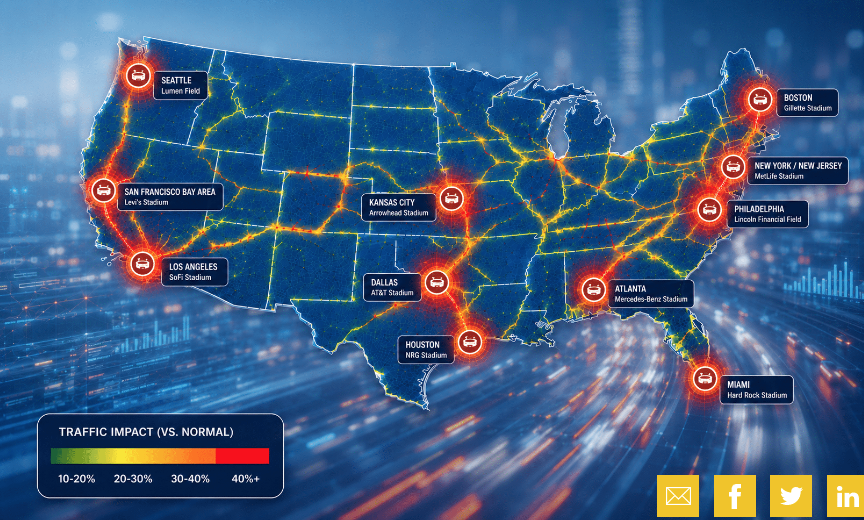
INRIX has launched its 2026 FIFA World Cup Data Hub, providing transportation agencies, event organisers, media, and travellers with a comprehensive, real-time view of how the world’s largest sporting event is moving millions of people.
The 2026 FIFA World Cup spans 16 cities across the United States, Canada, and Mexico, making it the most geographically diverse World Cup in history. With matches across 11 US stadiums attracting millions of fans from around the world, transportation demands vary as widely as the cities themselves. INRIX is uniquely positioned to capture that complexity at scale with unprecedented speed, backed by a data infrastructure no other company can beat.
Drawing on more than 300 million connected vehicles and devices, a 50-petabyte transportation data lake, and 44 billion data points generated daily, INRIX can analyse traffic conditions around any US stadium within hours of a match. The company compares event-day speeds against historical baselines, pinpoints corridor bottlenecks, and benchmarks World Cup impacts against other major events at the same venues, giving the public a real-time view of how World Cup travel behaves across multiple US metros at once.

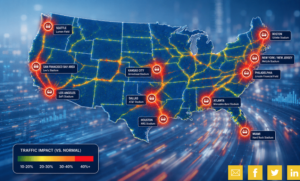
Early data from the tournament’s opening weekend confirmed significant congestion spikes before and after matches within one mile of the stadiums. Across Los Angeles, the San Francisco Bay Area, the New York/New Jersey area, Boston, Houston, Dallas, and Philadelphia, pre-game traffic speeds near some venues dropped nearly 50% below normal. Read INRIX’s full opening weekend report here.
“The breadth of data we have access to lets us answer questions about transportation that others can’t answer at this speed or scale,” said Ahmed Darrat, Chief Product Officer at INRIX. “Beyond tracking vehicle speeds, we’re analyzing signal performance, pedestrian and micromobility movement, multimodal comparisons across match types and cities, and how World Cup traffic stacks up against other major events at the same venues. That’s what 20-plus years of proprietary mobility data enables.”
(Picture: INRIX)