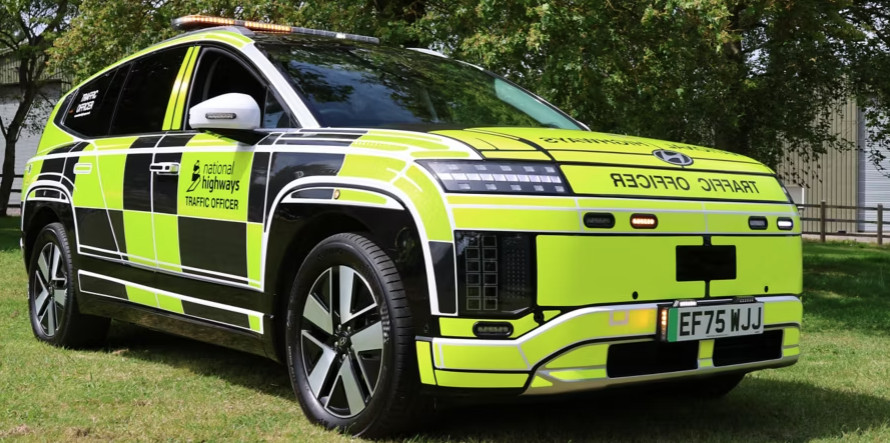
National Highways has taken delivery of four Hyundai Ioniq 9 SUVs to test across England’s motorways and major A-roads. Subject to the pilot’s success, National Highways is considering further fleet purchases over the rest of 2026.
According to Fleet World, the scheme will assess how the seven-seat EV performs in frontline operational use, combining zero tailpipe emissions, long electric range, rapid charging and the load capacity required for emergency response duties.
The SUVs have been converted to full traffic officer specification by Richell Vehicle Conversions (RVC).
The bespoke layout features National Highways livery and high-visibility decals, emergency lighting and a full suite of on-board incident response equipment.
To safely power the emergency warning suite without draining the vehicle’s primary power source, RVC integrated a dedicated 240Ah lithium auxiliary battery system, kept electrically separate from the main drivetrain battery. This system powers a lightbar, a 100W bullhorn and an array of amber and red warning LEDs, alongside further lighting on the wing mirrors, rear screen and tailgate, plus a flip-up standby traffic commander matrix board for incident messaging. RVC also engineered a bespoke load-carrying system to house the radio, Inseego telematics and CCTV equipment.
“This trial demonstrates Ioniq 9’s capability in demanding real-world roles,” said Ashley Andrew, president of Hyundai & Genesis UK, “combining zero-emission performance, practicality and rapid charging to support National Highways’ vital work.”
Launched in 2025, the Ioniq 9 flagship Ioniq 9 electric SUV teams up long-distance electric capability with flexible interior space and practical load-carrying capacity.
Built on Hyundai’s dedicated Electric-Global Modular Platform (E-GMP), the top-rung SUV features a 110.3kWh battery delivering a WLTP range of up to 385 miles. Its 800V architecture supports ultra-rapid charging to keep vehicle downtime to a minimum. Crucially for patrol duties, folding the third-row seats flat opens up 908 litres of cargo space, offering the flexible interior volume needed for heavy highway equipment.
Over the course of its trials, National Highways will assess the vehicle for operational suitability, equipment integration, charging performance to support the organisation’s work while also decarbonising its frontline network operations.
(Picture: Hyundai)