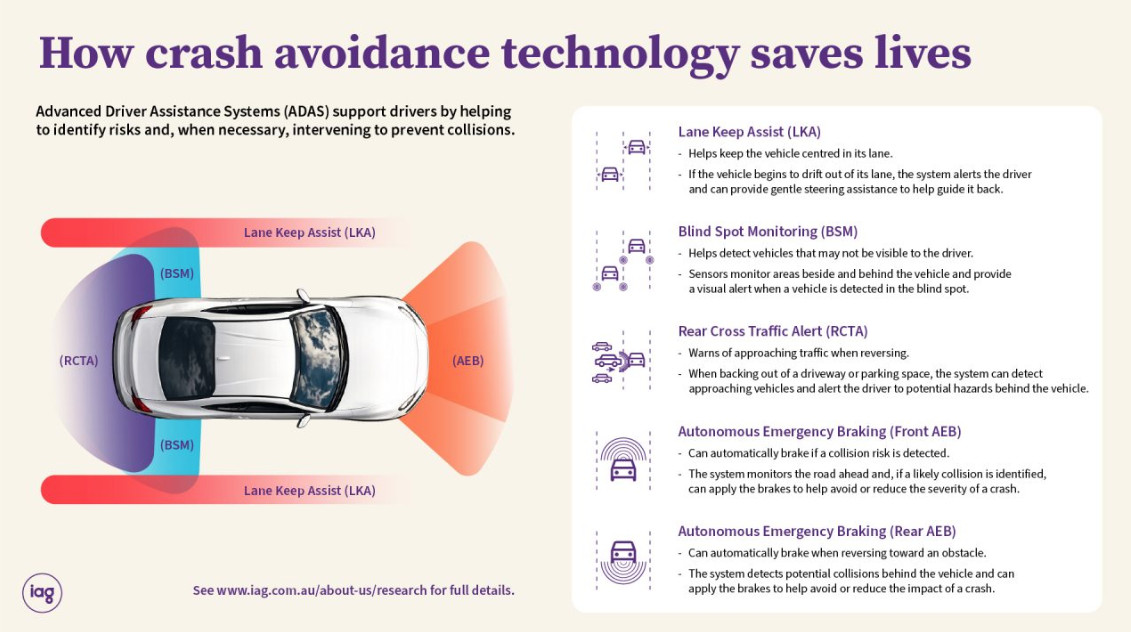
More than 7,000 casualties could be prevented each year on Australia’s roads through greater use of Advanced Driver Assistance Systems (ADAS), according to insights from a study by IAG.
IAG, whose brands include NRMA Insurance, CGU, WFI, Rollin’, RACV Insurance and RACQ Insurance, partnered with the Queensland University of Technology (QUT) and the iMOVE Cooperative Research Centre, to investigate why driver-assist systems are not delivering on their full potential to reduce road accidents, despite their proven safety benefits globally.
The release of IAG’s year-long study comes as the Federal Government’s first passenger vehicle ADAS mandate reaches its latest phase, with all new vehicles sold in Australia required to be fitted with car-to-pedestrian AEB from 1 August 2026.
This requirement builds on the initial phase fully implemented in March 2025, which required all new vehicles to be fitted with car-to-car AEB.

Lane Keeping Assist (LKA), which helps a vehicle remain centred in a lane, will become the next mandated ADAS feature for passenger vehicles, due to come into full effect in March 2029.
Both LKA and AEB were among the six individual ADAS technologies evaluated in QUT controlled field research.
In addition to the field research that observed 50 participant drivers using six ADAS safety features, IAG’s study includes QUT crash data analysis of 100,000 vehicle collisions, and a national survey of 2,000 drivers of ADAS-enabled vehicles.
“Sixty percent of Australian drivers tell us they are actively turning off driver-assist safety features in their cars, and we know the majority that do use the technology are learning through a process of trial and error alone,” Mr Ticehurst said.
“By finding out what’s stopping Australian drivers from embracing driver-assist safety features and what might encourage a shift in attitudes and behaviour, we’ve identified key barriers and knowledge gaps that need to urgently be addressed.”
As smart-car safety technology evolves rapidly, Mr Ticehurst said the human cost of driver education failing to keep pace is too great to ignore.
“The crash data analysis undertaken by QUT looked at 100,000 vehicle collisions on Australian roads and found every single driver-assist system significantly reduces the crash type it’s designed to prevent – with the largest reductions observed in sideswipes (up to 40%), head-on collisions (up to 21%) and lane change accidents (up to 15%).”
Click HERE for access to the report.
(Picture: IAG)