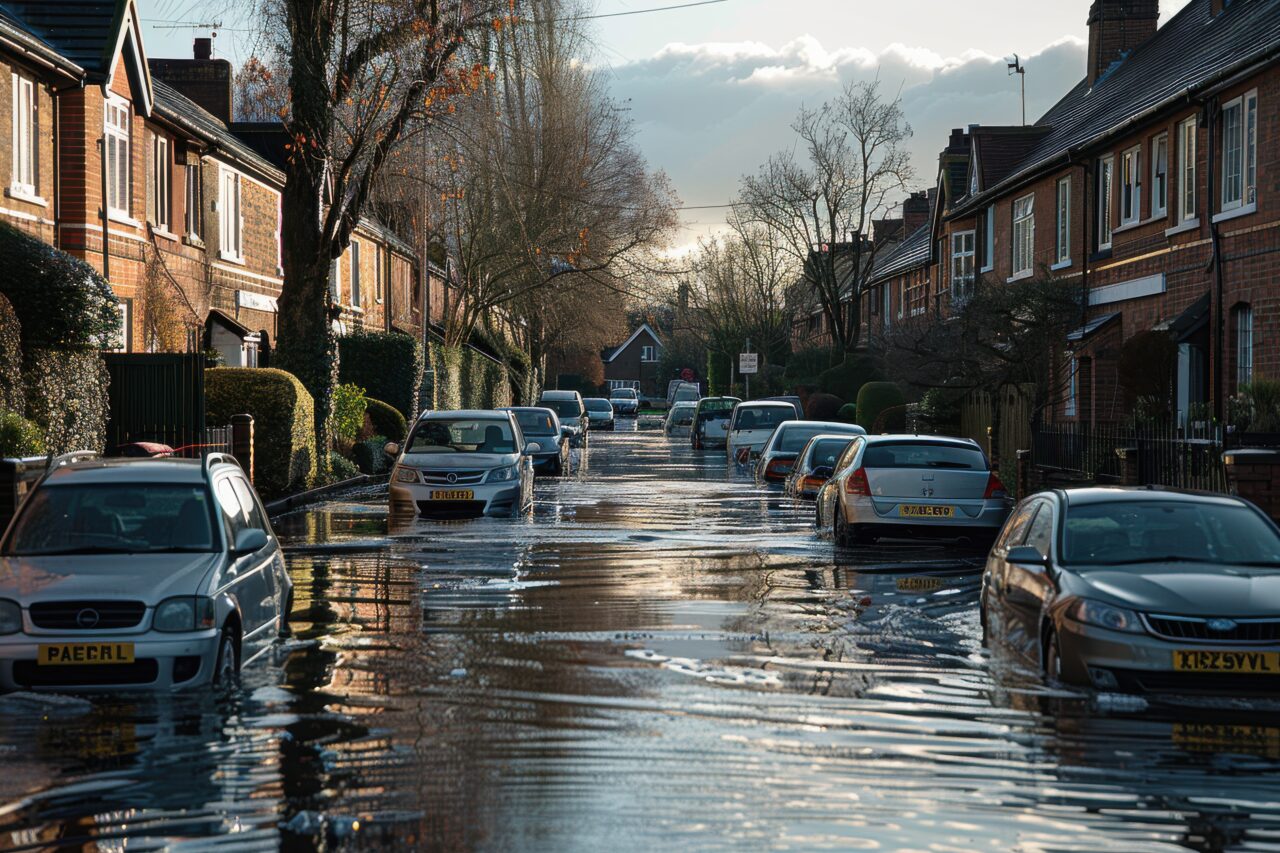
For drivers, the first sign of a drainage problem is rarely a technical one. It is spray hanging in the air, standing water across a lane, warning lights ahead or a queue building behind an emergency closure, says Martin Lambley, director of Somerset-based global water management specialists Hydro International.
For road operators, the same moment tells a bigger story. England’s strategic road network makes up just three per cent of the country’s roads yet carries a third of all motorised traffic and two thirds of freight. As rainfall becomes more intense, the ability to capture, store and release water is becoming even more critical to keeping this heavily used network reliable.
Flood risk on our roads is growing. Financial Times analysis of Ordnance Survey, Fathom and Environment Agency data revealed that close to a third of main roads into Greater London, 40 per cent into Birmingham and more than half into Greater Manchester are at risk of being disrupted by river flooding.

The challenge is likely to become even more acute. Forecasters expect the developing El Niño to be the strongest for more than a century, increasing the likelihood of a wetter, stormier UK autumn. For highways authorities and their supply chains, the question is not only how to protect communities and the environment, but how to maintain safe, reliable journeys as drainage assets come under increasing pressure.
That is the practical context for National Highways’ Road Investment Strategy 3 (RIS3). The £27bn, five-year programme sets out planned investment in England’s motorways and major A-roads, including maintenance and renewal activity intended to improve the performance and reliability of the network.
Road investment is often discussed in terms of journey times and capacity, with asset condition central to both. Drainage is part of that asset base: when heavy rain turns a familiar route into a flood risk, its condition and performance become one of the most visible tests of whether the network can keep moving.
Setting the wheels in motion
National Highways has recognised that drainage performance needs greater attention. Its 2030 Water Quality Plan sets out a programme to inspect, prioritise and upgrade high-risk drainage assets. Although the plan is focused on pollution, it sits within a broader resilience challenge: highways drainage systems are being asked to perform more effectively, more consistently and under more demanding conditions.
The challenge is that drainage programmes cannot be judged simply by the number of assets inspected or renewed. The central test is whether interventions help move water away from the carriageway quickly enough, store it safely where required and reduce the likelihood of disruption during peak rainfall events.
Designing for volume
Managing water quantity is not a single engineering problem. It means understanding how much runoff a section of road is likely to generate, how quickly that water will reach the drainage system and whether existing assets have the capacity to cope when rainfall intensity increases.
Scheme design is critical. The best approaches treat water quantity as a core resilience issue rather than a secondary design consideration.
Drainage interventions need to be planned around catchment behaviour, available land, maintenance requirements and the operational risk created by water remaining on or near the carriageway. A solution that works in open land may not be deliverable beside a constrained junction, cutting or urban approach road.
Green and nature-based drainage systems can play an important role by slowing flows, creating storage and reducing pressure on downstream assets. However, they are not always sufficient on their own, particularly where space is limited, ground conditions are challenging or large volumes of water need to be controlled within a compact footprint.
For example, on sections of the strategic road network where space is at a premium, it can be difficult to provide attenuation ponds or other large-scale drainage systems at the size and scale required to handle large quantities of water.
In these situations, combining nature-based drainage with engineered attenuation and flow-control technologies can help highways teams make better use of constrained sites. Proprietary systems can capture, store and release runoff at controlled rates, supporting flood resilience where traditional ponds or large-scale basins are not practical.
Putting compact attenuation into practice
The A428 Black Cat to Caxton Gibbet improvement scheme shows how this can work in practice. With space constrained, the drainage design will include 58 high-efficiency Hydro-Brake® Optimum vortex flow controls. Their hydraulic performance allows more water to pass through at lower heads, reducing the upstream storage required and helping to limit the amount of water held on or beneath the road. The scheme also incorporates flow-control and sediment-removal technologies to manage runoff across different site configurations.
Adaptability also matters over an asset’s lifetime. On most Hydro-Brake® Optimum units, an adjustable inlet can be used to alter the discharge rate if future development or climate pressures change the hydraulic requirements. Designing in that flexibility can help avoid replacing the flow control or reconstructing the chamber later.
For road operators, the priority is to keep water moving, keep drainage assets performing and keep roads open. That requires an approach that treats water quantity as a core resilience issue rather than a secondary design consideration.
The greatest value will come from drainage strategies designed around the volume and movement of water across the network, helping highways teams reduce flood risk, limit disruption and improve the reliability of critical routes.
(Picture: Yay Images)