33 road condition monitoring technologies have been put forward for PAS 2161 testing across three local authority networks, with a final report due to be submitted for Department for Transport approval by the end of February 2027.
PAS 2161 is a standard for collecting and reporting road condition data in England, using five condition categories to make results comparable regardless of the survey technology used. It gives local highway authorities greater choice over how they assess their roads, while requiring technologies to undergo independent testing to demonstrate that they meet the standard and produce consistent results.
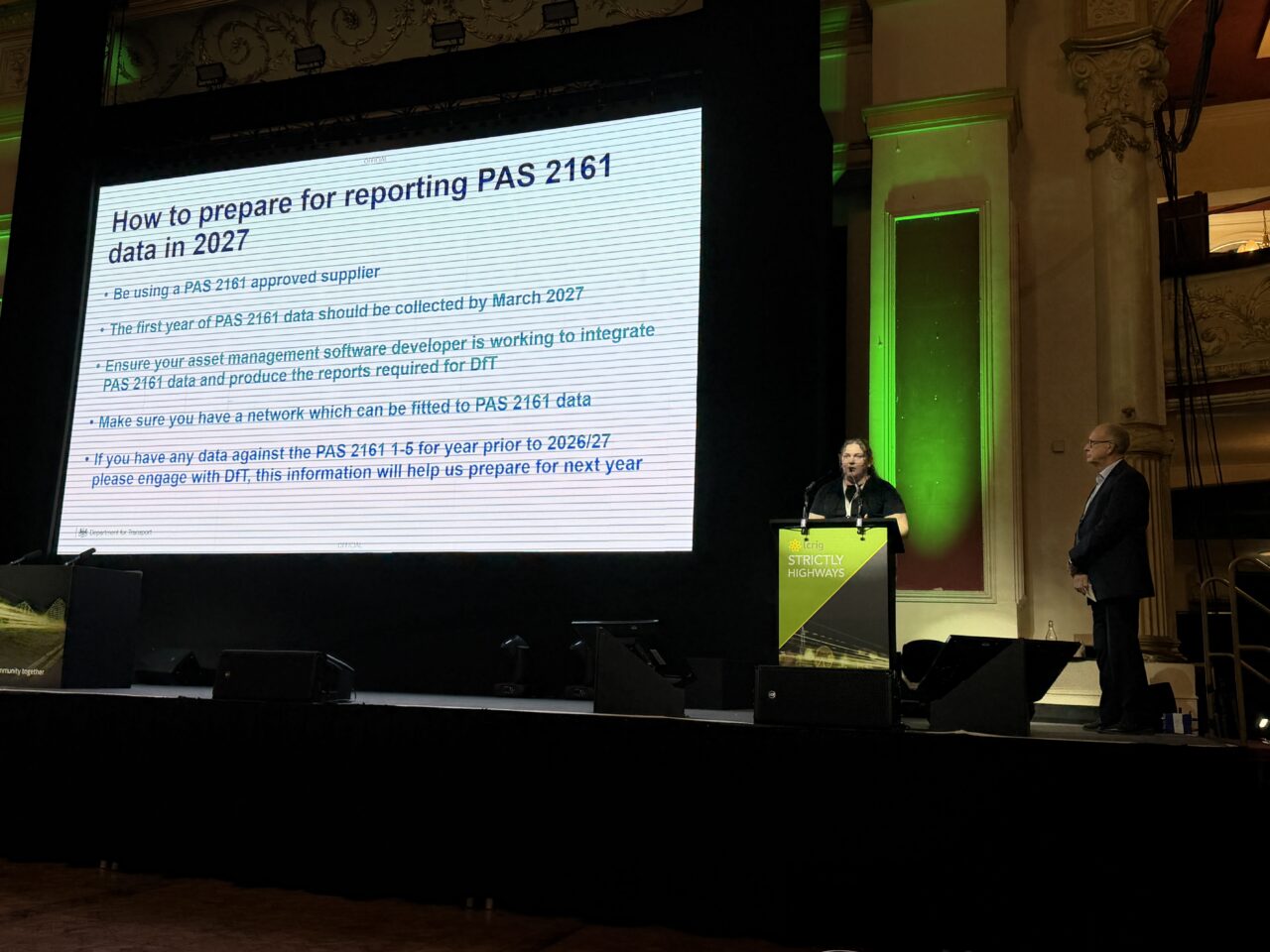
DfT Head of Road Condition Statistics Laura Murphy and TRL Principal Consultant (Assets) Mark Stevens told LCRIG’s Strictly Highways conference in Blackpool that the programme is assessing technologies against a benchmark established by highway engineers, testing both their condition assessments and the consistency of their results.

Nottinghamshire, Lincolnshire and Cheshire West and Chester are hosting this year’s trials, having been selected from 20 local highway authorities which volunteered their networks. The selection considered road condition, topography and the balance of urban and rural roads.
The work follows DfT’s appointment of TRL as the PAS 2161 approvals auditor. The standard provides a consistent framework for road condition reporting, allowing results from different monitoring technologies to be compared. TRL independently assesses whether providers can deliver data meeting its requirements.
Ms Murphy explained that PAS 2161 will become mandatory for classified-road condition reporting once authorities’ existing survey contracts have run out.
Mr Stevens said the latest assessment programme builds on testing of 25 technologies across six technology types in 2025, with 33 technologies putting themselves forward this year.
For each host authority, TRL identified a main survey route of approximately 100 km (around 60 miles). Local authority engineers assessed road condition using the PAS categories of one to five, with their assessments brought together to produce a coordinated benchmark.
Technology providers surveyed the same routes during a four-week window. They also surveyed a smaller repeatability route, covering approximately a quarter of the main route in each area, to demonstrate consistency in their reporting.
Mr Stevens explained that TRL would compare the engineers’ benchmark with the providers’ results to determine whether each technology had demonstrated compliance.
The routes include A, B and C roads alongside around 50 km of unclassified roads. Although unclassified roads are outside the current PAS reporting requirement, their inclusion has helped the trials capture more examples of roads in condition categories four and five.
Mr Stevens said this would provide a stronger test of technologies’ ability to identify poorer road condition. “We’re hoping that the assessment process is going to be more robust than in 2025,” he said.
The next stage involves providing suppliers with calibrated benchmark data for approximately 40km of each main route, showing how engineers have scored those sections.
Providers will then have five weeks to review that information and return their results for the full routes and repeatability sections. TRL will undertake a further five-week assessment to determine whether the technologies have demonstrated PAS 2161 compliance, with the final report due for DfT approval by the end of February 2027.
Further demonstration trials are planned for 2028 and 2030. Mr Stevens also encouraged authorities to put forward engineers for future benchmarking exercises, describing participation as “a great learning exercise”.
Alongside the trials, Ms Murphy outlined work to improve the comparability of condition data for unclassified roads. She said the proportion of authorities using traditional visual surveys had fallen from more than 75% to less than half over the past decade, with that trend expected to continue.
DfT is working with companies to explore how existing visual survey data could be translated into the PAS one-to-five categories, helping bring together results collected using different approaches.
(Picture – LCRIG)