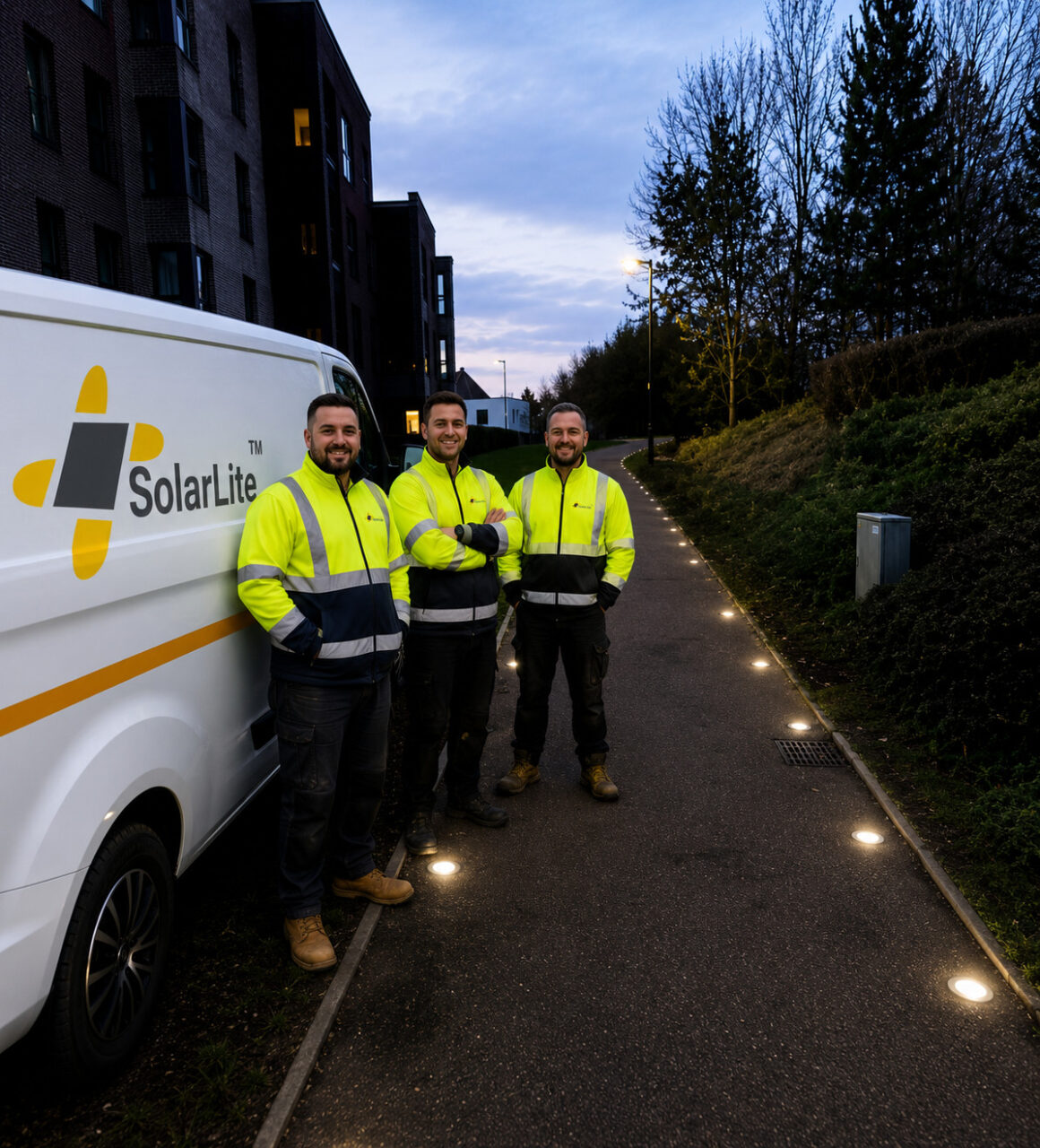
Local authorities are being invited to identify challenging locations on their road networks for the chance to have a new solar-powered active road stud scheme supplied and installed free of charge.
The SolarLite Local Authority Impact Challenge, being delivered in partnership with the Local Council Roads Innovation Group, LCRIG, will select three sites where active road studs could make a measurable difference to improve road safety and help reduce carbon emissions and road safety costs.
Each successful authority will receive up to 100 SolarLite active road studs, together with standard installation at no charge. Authorities are encouraged to nominate locations where conventional measures are proving ineffective, unaffordable or difficult to maintain.

Potential sites could include unlit collision hotspots, rural roads, junctions, roundabouts and link roads where better delineation could improve driver behaviour. Authorities can also put forward locations where the cost, carbon impact or condition of ageing street-lighting assets has become a recurring challenge.
Entries are open from today (1 October) until 30 November 2026 through a dedicated submission page on the LCRIG website. Applicants are asked to provide key information about the site, the problem they are seeking to address and the outcomes they would like to achieve.
A judging panel bringing together representatives from the Department for Transport, ADEPT, LCRIG, Highways News and SolarLite will assess the submissions. The three successful authorities are expected to be notified before Christmas, with installation planned between January and March 2027.
Alastair King, Head of SolarLite, said: “We want to hear specifically from local authorities about challenging parts of their network, whether that is a consistent unlit accident hotspot or somewhere the financial cost, carbon output or maintenance of ageing lighting assets is becoming a recurring problem.
“We are deliberately not being prescriptive about the type of road or location. What we really want to see are problem areas where active studs can make a difference.”
Unlike conventional retroreflective studs, which rely on vehicle headlights and are typically visible from around 90 metres, SolarLite active road studs use integrated LEDs to emit light and can provide visibility from up to 900 metres. They operate independently of mains electricity, using solar energy collected during daylight hours.
The competition follows the publication of the final report from the ADEPT Live Labs 2 decarbonising street lighting project led by East Riding of Yorkshire Council. More than 5,000 active road studs were installed as part of new visual guidance designs intended to support the removal of conventional street lighting at selected locations.
Across all the project’s test sites, the report identified potential ten-year savings of £1.24 million compared with conventional street-lighting replacement. It also calculated a 25% reduction in carbon over the same high-certainty appraisal period, potentially rising to 36% with further value engineering.
Initial monitoring found speed reductions at three-quarters of the test sites, reaching up to 10% at some locations. Night-time collision rates across the sites also fell compared with the previous year, although the project stressed that continued monitoring would be needed to assess the longer-term effects.
Mr King added: “This is all about data. We want to quantify the problem at each site and demonstrate, through before-and-after evidence, whether SolarLite active road studs make a difference.
“The Live Labs work in East Riding has shown what can be achieved. Now we want to support more local authorities in turning that evidence into action. If you are an authority that has heard about active studs but never tried them, I would encourage you to give us your best challenge.”
The winning schemes will be monitored following installation, allowing SolarLite and the participating authorities to assess their effect on factors such as vehicle speeds, driver behaviour, safety, energy use and whole-life costs. Learning from the projects will be shared with the wider highways sector, including through SolarLite’s Stud for Thought series.
“LCRIG is pleased to be partnering with SolarLite on this initiative, creating an opportunity for local authorities to explore innovative approaches that could deliver practical benefits,” added Susanne Ingham, Relationship Director, LCRIG. “Together, we are helping provide a platform for authorities to test new approaches and build an evidence base around what works. This is particularly important at a time when the sector is facing increasing pressure to improve road safety, make the best use of limited resources and deliver more sustainable solutions.
“We look forward to seeing the submissions that come forward through the challenge and to sharing the learning from the successful schemes with the wider highways community, helping to support innovation and inform future approaches across the sector.”
While SolarLite is now established as a distinct specialist brand, its technology is far from new. Solar-powered road studs have been delivered and developed by Clearview Intelligence since the 1990s, with installations on local and strategic roads in the UK and overseas. This includes major deployments on the A2, A20, M25 and M40, as well as applications on rural roads, active-travel routes and level crossings.
You can hear more about it on this week’s Highways Voices podcast.
SolarLite is a Clearview Intelligence company.
Local authorities can enter the SolarLite Local Authority Impact Challenge through the LCRIG website.
(Picture – Clearview/SolarLite)