In April we brought you the news that the Scottish National Party had announced it will bring Transport Scotland back within the Scottish Government if it won a majority in May’s Scottish Parliamentary elections.
Now the Scottish Government has confirmed that Transport Scotland will indeed be brought back into the core of government as part of what First Minister John Swinney describes as the “most radical reshaping of public services” since the creation of the Scottish Parliament.
The announcement, contained in the Scottish Government’s new five-year Programme for Government, is brief on detail – but the change could have important implications for Scotland’s roads and wider transport network.
Transport Scotland is currently an executive agency of the Scottish Government. It is therefore not a separate company or arm’s-length public body: its staff are civil servants, it is directly accountable to Scottish Ministers and its finances are consolidated within the Scottish Government’s accounts.
Its executive-agency status does, however, give it a degree of operational autonomy. Transport Scotland has its own chief executive and is responsible for delivering major infrastructure programmes, managing Scotland’s trunk road network and advising ministers on transport policy.
The government’s proposal appears to mean removing that executive-agency structure and incorporating Transport Scotland into the core civil service.
That distinction matters. It does not mean Transport Scotland is being “abolished” in the conventional sense, nor does it mean the Scottish Government is taking over a body that currently sits outside government. Rather, the agency model is likely to disappear, with its functions and staff becoming part of the central government structure.
The government has provided little detail on how that will work. In June, Transport Secretary Stephen Flynn told MSPs that preparations were at an early stage, saying the transport system had evolved into a “complex landscape” of national bodies, agencies and local actors, with blurred lines of accountability and insufficient integration. Ministers said they wanted a wider review of how transport is delivered across Scotland.
That wider reform agenda is arguably more significant for the highways sector than the organisational change itself.
The Programme for Government says the Scottish Government will review the remaining national transport bodies for potential mergers, while also considering the creation of a single ferries body for the Clyde and Western Isles. It also proposes changes to bodies including the Mobility and Access Committee and the National Smart Ticketing Advisory Board.
For roads, the immediate message is that the major commitments remain intact. Ministers have reaffirmed their plans to dual the A9 and A96, address the long-running A83 Rest and Be Thankful problem, and continue investment in Scotland’s transport infrastructure. The government also intends to conclude a new A9 framework agreement, procure the Pitlochry-Killiecrankie section and progress advanced works on parts of the A96.
The real question, therefore, is whether moving Transport Scotland into core government will make those commitments easier to deliver – or simply create another period of organisational upheaval.
Ministers argue that removing duplication and simplifying accountability will make public investment more effective. For the highways industry, however, the test will be practical: whether decisions are made faster, projects are delivered more predictably, and the relationship between policy, funding and infrastructure delivery becomes clearer.
For now, the government has supplied the direction of travel but not the road map. The detailed structure, timetable, implications for Transport Scotland’s leadership and whether responsibilities will be redistributed elsewhere in government all remain to be worked out.
With the agency responsible for Scotland’s strategic road network about to undergo its biggest structural change in two decades, those details will matter considerably.
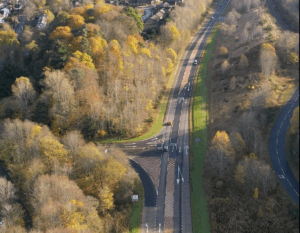
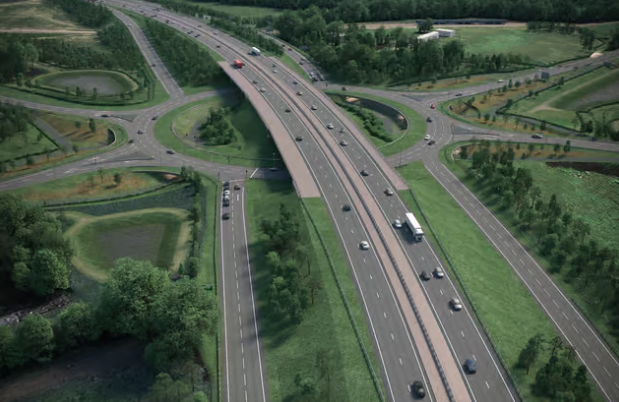
(Picture: Transport Scotland)