
Veteran newspaper columnist Peter Hitchens has told Highways News Britain needs to recognise that allowing the motor car to dominate its transport system was a historic mistake, before it can begin planning a different future.
In an extended Highways Voices debate with behavioural science expert Rory Sutherland, Mr Hitchens launches a wide-ranging attack on car dependence, saying: “It’s been a mistake. It hasn’t worked. It’s polluted the world. It’s made us dependent upon grotesque regimes in the Middle East, and it has uglified almost everything.” He adds: “This country has grown immensely uglier in my lifetime because of the motor car.”
However, Mr Hitchens stresses that he is not suggesting car use could simply be removed through immediate Government action. “I don’t believe that within my lifetime, or indeed my children’s, or probably my grandchildren, this thing can be put right,” he says. “Nor do I believe for a moment that you could instantaneously introduce laws about cars, which would restrain them in important ways. Nor do I think you could rapidly recreate the railway system.” His argument, he says, could instead be turned into “intelligent planning for the future”.
Central to his case is the loss of Britain’s former rail network. Mr Hitchens says: “We had an actual network of railways, almost as dense as the network of roads we now have, and it could be restored.” He describes its disappearance as “the great outrage and tragedy”, while also arguing that spending on HS2 would have been better directed towards reopening and improving conventional railways.
Mr Sutherland strongly disputes the idea that the car itself represents a transport failure. “The reason we own them is for the convenience of having them available when and where we need them,” he says, arguing that the car works across an “extraordinary range of journeys”. He also challenges Mr Hitchens’s vision by emphasising the personal autonomy offered by road travel and the difficulty of replacing it for many existing journeys.
Despite their fundamental disagreement, the two find common ground over the need for better rail and scepticism about the way major transport investment is assessed. Their full, frequently robust but good-humoured conversation will be published as a three-part Highways Voices special next week.
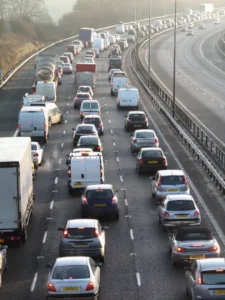
(Picture – Mail on Sunday)