A bespoke traffic signal strategy in Birmingham is allowing trams, pedestrians and buses to receive greater priority without causing significant disruption to general traffic, the JCT Traffic Signal Symposium has heard.
The approach has been developed for the Bull Street and Corporation Street junction, one of the most operationally complex signal-controlled tram junctions on the West Midlands Metro network.
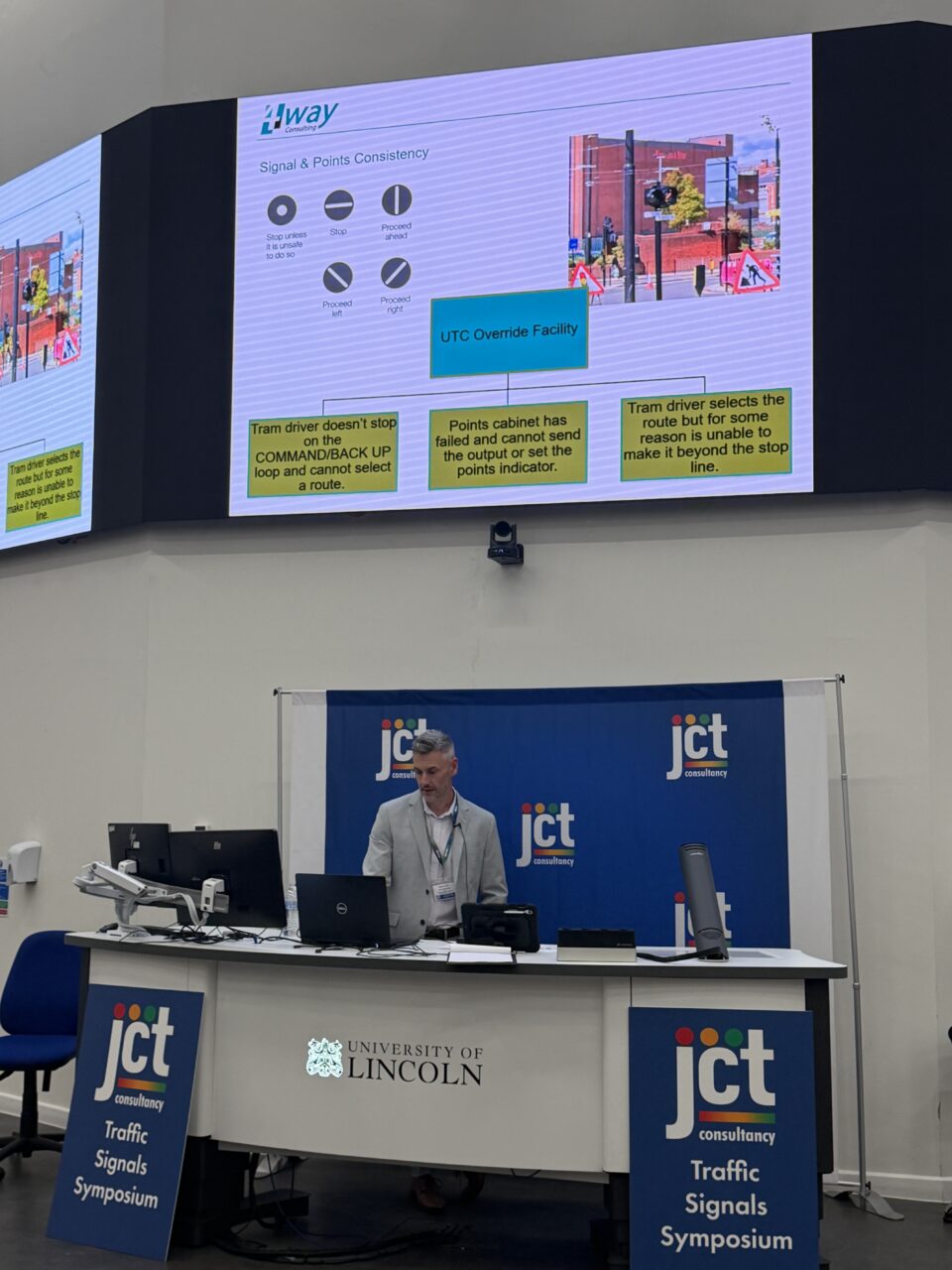
Presenting a paper at the symposium yesterday (16 September 2026), 4way Consulting smart cities sector lead Shane Collins explained how engineers had sought to make public transport, walking and cycling more attractive while maintaining the junction’s capacity and limiting queues that could affect surrounding roads and city-centre activity.
The junction forms part of the Birmingham Eastside Metro Extension and operates as a tram “delta”, with a triangular track arrangement allowing services to travel between three different directions without reversing. It must also accommodate buses, general traffic, pedestrians and cyclists.
He explained the challenge was to provide effective tram priority without allowing a single mode to dominate the junction. Rather than giving trams unconditional priority, the controller responds to the route selected by the driver. Once the route has been selected, the points are locked and the points indicator is displaying the correct direction, the controller calls the corresponding tram phase. If the junction is already close to the required stage, it can move towards the tram phase after the necessary safety timings. The staging has also been designed to avoid unnecessarily holding buses or other vehicles behind a tram waiting to take a different route.
Mr Collins said the resulting strategy showed that effective tram priority did not necessarily mean “absolute” tram priority. Instead, the system balances reliable tram operation against the needs of pedestrians, cyclists, buses and general traffic.
Pedestrians and cyclists have been given several opportunities to receive a crossing stage during each controller cycle. Although the all-red crossing across Upper Corporation Street can operate only once within a set period, the controller can introduce it at several different points in its sequence. He explained this means a demand can generally be served at the next suitable opportunity, rather than pedestrians having to wait for the controller to complete an entire cycle. Further demands are stored and served once a 90-second inhibit period has expired.
However he added that bus movements have also influenced the design. The controller’s normal reversion stage favours Lower Bull Street, which carries the highest volume of buses. A traffic-responsive link with the Dale End and High Street junction, approximately 110 yards (100 metres) away, can hold the Lower Bull Street approach on green when buses are approaching. As well as helping bus journey times, the arrangement is intended to prevent queues blocking the upstream junction.
The audience heard that traffic volumes on the other approaches were relatively low, allowing the strategy to support buses while retaining the pedestrian and tram priority functions. Provision has also been made for the future introduction of Automatic Route Setting. This would allow the points to be set before an approaching tram reaches the junction, enabling the controller to prepare the appropriate signal stage earlier.
The junction was commissioned for road traffic and pedestrians in 2021, with full tram testing beginning in 2025. Sections one and two of the Eastside extension opened to passengers in April 2026, connecting the existing network to a new stop at Millennium Point. Testing included simulations witnessed by stakeholders and extensive overnight checks of the interfaces between the traffic signal controller, tram points, signalling equipment and Birmingham’s urban traffic control system. Several software integration issues were identified and addressed before opening, according to the paper. The timings and priority arrangements were subsequently validated on site during driver training and shadow running.
Mr Collins said the junction had since accommodated tram movements from all three approaches while retaining pedestrian access and limiting the effects on neighbouring bus services.
The paper concluded that tram priority and traffic efficiency needed to be considered together. Its authors said that multiple opportunities for pedestrian stages, carefully chosen reversion stages and coordination with nearby junctions could support more sustainable travel without imposing unnecessary delays on other road users.
By maintaining general traffic movement while improving the relative reliability and convenience of trams, buses, walking and cycling, the approach is intended to support modal shift without compromising access needed for the wider city-centre economy.
(Picture – JCT)